
Janet Jackson’s vocal range spans approximately C3 to D6 — three octaves and one note — with an instrument that has generated persistent debate about whether it constitutes a mezzo-soprano or a light soprano, and consistent criticism about its limits relative to her cultural stature. The Diva Devotee vocal profile classifies her as a mezzo-soprano; The Range Planet classifies her as a soprano. Both agree on the documented range. Born May 16, 1966 in Gary, Indiana as the youngest of the Jackson siblings, she has sold over 50 million albums worldwide, making her one of the best-selling music artists of all time — an achievement built as much on production, dance, and cultural impact as on vocal technique.
The honest assessment of her voice is that it works extremely well for what it does. The honest critique is that what it does is limited in ways that Whitney Houston and Mariah Carey’s voices were not. Both of these things can be true simultaneously, and neither invalidates the other.
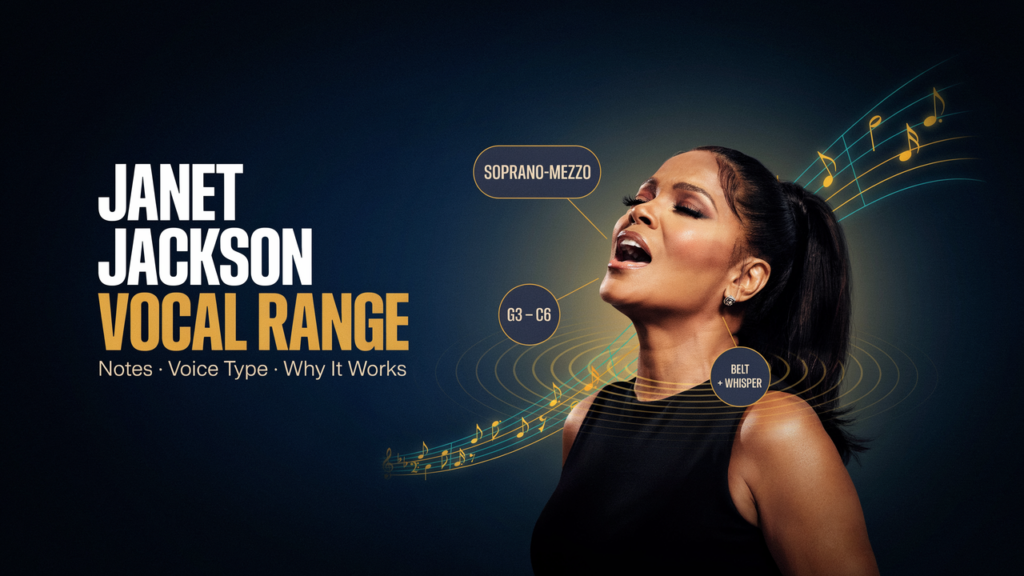
Janet Jackson’s Vocal Range at a Glance
Vocal range: approximately C3 – D6 Voice type: Mezzo-soprano (light; some analysts classify as light soprano) Vocal registers in use: Chest voice, mixed voice, head voice Approximate span: Just over 3 octaves Tessitura (comfortable centre): Roughly E3 to C5 Active career: 1973–present
What Voice Type Is Janet Jackson?
The soprano vs mezzo-soprano debate around Janet Jackson reflects a genuine analytical ambiguity. The Diva Devotee analysis — one of the more rigorous available — classifies her as a mezzo-soprano on the basis of her timbre and tessitura: her voice has “an overarching sweet and warm timbre” with a “head dominant mix” that allows her to access chest notes with relative ease, though “the resonance/power achieved isn’t very strong.”
The soprano classification from Range Planet and others is based partly on the D6 upper ceiling, which reaches into soprano-adjacent territory. In practice, her natural tessitura — where the voice sounds most comfortable — sits in the E3–C5 zone, which is mezzo territory. The D6 extension appears in head voice passages rather than as a chest or mix belt.
The most useful framing is light or lyric mezzo-soprano — a voice with a bright, warm quality in the mid-range, comfortable access to the upper fourth and lower fifth octave in head voice, and a lower chest register that is used sparingly but carries a “comfortable, dark and surprisingly solid” quality, as Diva Devotee notes.
The mezzo-soprano vocal range page covers where her voice type sits in the full female classification system.
Her Lower Register: C3 and the Darker Chest Voice
The lower end of her range — C3 and below — sits in contralto territory and is used sparingly. Her most frequently cited examples of lower register work include harmonies in “Take Care,” the chest voice in “Son of a Gun (I Betcha Think This Song Is About You),” and the more aggressive, growling delivery she applies to tracks like “Nasty” and “Black Cat.”
These moments demonstrate that the lower register, when she uses it, has genuine character — darker, more solid than the breathy mid-range style that dominates her catalogue. One online analysis notes her ability to produce “near-contralto notes” in songs like “You” and “Love Will Never Do Without You.” The range is there; it simply isn’t her primary mode.
Her Mid-Range: Where the Voice Shines
The mid-range — roughly E3 to B4 — is where Jackson’s voice is most itself. This is the zone of “Control,” “What Have You Done for Me Lately,” “Rhythm Nation,” and the bulk of her catalogue. The tone in this range is warm, breathy, and immediately recognisable: a sweet, light quality that works beautifully for layered studio production.
Vocal coach Roger Love, commenting on her technique, observed that “when Janet sings, she allows a tremendous amount of air to come through. She’s obviously aiming for a sexy, sultry effect and on one level that works nicely.” That breathy quality — technically, a slightly open glottis allowing more air through the cords than fully supported classical singing would — creates an intimate, close-mic feel that suits studio recording precisely and translates less cleanly to large live venues. Love acknowledged that despite this limitation, “the live show is still magnificent” because of her dancing, presence, and production.
The D6 Upper Extension
D6 — well above soprano high C — is the documented upper ceiling, reached in head voice. The Diva Devotee analysis notes that her head voice is “perhaps the most resonant part of the Diva’s voice, being punchy, bright and of some thickness” — most clearly demonstrated in “He Doesn’t Know I’m Alive” and the upper passages of “Love Will Never Do Without You.”
This head voice extension is not deployed as a technical showcase. Jackson uses it sparingly, as a tonal colour at specific emotional moments rather than as a demonstration of range. Understanding the technical distinction between chest voice, mix, and head voice is relevant here — the chest voice vs head voice page covers how these registers function differently.
Why Her Voice Works Despite Its Limits
The narrative around Janet Jackson’s voice tends to focus on what it lacks relative to the power vocalists of her era. What this narrative undersells is how well the voice serves what she actually does.
Jackson’s records are built around rhythm, production, and layered vocal textures — not around a single powerful voice carrying everything. The breathy, warm mid-range tone stacks in harmonies in a way that a more powerful, resonant voice wouldn’t. The intimate quality works in the studio context her producers built for it. The accessibility of her voice — no technical barriers between the listener and the emotional content of the lyric — makes connection easier, not harder.
The vocal range and singing techniques page covers how voice type and production context interact in ways directly relevant to understanding Jackson’s approach.
FAQs About Janet Jackson’s Vocal Range
What is Janet Jackson’s vocal range?
Her documented range spans approximately C3 to D6 — just over three octaves. Her comfortable working range sits primarily in the E3–C5 zone, with lower chest voice extensions used sparingly and the D6 upper limit accessed in head voice.
What voice type is Janet Jackson?
The Diva Devotee profile classifies her as a mezzo-soprano; The Range Planet as a soprano. Her timbre and tessitura are more consistent with a light lyric mezzo-soprano — warm, breathy, and most natural in the mid-range. The upper D6 extension places her outside the standard mezzo ceiling in head voice.
Why is Janet Jackson criticised as a vocalist?
The most cited critique — articulated by vocal coach Roger Love — is that she allows excessive air through the cords, creating a breathy quality that lacks power and doesn’t project well live. The comparison to Whitney Houston and Mariah Carey frames her as technically limited by contrast. Both assessments are accurate; they don’t account for how well her specific voice serves her specific music.
What are Janet Jackson’s best vocal performances?
“What About” is most often cited for demonstrating her vocal versatility — moving between soft, breathy vulnerability and more aggressive, characterful delivery. “Love Will Never Do Without You” demonstrates the upper head voice in a pop ballad context. “Black Cat” shows a harder-edged chest voice quality rarely heard in her catalogue.
How many albums has Janet Jackson sold?
Over 50 million worldwide, making her one of the best-selling music artists of all time. Her classic albums Control (1986), Rhythm Nation 1814 (1989), and janet. (1993) are considered foundational to the development of contemporary R&B and pop production.
Erika Parker is a vocal analysis and singing education writer at Vocal Range Test. She focuses on vocal range testing, voice type analysis, pitch recognition, and singing tools for vocalists, musicians, choir singers, and beginners.