
Joni Mitchell’s vocal range story is one of the most thoroughly documented voice evolutions in popular music history: a mezzo-soprano in the 1960s and early 1970s — bright, wide-vibrato, comfortable in the upper register — who had shifted to a wide-ranging contralto by approximately 1975, and whose voice by later decades The Range Place described as “closer to that of a contralto than a mezzo-soprano, having reduced considerably more than other singers from the seventies” — a likely consequence, analysts note, of her lifelong smoking addiction.
Born November 7, 1943 in Fort Macleod, Alberta, Mitchell contracted polio at age nine — an illness that, as she has described, awakened her creative sensitivity during convalescence and introduced her to “a love for sketching, both in images and in words.” The weakened left hand it left her with became the unexpected catalyst for her mastery of alternate guitar tunings — the “Joni-tuned” guitars that are as definitive a feature of her sound as the voice itself.
Blue (1971) is rated number 30 among Rolling Stone’s 500 Greatest Albums of All Time, number one on NPR’s list of Greatest Albums Made By Women, and one of 25 albums chosen by The New York Times as “turning points and pinnacles in 20th-century popular music.” The voice across that record is the mezzo-soprano at its peak.
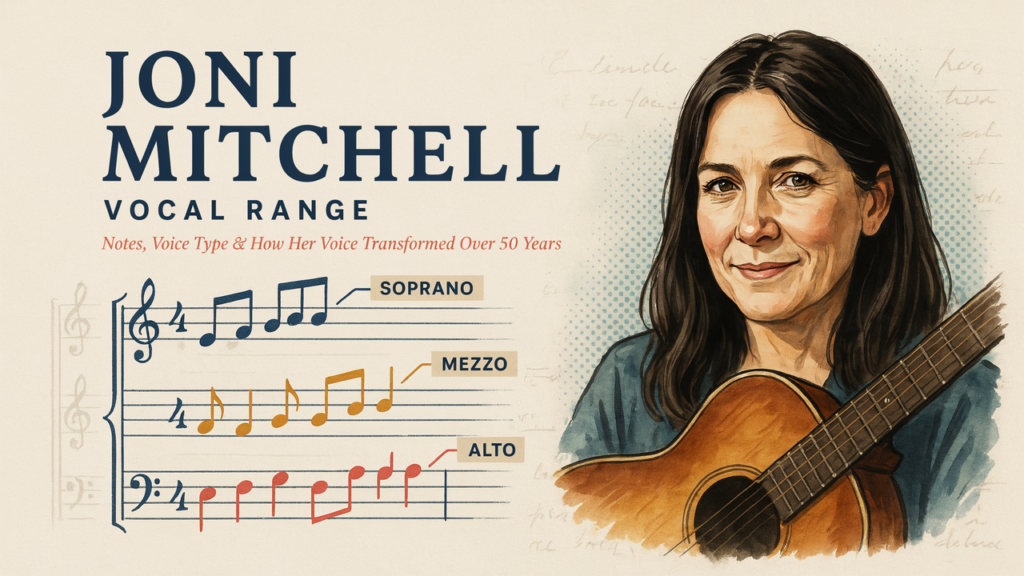
Joni Mitchell’s Vocal Range at a Glance
Early career voice type: Lyric mezzo-soprano (1960s–mid-1970s) Later career voice type: Wide-ranging contralto (mid-1970s onward) Singing Carrots documented range: Gb3 – Cb5 (“Both Sides, Now”) Active career: 1963–2024
The Early Voice: Mezzo-Soprano at Its Peak
Mitchell’s voice in the late 1960s and early 1970s — the period of her most celebrated recordings — is described by TalesofTessitura as “a pure, refined lyric-mezzo”: a voice with “very wide and noticeable vibrato,” comfortable access to the upper register through “a blissful falsetto,” and the ability to reach “some smooth lower notes with ease.”
The Joni Library analysis from The Range Place is specific: “In her early days, Joni’s timbre was noticeably different to her sound now — with very wide and noticeable vibrato, she would frequently reach into her upper register comfortably while still being able to reach some smooth lower notes. She was a mezzo-soprano through the late sixties and seventies.”
What made this voice distinctive wasn’t extreme range but the specific character of its production. The vibrato — wide, expressive, sometimes almost operatic in its oscillation — was a stylistic signature rather than a classical choice. Combined with the rhythmic sophistication her multi-instrumental playing gave her, it produced a vocal quality that vocal coach Jaime Babbitt describes as reflecting that “singers who study singing and play instruments that make chords are better than all the rest” — the timing precision of a multi-instrumentalist giving her vocal phrasing unusual precision even within freely expressive folk delivery.
The Singing Carrots data for “Both Sides, Now” (Gb3–Cb5) documents the early voice in the most widely heard song she ever wrote — first a hit for Judy Collins before Mitchell recorded her own definitive version.
The Shift: 1975 and the Contralto Emergence
Around 1975, multiple independent sources document a recognisable shift in Mitchell’s voice type. The Folk Song Index, citing multiple academic sources, states: “Around 1975 her vocal range began to shift from mezzo-soprano to more of a wide-ranging contralto.” The causes were multiple: natural vocal aging, the deliberate artistic choice to inhabit lower, darker registers as her music moved toward jazz, and the cumulative effect of heavy smoking on the vocal cords and their flexibility in the upper register.
TalesofTessitura traces the evolution specifically: by the Wild Things Run Fast album (1982), “Joni’s voice had transformed irretrievably from the pure, refined lyric-mezzo from even 5 years earlier… the middle to lower registers are enveloped in dark, breathy textures like a contralto. Her sustained vocal lines, particularly in the middle register now have a very unbridled vibrato, and no longer have the cleanliness of her youth.”
This isn’t a decline narrative — it’s a transformation narrative. The contralto that emerged has different qualities from the mezzo-soprano that preceded it: warmer, darker, more emotionally weathered, with a weight in the lower register that the earlier voice didn’t possess. Different repertoire suits it; different expressive choices become available.
The does vocal range change with age page covers the physiology that underlies exactly this kind of documented voice type shift.
The Alternate Guitar Tunings and Their Vocal Consequence
Mitchell is known for developing an extensive personal system of open and alternate guitar tunings — partly a consequence of her weakened left hand from polio — that allowed her to access chord voicings not available in standard tuning. This compositional habit had a direct consequence for her vocal repertoire: she wrote songs in keys that suited her voice precisely rather than being constrained by standard-tuning conventions.
The result is that her songs sit in unusually specific ranges — neither arbitrarily high nor arbitrarily low, but precisely where her voice of a particular era was most characterful. This is a form of self-directed vocal repertoire matching that formal voice training addresses through separate study of tessitura and repertoire selection.
Blue and the Definitive Mezzo-Soprano Document
Blue (1971) is the fullest document of Mitchell’s voice at its mezzo peak. The album’s production is deliberately spare — guitar, piano, minimal accompaniment — which means the voice is exposed and unprotected across its entire runtime.
The emotional nakedness of the album’s lyrics is matched by the technical nakedness of its recording. There are no vocal layers, no production strategies to cover imprecision. What the listener hears is the voice as it is: the mezzo-soprano with wide vibrato, clean upper register access, and the extraordinary rhythmic precision of a multi-instrumentalist who has internalised the melodic structure of a song from the inside out.
Rolling Stone’s #30 ranking and NPR’s #1 ranking among albums by women reflect the combination of the songwriting and the vocal delivery as inseparable contributions. You cannot fully separate the voice from the material; what Mitchell does vocally in Blue is the interpretation of the material as much as it is the sound of the voice.
Notable Vocal Performances
Both Sides, Now (1969/2000): The song she wrote and which Judy Collins first hit with. Her own 1969 recording demonstrates the early mezzo-soprano; her 2000 re-recording at age 56 is one of the most discussed vocal documents of her later contralto — same melody, completely different voice, entirely different emotional weight.
A Case of You (1971, Blue): One of the most praised individual performances in the album — the isolated vocal has been studied by vocal coaches and analysed in academic contexts as a document of folk vocal technique.
River (1971, Blue): The isolated vocal, widely circulated online, shows the mezzo-soprano’s precise timing and controlled vibrato in stark acoustic clarity.
FAQs About Joni Mitchell’s Vocal Range
What was Joni Mitchell’s vocal range?
Her Singing Carrots repertoire data documents “Both Sides, Now” at Gb3–Cb5, which is consistent with mezzo-soprano territory. Her total range in earlier years was wider, with comfortable upper register access; in later years the voice settled deeper into contralto territory.
What voice type is Joni Mitchell?
A lyric mezzo-soprano in her 1960s–mid-1970s career, shifting to a wide-ranging contralto from around 1975 onward. Multiple independent sources — The Range Place, TalesofTessitura, the Folk Song Index — document this transition consistently.
Why did Joni Mitchell’s voice change?
Multiple factors: natural vocal aging, deliberate artistic choices toward lower, darker registers as she explored jazz, and the documented effect of her lifelong smoking habit on the upper register’s flexibility. The Range Place specifically attributes the reduction in her range compared to other 1970s singers to the smoking addiction.
What is Joni Mitchell’s greatest album?
Blue (1971) is the consensus critical choice — rated #30 by Rolling Stone’s 500 Greatest Albums, #1 by NPR among albums made by women, and one of 25 albums selected by The New York Times as turning points in 20th-century popular music.
Did Joni Mitchell write “Both Sides, Now”?
Yes — she wrote it in 1966. Judy Collins released the first widely heard version in 1967, which reached number eight on the US pop charts. Mitchell released her own version in 1969. She re-recorded it in 2000 for the album Both Sides Now, at which point the contrast between the younger mezzo-soprano voice and the older contralto version of the same song became a widely cited example of vocal aging.
Erika Parker is a vocal analysis and singing education writer at Vocal Range Test. She focuses on vocal range testing, voice type analysis, pitch recognition, and singing tools for vocalists, musicians, choir singers, and beginners.