
Jonathan Groff’s vocal range spans approximately C3 to B4, with a lyric tenor instrument that has carried him from a Tony-nominated Broadway debut in Spring Awakening (2006) to King George III in Hamilton, the voice of Kristoff in Frozen, and a career that spans musical theatre, television drama, and film voice acting with equal credibility. Born August 26, 1985 in Ronks, Pennsylvania, he arrived in New York at 19 with the intention of joining a Broadway ensemble; by 21, he was originating the lead role in one of the most acclaimed musicals of the decade.
His voice has been called “a voice of an angel” in multiple published reviews, which is high praise in a world where the phrase risks becoming meaningless. What it points toward is a specific quality — a brightness, an emotional transparency, and an absence of visible effort — that characterises the lyric tenor at its most natural.
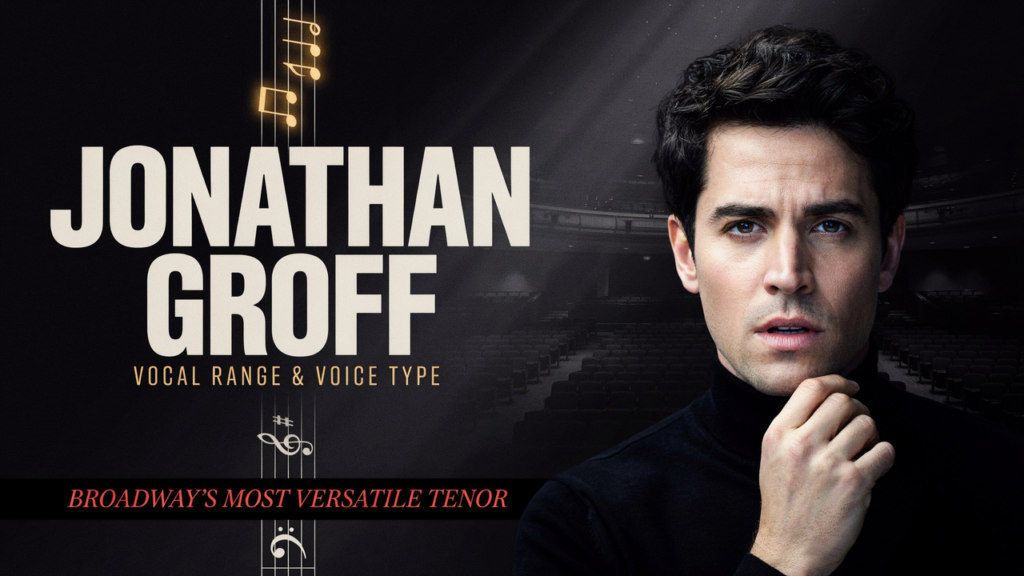
Jonathan Groff’s Vocal Range at a Glance
Vocal range: approximately C3 – B4 (primary working range) Voice type: Lyric tenor Vocal registers in use: Chest voice, mixed voice, head voice/falsetto Approximate span: Around 2 octaves in primary working range Tessitura (comfortable centre): Roughly D3 to G4 Active career: 2005–present
What Voice Type Is Jonathan Groff?
Groff is a lyric tenor — a lighter, warmer instrument than the more powerful spinto tenor, with the agility and emotional clarity that the lyric classification implies. His natural timbre is bright and forward-placed, with the specific quality that makes a voice cut through theatrical space without effort — not volume-driven, but resonant in its placement.
What’s worth noting is how different his two most famous Broadway roles use that instrument. Melchior Gabor in Spring Awakening — a rock musical with emotional intensity and vocal demands that lean toward power and urgency — pushed the lyric tenor into more exposed, raw territory. King George III in Hamilton — written as a sardonic, theatrical showstopper sung directly to the audience — uses the same voice in a completely different mode: precise, pointed, slightly camp, deliberately artificial.
Both performances earned Tony nominations. The same instrument, serving two completely opposite dramatic purposes.
The tenor vocal range page covers where the lyric tenor sits relative to the other male voice types.
Spring Awakening: Melchior and the Rock Musical Tenor
Spring Awakening (2006) was a turning point in Broadway history — a rock musical adaptation of Frank Wedekind’s 1891 play, with a score by Duncan Sheik and lyrics by Steven Sater, that put rock vocal demands into a theatrical context. Groff’s role as Melchior Gabor required the lyric tenor to sustain emotional intensity across a score that valued rawness over polish.
This is where his first Tony nomination came — for Best Leading Actor in a Musical in 2007, at 21 years old. The performance established that his voice could carry dramatic weight beyond the typical lyric tenor’s refined comfort zone, while still maintaining the brightness and clarity that distinguish the voice type.
Hamilton: King George III and the Theatrical Showstopper
King George III’s material in Hamilton — most famously “You’ll Be Back” — sits in a relatively high, light tenor zone and requires precise, theatrical delivery with the specific quality that Lin-Manuel Miranda wrote into the character: charming, passive-aggressive, and entirely in command of his own bizarre theatrical space.
Groff’s performance received a second Tony nomination — Best Featured Actor in a Musical in 2016. He also received a Grammy Award as part of the Hamilton original Broadway cast recording, which won Best Musical Theater Album. The recording documents the King George passages in the clearest possible way: the lightness and brightness of the lyric tenor at its most deliberate, shaped for theatrical effect rather than emotional exposure.
Frozen: Kristoff and the Voice Acting Tenor
Voicing Kristoff in Disney’s Frozen (2013) and Frozen 2 (2019) placed Groff’s tenor in a animated film context — close-mic’d, intimate, with the voice serving character rather than theatrical projection. His song “Lost in the Woods” in Frozen 2 (in the style of an 1980s power ballad) gave the lyric tenor a different kind of showcase: self-aware, slightly campy, and demanding both technical control and comic timing.
The Frozen franchise’s global reach — $1.3 billion gross for the first film — introduced his voice to an audience many times larger than any Broadway production could reach. Many people know the voice of Kristoff before they know Jonathan Groff.
The average vocal range of pop vs classical singers page gives useful context for how the lyric tenor voice type sits across different performance contexts — the kind of range breadth Groff demonstrates across Broadway, television, and voice acting.
Just in Time: Bobby Darin and Current Broadway
In 2026, Groff returned to Broadway starring as Bobby Darin in Just in Time at Circle in the Square Theatre — a bio-musical about the 1950s pop and jazz singer. Bobby Darin’s catalogue requires a voice capable of swing, jazz phrasing, and pop delivery across a range of material from “Mack the Knife” to “Beyond the Sea.” The role places the lyric tenor in a very different historical and stylistic register from his previous Broadway work.
FAQs About Jonathan Groff’s Vocal Range
What is Jonathan Groff’s vocal range?
His practical working range spans approximately C3 to B4, with his most characterful zone in the D3–G4 range. His lyric tenor sits at the lighter, brighter end of the male tenor spectrum.
What voice type is Jonathan Groff?
He’s a lyric tenor — bright, warm, forward-placed, and with the emotional transparency that characterises the type. His two Tony nominations reflect how the same lyric tenor instrument can serve two completely different dramatic contexts (Spring Awakening vs. Hamilton).
What awards has Jonathan Groff won?
He won a Grammy Award for Best Musical Theater Album as part of the Hamilton original Broadway cast recording. He has received two Tony Award nominations — for Spring Awakening (Best Leading Actor in a Musical, 2007) and Hamilton (Best Featured Actor in a Musical, 2016).
Is Jonathan Groff a trained singer?
He comes from a theatrical background rather than conservatory training — he grew up performing in musicals around Lancaster, Pennsylvania, earned his Equity card at 19, and was cast in Spring Awakening in 2006 without specific classical vocal training. His technique reflects the practical theatrical approach rather than formal conservatory study.
What is the most famous song Jonathan Groff has sung?
“You’ll Be Back” as King George III in Hamilton is probably the most widely known — the cast recording has been heard by millions globally. “Lost in the Woods” from Frozen 2 reaches a different, equally large audience through the Disney animated film.
Erika Parker is a vocal analysis and singing education writer at Vocal Range Test. She focuses on vocal range testing, voice type analysis, pitch recognition, and singing tools for vocalists, musicians, choir singers, and beginners.