
Julie Andrews possessed a four-to-five octave coloratura soprano voice — described by biographer Robert Windeler in 1983 as “crystalline” and by IMDB as a “five-octave coloratura soprano range” — that made her the best-loved entertainer in the world by the time she was 30. Born Julia Elizabeth Wells on October 1, 1935 in Walton-on-Thames, England, she made her professional solo debut shortly after turning 12, played Eliza Doolittle in the original Broadway My Fair Lady, won the Academy Award for Best Actress for Mary Poppins (1964), and cemented her place in film history with The Sound of Music (1965), one of the highest-grossing films of all time.
In 1997, she had vocal cord surgery to remove a benign lesion and the operation permanently damaged her singing voice. She has not sung in her full capacity since. The voice that produced “The Sound of Music,” “Supercalifragilisticexpialidocious,” and “My Favorite Things” belongs now entirely to the recordings she made before the surgery.
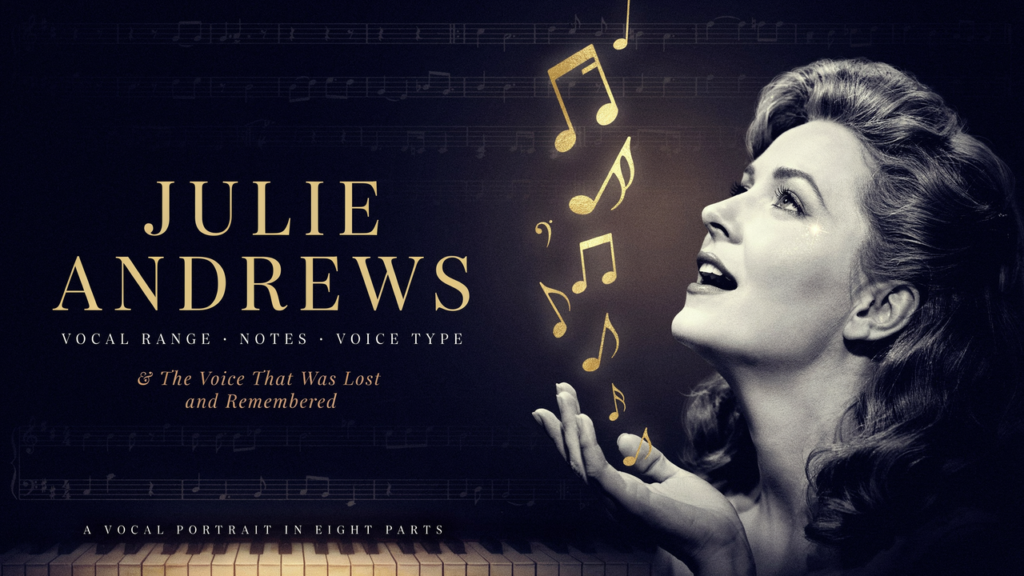
Julie Andrews’ Vocal Range at a Glance
Vocal range: four octaves (most documented sources) to five octaves (IMDB, Windeler biography) Voice type: Coloratura soprano Vocal registers in use: Chest voice, mixed voice, head voice, upper extensions Perfect pitch: Yes — confirmed by multiple sources Active career: 1945–1997 (as singer); 1997–present (as actress)
What Voice Type Was Julie Andrews?
She was a coloratura soprano — the voice type defined by agility, a bright crystalline timbre, and the ability to access the upper register with precision and speed. The coloratura soprano differs from the lyric soprano in its greater facility in ornamental passages and upper-register extremes; it’s the voice type most associated with the highest, most agile soprano roles in opera.
Her “crystalline” tone — the adjective that appears most consistently across descriptions of her voice from the 1950s through the 1990s — reflects the specific acoustic character of a well-supported coloratura instrument: bright, forward-placed, with exceptional clarity in the upper register. Voice teacher Carol Ann Allred noted: “Even in ‘The Sound of Music,’ she hit a high C at the end of ‘Do-Re-Mi'” — soprano high C is C6, the benchmark of classical soprano facility, and Andrews reached it with the apparent ease that characterised her entire vocal approach.
The soprano vocal range page covers the coloratura classification in detail.
The Range: Four or Five Octaves?
Multiple credible sources give different figures: Panorama Tours and the Deseret News vocal coach analysis both cite four octaves; IMDB’s trivia section and the Encyclopedia.com entry citing the Windeler biography both say five octaves.
The honest answer is that the five-octave figure likely includes the extreme coloratura extensions that a classically trained soprano develops in upper register technique but may not deploy in film or musical theatre performance. For a coloratura soprano in her prime — as Andrews was from the 1950s through the 1990s — five octaves across all registers including the highest head voice extensions is plausible; four octaves of practical, performance-ready range is the more conservative and defensible figure.
Either figure is exceptional. The widest vocal range page gives context for where four-to-five octave spans sit in the documented landscape of singers.
What Made Her Technique Distinctive
Utah vocal coaches interviewed by Deseret News identified specific technical qualities: she moved seamlessly between speaking and singing, using a “lilt” in her voice between notes; she enunciated consonants precisely at the beginnings and ends of words; she used vibrato at the end of phrases rather than throughout, keeping the tone clean and direct; and she avoided breathiness — the voice was “sweet” but not “breathy,” which is a specific production choice.
The Deseret News analysis notes she didn’t belt — her power came from breath support, forward placement, and the acoustic efficiency of a well-supported coloratura instrument, not from the chest-voice pressure that makes a belt voice loud. “It never sounded strained or difficult,” one coach noted — the hallmark of correct technique is that it appears effortless even when it isn’t.
She also had documented perfect pitch — the ability to identify and reproduce pitches without a reference tone. This shaped how she heard her own voice and how precisely she could control intonation across her full range.
The 1997 Surgery: The Voice That Was Lost
In 1997, Andrews had vocal cord surgery to remove what she described in 2015 as “a weak spot” — alternately described in reports as noncancerous nodules, a benign polyp, or a cyst. She had experienced vocal issues during two years performing in the Broadway musical version of Victor/Victoria.
The surgery went wrong. Rather than correcting the problem, the procedure permanently damaged her vocal cords in a way that robbed her of her singing range. She sued the doctors involved and settled. She has spoken publicly about the loss with a combination of grief and acceptance: the voice that defined her career — that four-to-five octave coloratura instrument — was permanently gone.
She has continued working as an actress, receiving critical acclaim in The Princess Diaries (2001), Shrek (2004), and other films. But the singing voice she brought to Mary Poppins and The Sound of Music belongs entirely to the recordings and films made before 1997.
The vocal health for singers page covers the medical considerations around vocal cord procedures — the kind of information that is directly relevant to understanding what happened to Andrews in 1997.
The Sound of Music and Mary Poppins: The Definitive Documents
Both Mary Poppins (1964) and The Sound of Music (1965) have been selected for the National Film Registry by the Library of Congress as “culturally, historically or aesthetically significant.” They represent the fullest public document of Andrews’ voice at its peak.
The Sound of Music specifically demonstrates the range in action: “Do-Re-Mi” includes the high C Allred referenced; “Climb Ev’ry Mountain” (sung by someone else in the film, but Andrews performed it in concert) demonstrates the lower, more lyrical range of the coloratura soprano; “The Sound of Music” title song showcases the middle register at its most characteristic.
Mary Poppins won her the Academy Award for Best Actress — the role for which she beat out Audrey Hepburn (who had taken her original My Fair Lady stage role) in a result that felt both like justice and like recognition of a voice that couldn’t be replaced by lip-syncing.
FAQs About Julie Andrews’ Vocal Range
What was Julie Andrews’ vocal range?
Four to five octaves, depending on the source — four octaves of practical performance range and five when upper coloratura extensions are included. She was a coloratura soprano with documented perfect pitch and a high C in The Sound of Music.
What voice type was Julie Andrews?
A coloratura soprano — the most agile and highest-reaching soprano classification, defined by tonal clarity, ornamental facility, and upper-register precision. Her “crystalline” timbre is the characteristic sound of this voice type.
Why can’t Julie Andrews sing anymore?
A 1997 vocal cord surgery to remove a benign lesion permanently damaged her voice. The procedure, which she expected to be routine, instead destroyed the singing range she had maintained for over five decades of professional performance. She has not sung in her full capacity since.
Did Julie Andrews have perfect pitch?
Yes — confirmed by multiple sources including the Panorama Tours biography and the Deseret News vocal coach analysis. Perfect pitch allowed her to control intonation with unusual precision across her full four-to-five octave range.
What is Julie Andrews’ most famous vocal performance?
“My Favorite Things” and “The Sound of Music” from the film are the most widely heard. “Do-Re-Mi” is most often cited by vocal coaches as demonstrating the technical quality of her voice — particularly the high C at the end of the song. Her Carnegie Hall-adjacent live concert recordings from the 1960s are considered the best documents of the full voice in performance.
Erika Parker is a vocal analysis and singing education writer at Vocal Range Test. She focuses on vocal range testing, voice type analysis, pitch recognition, and singing tools for vocalists, musicians, choir singers, and beginners.