
Maynard James Keenan’s vocal range spans approximately four octaves, documented across his work with Tool, A Perfect Circle, and Puscifer, with a tenor-baritone instrument that Loudwire described as capable of singing you “to sleep and scare you to death” — sometimes within the same song. Born April 17, 1964, Keenan is one of the most technically accomplished and most deliberately enigmatic vocalists in rock: a singer who performs facing away from the audience, who uses prerecorded backing vocals live to augment rather than replace his voice, and who has spent four decades making records that require his instrument to function in every register from intimate falsetto to full-throated intensity.
He won a Grammy as the vocalist of Tool — the progressive metal band he co-founded in 1990 — and has created parallel careers with A Perfect Circle (the atmospheric rock supergroup he co-founded with guitarist Billy Howerdel) and Puscifer (his avant-garde solo project). He is also a winemaker, operating Caduceus Cellars in Arizona.
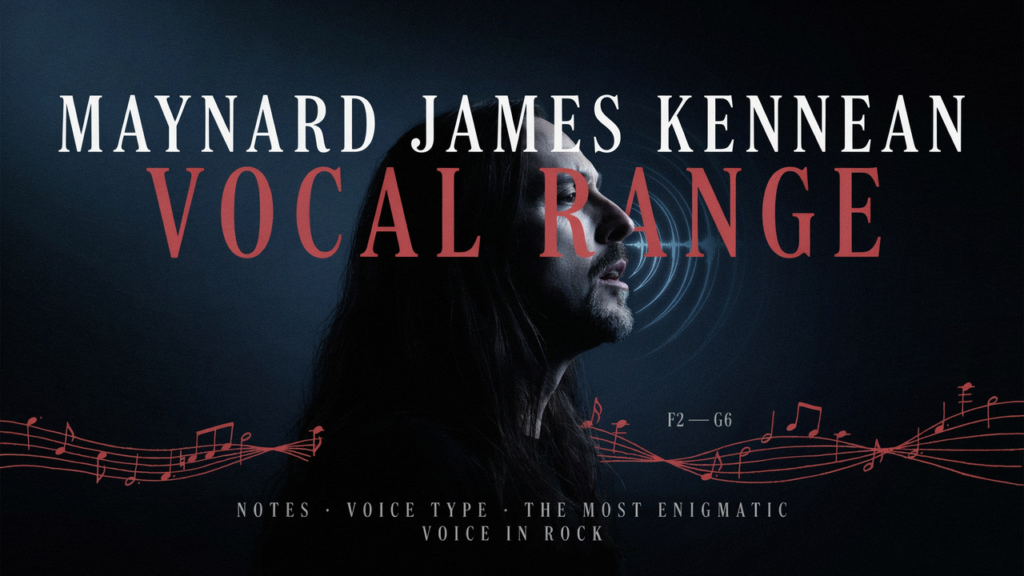
Maynard James Keenan’s Vocal Range at a Glance
Vocal range: approximately four octaves (documented across multiple sources) Voice type: Tenor-baritone (specific classification debated; functionally covers both) Vocal registers in use: Chest voice, mixed voice, falsetto, distortion Approximate span: Around 4 octaves Active career: 1990–present
What Voice Type Is Maynard James Keenan?
The voice type question generates genuine debate. His lower register — evident in quieter, more atmospheric passages of Tool and A Perfect Circle — has baritone depth and weight. His upper register — documented reaching into tenor territory in live performances of songs like “Pushit” — accesses high notes with the power and brightness associated with the tenor voice type. SingersAvenue classifies him as a tenor; other analyses place him as a high baritone or bari-tenor.
The Singing Carrots guide identifies “long, sustained notes with an emphasis on breath control” and a “blending of chest voice and head voice seamlessly” as his primary technical signatures. This mixed-voice integration — where chest and head resonance blend rather than alternate — is what gives his voice its characteristic quality of sounding simultaneously powerful and vulnerable, sometimes sustaining notes that feel like they could break in either direction.
What’s most accurate is that his voice defies clean classification. It operates differently in different projects: Tool’s arrangements demand more upper-register power and intensity; A Perfect Circle’s more atmospheric writing often keeps him in the warmer, more intimate mid-range; Puscifer explores the softer, more idiosyncratic territory beyond what either band’s aesthetic allows.
The baritone vocal range and tenor vocal range pages cover both classifications he straddles.
The Mixed-Voice Technique: His Primary Technical Tool
Keenan’s most distinctive vocal technique is his use of mixed voice — the blended register that sits between chest and head resonance. Rather than the sharp distinction between a chest belt and a head voice falsetto that characterises many rock singers, his voice moves through the register transition in a way that maintains tonal continuity.
This means his softest passages and his most intense passages come from the same integrated instrument. The opening of A Perfect Circle’s “Judith” builds from a relatively quiet, chest-adjacent register to an intense upper passage without the vocal gear change that most singers produce in the same dynamic arc. The continuity is the technique — the blend allows the dynamic escalation without breaking the tonal identity of the voice.
The mixed voice page covers the technical principles of this register, which is central to Keenan’s vocal approach.
The Performance Approach: Back to the Audience
Keenan’s stage positioning — frequently performing from the back of the stage or a raised platform, facing away from the audience toward the drummer — is one of the most discussed features of his live performances and one of the most misunderstood. It’s not audience hostility; it’s a deliberate artistic choice to orient the performance toward the music rather than the crowd.
This positioning has practical vocal consequences: performing facing away from the front-of-house speakers, with less monitoring feedback and more exposure to the raw stage sound, requires a voice with genuine acoustic projection and without reliance on monitoring to stay in pitch. His voice demonstrably functions this way — live recordings capture it holding its quality regardless of the monitoring context.
Tool, A Perfect Circle, Puscifer: Three Versions of the Same Voice
The three-project structure of Keenan’s career is vocally significant because each project uses the instrument differently:
Tool: Progressive metal arrangements that emphasise power, intensity, and the upper register. “Schism,” “Lateralus,” and “Pushit” demonstrate the voice at its most intense and technically demanding. The Grammy-winning band represents his most mainstream and commercially successful context.
A Perfect Circle: More atmospheric, more melodic, more exposed. “Judith,” “3 Libras,” and “Orestes” demonstrate the voice in contexts where the blend of tenderness and intensity is the primary sonic content rather than power alone. The writing by Billy Howerdel creates a different frame for the same instrument.
Puscifer: The most experimental and least constrained. Projects like “Monsoons” and “The Humbling River” show the voice in its most vulnerable and introspective territory — closer to ambient vocal music than rock or metal.
Notable Vocal Performances
Sober (1993, live at Reading Festival): The 1993 Reading performance, with over 3 million YouTube views, captures the voice at its most raw and early — intense, slightly unpolished, but demonstrating the upper register power that would be refined over subsequent decades.
Pushit (live, 1998): The Tool live performance frequently cited for demonstrating the full dynamic range — from intimate to intensely powerful — within a single extended performance.
Judith (A Perfect Circle, 2000): The song that introduced many listeners to A Perfect Circle and to a different dimension of Keenan’s voice — the dramatic build from quiet vulnerability to intense upper register, achieved through the mixed-voice integration that is his signature.
Monsoons (Puscifer): Frequently cited as his most emotionally delicate and vocally exposed performance — the instrument stripped of all power-rock context and given only space and melody.
FAQs About Maynard James Keenan’s Vocal Range
What is Maynard James Keenan’s vocal range?
Multiple sources document his range as four octaves. His comfortable working range across Tool, A Perfect Circle, and Puscifer spans from baritone depth in the lower register through tenor-range upper passages. His screaming and distortion extend the perceived range further at both extremes.
What voice type is Maynard James Keenan?
Opinions differ — some classify him as a tenor, others as a high baritone or bari-tenor. His voice functions convincingly in both registers, and his mixed-voice technique makes the border between them less audible than it would be in a more conventionally trained classical voice.
Why does Maynard James Keenan face away from the audience?
It’s a deliberate artistic and philosophical choice — performing toward the drums and musicians rather than playing to the crowd. He has described his discomfort with the performer-audience dynamic that faces the musician toward the audience as if performing for them, rather than with the band.
What other projects is Maynard James Keenan involved in besides Tool?
He co-founded A Perfect Circle with guitarist Billy Howerdel, which has released four studio albums. He also created Puscifer, his most experimental project. Outside music, he operates Caduceus Cellars, a winery in Jerome, Arizona, and has described winemaking as a creative pursuit as serious as his music.
Has Maynard James Keenan’s voice changed over the years?
Yes — his early Tool recordings feature more harsh, intense vocal production that has moderated over decades. Some critics have noted his live voice becoming less powerful in recent years, though he continues to perform. His screaming technique has diminished more than his clean singing.
Erika Parker is a vocal analysis and singing education writer at Vocal Range Test. She focuses on vocal range testing, voice type analysis, pitch recognition, and singing tools for vocalists, musicians, choir singers, and beginners.