
Nicole Scherzinger’s vocal range is commonly cited around D3 to G#6, which is roughly three and a half octaves, not a clean four-octave span. Treat that as a public range estimate rather than a formal voice-lab measurement. What is easier to verify from her performances is the main shape of her voice: a strong pop-theatre belt, a bright upper extension, classical training influence, and enough dramatic weight to make the soprano vs mezzo-soprano debate understandable.
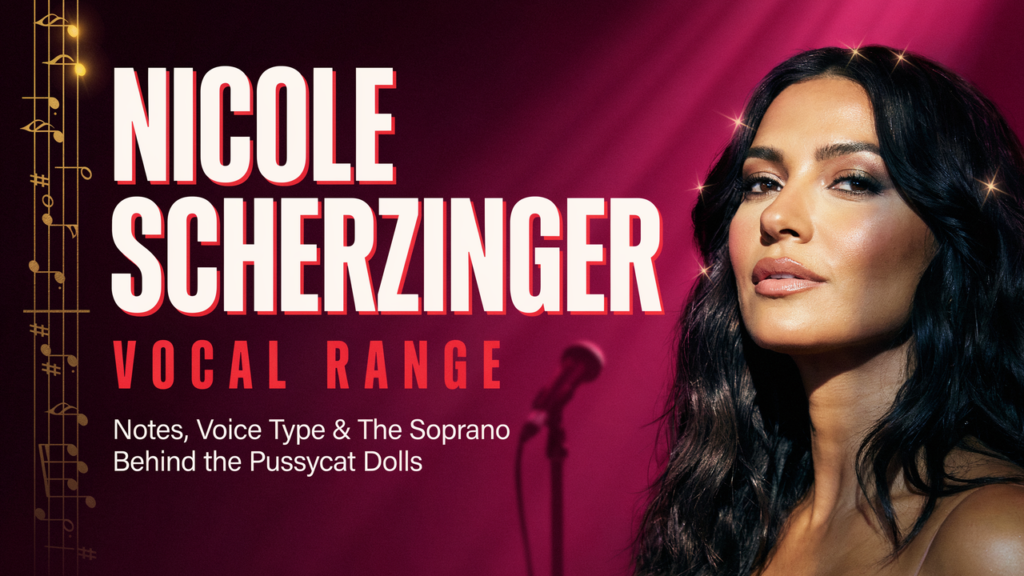
Nicole Scherzinger’s Vocal Range at a Glance
| Commonly cited range | D3-G#6 / Ab6 |
| Approximate span | About 3.5 octaves |
| Likely voice-type discussion | Soprano vs mezzo-soprano, often described as a dramatic pop/theatre soprano |
| Most reliable strengths | Belt, head voice, dramatic phrasing, stage stamina, and register control |
| Best listening examples | Sunset Boulevard material, “And I Am Telling You,” “Don’t Cha,” “Buttons,” “I Hate This Part” |
If you want to compare your own range with Scherzinger’s, start with the vocal range guide and then test your current notes with the vocal range finder. Her highest cited notes are interesting, but her real strength is how she uses the middle, belt, and upper register in performance.
Is Nicole Scherzinger a Soprano or Mezzo-Soprano?
The most practical answer is that Nicole Scherzinger is usually discussed as a soprano-leaning pop and musical-theatre vocalist, but the mezzo-soprano argument is not random. Her voice has more weight and darker color than many light pop sopranos, and much of her commercial work sits in a strong middle range rather than constantly living at the top.
The soprano argument comes from her upper extension, her head-voice access, and the way she handles high musical-theatre climaxes. The mezzo argument comes from timbre, vocal weight, and where her tone often sounds most grounded. This is why range alone does not settle the label. Voice type also depends on tessitura, passaggio, resonance, training, and what part of the voice stays most reliable over a full show.
For context, compare the soprano vocal range with the mezzo-soprano vocal range. Scherzinger’s upper range points toward soprano, while her tone and dramatic weight explain why some listeners hear mezzo qualities.
Why D3-G#6 Should Be Treated as an Estimate
The D3-G#6 figure appears in online vocal analyses, but it should not be presented as a fully documented clinical measurement. Singer range lists often combine live clips, TV performances, studio vocals, head voice, possible whistle-like upper notes, and fan transcriptions. Those can be useful for discussion, but they are not the same as a controlled assessment.
It is also important to count the range correctly. D3 to G#6 is about 42 semitones, or roughly 3.5 octaves. Calling it a full four-octave range overstates the span. The better wording is “commonly cited around D3-G#6” or “roughly three and a half octaves.”
The vocal range chart can help you understand where D3, B5, and G#6 sit on the keyboard. It also shows why a singer’s comfortable range can be more important than the widest note span listed online.
What Her Voice Does Best
Scherzinger’s voice is strongest when it combines pop precision with theatrical intensity. She can sing glossy dance-pop lines cleanly, but her more impressive moments usually come when the material lets her open into a dramatic belt or sustained upper phrase.
That matters because the Pussycat Dolls catalog does not fully show what her voice can do. Songs like “Don’t Cha” and “Buttons” are built around groove, hook, image, and choreography. They require control and stamina, but they do not expose the full theatrical side of her voice.
When she sings musical-theatre material, the voice sounds more complete: clearer vowel shaping, stronger dramatic pacing, and more room for sustained high phrases. If you are studying her belt approach, the how to belt guide explains why power should come from coordination, not throat pressure.
Classical and Musical-Theatre Training Context
Scherzinger’s background includes musical-theatre training, and that context helps explain why her voice often sounds more technically organized than a typical dance-pop lead vocal. A trained theatre singer needs more than high notes. She needs projection, text clarity, breath pacing, emotional timing, and the ability to repeat demanding material several times a week.
That skill set became especially visible in Sunset Boulevard, where she played Norma Desmond. The role asks for vocal drama, acting commitment, and sustained stage control. Scherzinger won major theatre recognition for the role, including a Tony Award listing for Sunset Blvd. on the official Tony Awards site. The Tony Awards production page is a useful source for the Broadway award context.
Pussycat Dolls vs Theatre Voice
The Pussycat Dolls made Scherzinger globally famous, but that era can make her voice easy to underestimate. In that setting, the lead vocal had to serve dance-pop production and choreography. The songs were not designed to prove the outer edges of her range.
Theatre and live television performances reveal a different singer. They show more upper-register control, more dramatic phrasing, and a stronger connection between acting and sound. This is why judging her only by the biggest Pussycat Dolls singles gives an incomplete picture.
Best Performances to Hear Her Voice
Sunset Boulevard performances are the best place to hear her theatre voice. They show stage stamina, dramatic build, and a more serious vocal identity than her dance-pop singles.
“And I Am Telling You I’m Not Going” is often cited by fans because it shows her willingness to take on big, dramatic belting material. It is useful for hearing power and theatrical attack, even if it is not the only measure of her voice.
“I Hate This Part” gives a clearer pop-ballad example from the Pussycat Dolls era. It sits closer to mainstream pop but still lets her shape a more emotional vocal line.
“Don’t Cha” and “Buttons” are not range showcases, but they are useful for understanding her commercial pop role: precise rhythm, confident tone, and lead-vocal control over dance-heavy production.
Can You Sing Like Nicole Scherzinger?
You can study her control, but copying her power without the same coordination can lead to strain. Start by finding your own voice type with the voice types guide, then compare your range with the singer comparison tool. If your voice is lighter or lower, choose a key that lets you keep tone instead of forcing her exact register.
The most useful lesson from Scherzinger is not “sing higher at any cost.” It is to connect technical control with performance. Her strongest work is not only high; it is committed, clear, and dramatically shaped.
FAQs About Nicole Scherzinger’s Vocal Range
What is Nicole Scherzinger’s vocal range?
Nicole Scherzinger’s range is commonly cited around D3 to G#6 / Ab6, which is about three and a half octaves. Treat that as a public estimate rather than a formally verified measurement.
What voice type is Nicole Scherzinger?
She is often discussed as a soprano-leaning pop and musical-theatre vocalist, though some listeners argue for mezzo-soprano because of her vocal weight, darker tone, and strong middle register.
Is Nicole Scherzinger classically trained?
She has a musical-theatre training background, and her stage work shows more formal vocal discipline than many listeners would hear from the Pussycat Dolls singles alone.
What is Nicole Scherzinger’s most impressive vocal performance?
Her Sunset Boulevard performances are the strongest current evidence of her full stage voice because they combine singing, acting, stamina, and dramatic phrasing.
Did Nicole Scherzinger win a Tony Award?
Yes. She won major Broadway recognition for Sunset Blvd., and the official Tony Awards page lists her among the winners for the production.
Erika Parker is a vocal analysis and singing education writer at Vocal Range Test. She focuses on vocal range testing, voice type analysis, pitch recognition, and singing tools for vocalists, musicians, choir singers, and beginners.