
Nana Mouskouri’s vocal range spans approximately D3 to G#5 — just under two and a half octaves — with a coloratura mezzo-soprano instrument that The Range Planet classifies as a soprano while multiple biographical sources describe as moving “from a husky, dark alto in her younger years to a ringing coloratura mezzo.” Born Ioanna Mouskouri on October 13, 1934 in Chania, Crete, she has sold over 350 million albums worldwide across more than 200 albums in at least 12 languages — making her one of the highest-selling female recording artists in history. She turns 91 in October 2025.
The most fascinating fact about her voice is physiological: a medical examination revealed she has asymmetric vocal cords — one is thicker than the other. This structural difference is widely attributed as the source of both the extraordinary quality of her singing voice and the raspy, breathy quality of her speaking voice. As the Greek Gateway notes: “Mouskouri has said she has only one working vocal cord… this may well account for her extraordinary singing voice.”
(A clarifying note: strictly speaking, having only one vocal cord would make phonation impossible. The accurate description, from Wikipedia and other careful sources, is that she has one vocal cord thicker than the other — asymmetric vocal cords — which is the physical basis for her distinctive vocal production.)
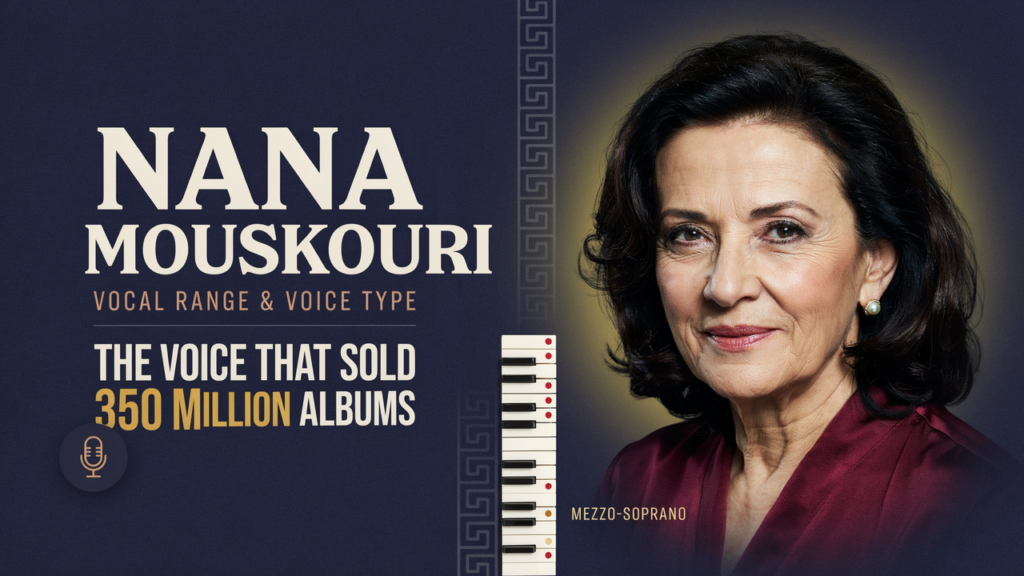
Nana Mouskouri’s Vocal Range at a Glance
Vocal range: approximately D3 – G#5 (Range Planet documented) Voice type: Coloratura mezzo-soprano (alto/dark mezzo in earlier years) Vocal registers in use: Chest voice, mixed voice, head voice/coloratura upper register Approximate span: Just under 2.5 octaves Active career: 1958–2008, 2011–present
What Voice Type Is Nana Mouskouri?
The voice type classification has evolved across her career. Wikipedia describes her younger voice as “a husky, dark alto, which she later dropped” that developed into “a ringing coloratura mezzo” — a trajectory from deeper, darker qualities to a brighter, higher coloratura mezzo over the arc of her career. The Range Planet classifies her as a soprano based on the documented range to G#5.
The asymmetric vocal cords are the key context. One cord being thicker than the other changes how the cords vibrate together, producing the specific timbre that makes her voice unmistakeable — the blend of warmth, clarity, and the slight rasp or breathiness that her speaking voice exhibits but her singing voice largely controls. The Greek music site correction is important: the “one vocal cord” mythology is a simplification of the actual asymmetric cord anatomy.
Her Athens Conservatoire training — eight years of classical music with an emphasis on opera — gave the instrument its technical framework, even though she left before completing her studies when her jazz performance was discovered by the professor.
The mezzo-soprano vocal range page covers the classification in full context.
The Career Context: 350 Million Albums, 12 Languages
The scale of Mouskouri’s career is almost impossible to absorb as a single fact. Over 200 albums in Greek, French, English, German, Dutch, Italian, Portuguese, Spanish, Hebrew, Welsh, Mandarin Chinese, and Corsican. UNICEF Goodwill Ambassador for over 20 years. Member of the European Parliament for Greece (1994–1999, representing the New Democracy party). Multiple honorary doctorates and national decorations.
Her early career was launched when composer and producer Manos Hadjidakis — one of the most important figures in Greek music of the 20th century — discovered her performing jazz at a nightclub in Athens and became her mentor, introducing her to intellectual circles and guiding her toward a wider repertoire. From Athens she moved to Paris in 1960, and from there to a global career that made her effectively the first Greek international pop star.
The jazz foundation is audible in how she phrases: the specific rhythmic flexibility and ornamental approach to melody that jazz training produces, applied to repertoire from Greek folk songs to French chansons to classical operatic material, gives her recordings their particular quality of seeming to inhabit each song’s world fully rather than simply performing the notes.
The Conservatoire Years and Their Consequence
Mouskouri’s eight years at the Athens Conservatoire — where she was admitted in 1950 at age 16 — were interrupted rather than completed. When her professor discovered she was performing jazz at night, he prevented her from sitting her exams. She left and began performing professionally.
This biographical detail matters for understanding her voice because it means her technical development was rigorous (eight years of classical training with opera emphasis) but her artistic formation was outside the classical tradition. The result was a voice with classical technique applied to completely unconstrained repertoire — which is exactly what allowed her to record in 12 languages across every genre she encountered.
Her influences as a teenager — Frank Sinatra, Ella Fitzgerald, Billie Holiday, Édith Piaf — shaped her interpretive approach: the emphasis on emotional truth in phrasing over technical display, the priority of communicating a song’s meaning over demonstrating what the voice can do.
Notable Vocal Performances
“White Rose of Athens” — her 1961 international breakthrough, recorded in English, German, French, Dutch and other languages. The song introduced the coloratura mezzo instrument to European audiences who hadn’t heard her Greek recordings.
“Weiße Rosen aus Athen” — the German version that became her biggest hit in German-speaking markets and remains one of the best-selling German-language singles of all time.
“The Rousseau” and operatic repertoire — pieces like “Casta Diva” (which documents her G#5 high note) demonstrate the range’s upper limit in a classical context.
Greek folk repertoire — the material closest to her cultural roots, where the voice is most immediately and personally connected to the songs.
FAQs About Nana Mouskouri’s Vocal Range
What is Nana Mouskouri’s vocal range?
The Range Planet documents her range as D3 to G#5, with specific high notes at G#5 in “Casta Diva” and “Land of Make Believe.” This spans just under two and a half octaves.
What voice type is Nana Mouskouri?
In her earlier years a husky dark alto that developed into a coloratura mezzo-soprano — a trajectory documented in Wikipedia and multiple biographical sources. The Range Planet classifies her as a soprano based on the documented high note ceiling.
What is the story about her vocal cords?
A medical examination revealed she has asymmetric vocal cords — one is thicker than the other — which is attributed as the source of her distinctive singing voice quality and the contrast with her breathy, raspy speaking voice. This is sometimes reported inaccurately as having “only one vocal cord,” which would make phonation impossible.
How many albums has Nana Mouskouri sold?
Over 350 million albums worldwide across more than 200 albums in at least 12 languages, making her one of the highest-selling female recording artists in history.
What languages has Nana Mouskouri recorded in?
At least 12: Greek, French, English, German, Dutch, Italian, Portuguese, Spanish, Hebrew, Welsh, Mandarin Chinese, and Corsican.
Erika Parker is a vocal analysis and singing education writer at Vocal Range Test. She focuses on vocal range testing, voice type analysis, pitch recognition, and singing tools for vocalists, musicians, choir singers, and beginners.