
Patsy Cline’s vocal range spanned approximately G3 to A5 — just under two octaves in her primary working register — with a contralto instrument that Britannica described as “exceptional” and Singing Carrots documents across her most enduring recordings: “Crazy” at D4–G5, “I Fall to Pieces” at C4–E5, “Sweet Dreams” at D4–A5. Born Virginia Patterson Hensley on September 8, 1932 in Winchester, Virginia, and dying on March 5, 1963 at age 30 in a private plane crash at the height of her career, Cline had just under a decade to produce the body of work that earned her the first woman inducted into the Country Music Hall of Fame in 1973, and placement in the Rolling Stone Greatest Artists list.
She could not read sheet music. She had perfect pitch as a child. She recorded “Crazy” — written by an unknown Willie Nelson — in one take, after initially stopping the session because she “could not sing up to her own personal standards.”
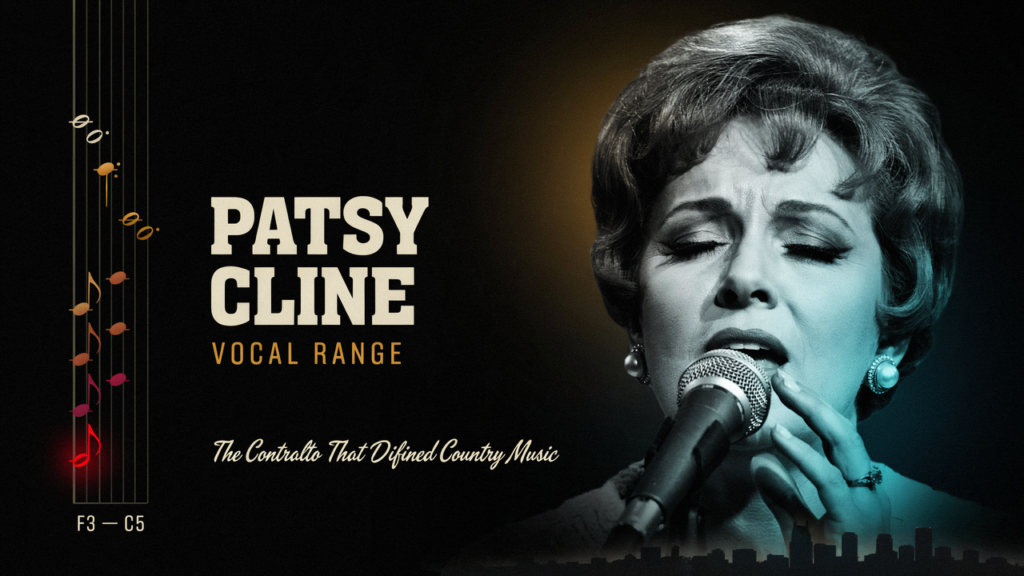
Patsy Cline’s Vocal Range at a Glance
Vocal range: approximately G3 – A5 (practical range) Documented song ranges: “Crazy” D4–G5; “I Fall to Pieces” C4–E5; “Sweet Dreams” D4–A5 Voice type: Contralto Tessitura (comfortable centre): Roughly C4 to E5 Active career: 1955–1963
What Voice Type Was Patsy Cline?
Every credible source converges: Patsy Cline was a contralto. Britannica calls her voice “exceptional contralto.” The Utah Shakespeare Festival profile describes her as “best known for her rich tone and emotionally expressive bold contralto voice.” The Grokipedia entry describes “a distinctive contralto voice, characterized by its rich, low register and emotional depth.”
The contralto is the lowest standard female voice type, and it’s rare — genuine contraltos are unusual enough that musical theatre and opera tend to cast mezzo-sopranos with developed lower registers in contralto roles. What distinguished Cline’s contralto was not simply the depth of the low notes but the warmth and resonance she produced throughout the full range: the voice had weight and presence from the low G3 through the upper A5, without the thinning that many contraltos experience in the upper register.
Her voice also had what multiple sources call a “smoky edge” — a slight roughness or grain that was partly the natural texture of her instrument and partly the expressive choice of a singer who understood that vulnerability in a voice conveys emotion more directly than polished perfection. This quality is most audible in “Crazy” and “Sweet Dreams.”
The contralto vocal range page covers the voice type and where it sits in the full female classification system.
“Crazy” and the One-Take Recording
The Library of Congress essay on “Crazy” — added to the National Recording Registry in 2003 — is one of the most detailed analyses of Cline’s vocal approach available. It describes how producer Owen Bradley “was also able to bring out the complexity in Patsy’s vocal phrasing. She seemed vocally at ease, and her expression of the pain of lost love became her defining style.”
The essay notes that the recording session was initially aborted: Cline stopped when she “could not sing up to her own personal standards.” She returned a few days later and recorded the vocal in one take. That combination — the perfectionism that stopped the first session and the mastery that produced the final take in a single attempt — is the clearest evidence of what her voice could do when properly commanded.
The library essay also documents that Bradley “arranged Willie Nelson’s demo tape for Patsy so that it would be in her vocal ‘comfort zone'” — which is a producer’s acknowledgment that the voice has specific territories where it sounds most natural and most powerful, and that the song needed to come to the voice rather than the other way around.
The Nashville Sound and Cline’s Role in It
The Nashville Sound — the production approach that Owen Bradley pioneered in the late 1950s and early 1960s to make country music accessible to pop audiences — was built significantly around Patsy Cline’s voice. The piano and electric guitar replacing acoustic instruments, the Jordanaires providing backup vocals that recalled their work with Elvis, the lush string arrangements: all of this was designed to frame the contralto instrument in a setting that would carry to pop radio audiences.
“I Fall to Pieces” (1961) topped the Billboard Hot Country Songs chart for two weeks and reached number 12 on the Hot 100 — the crossover success that validated Bradley’s production approach and established the Nashville Sound as a commercial strategy.
“Crazy” reached number two on the country chart and number 9 on the pop chart. These achievements, combined with the voice that carried them, made Cline the first artist to demonstrate that country music could be both artistically serious and pop-commercially viable simultaneously — a template that every subsequent crossover country artist has followed.
Perfect Pitch Without Formal Training
The Library of Congress essay notes she had perfect pitch “even as a child” — a natural acoustic gift that allowed her to match pitches precisely without a reference instrument and to hear immediately when she wasn’t satisfying her own standards. This is partly why the “Crazy” session was halted: a singer with perfect pitch knows immediately when the performance isn’t what it should be.
She was self-taught, unable to read sheet music throughout her career. The combination of natural perfect pitch, self-taught musicianship, and an instrument shaped by gospel music in the Virginia mountains produces exactly the profile you’d expect: technically precise (because perfect pitch demands it), emotionally direct (because self-taught singers develop expression before technique), and deeply rooted in a specific regional musical tradition.
Notable Vocal Performances
Crazy (1961): The definitive document of her voice at its most characteristic — the contralto warmth through the D4–G5 range, the “pauses, elongation of notes, and slidings from phrase to phrase” that Bradley incorporated into the arrangement. Recorded in one take. Named one of the greatest country songs ever written by Rolling Stone.
I Fall to Pieces (1961): Her first Billboard number one country single. The C4–E5 range sits at the heart of the contralto’s most resonant territory. “Twenty weeks on the charts” (Utah Shakespeare Festival).
Sweet Dreams (1963): Posthumously released, D4–A5, demonstrating the upper ceiling of her practical range. The A5 note sits at the top of mezzo territory and at the low end of soprano territory — confirming that the contralto voice, when properly supported, can access notes well above what the classification might suggest.
Walkin’ After Midnight (1957): Her first major country hit. The song sits in the G3–A4 range — the lower end of her tessitura — and demonstrates the smoky, warm quality that made her voice immediately identifiable from the first note.
FAQs About Patsy Cline’s Vocal Range
What was Patsy Cline’s vocal range?
Singing Carrots documents “Crazy” at D4–G5, “I Fall to Pieces” at C4–E5, and “Sweet Dreams” at D4–A5. Her practical working range spans approximately G3 to A5 — just under two octaves.
What voice type was Patsy Cline?
A contralto — the lowest standard female voice type. Multiple authoritative sources confirm this: Britannica, the Utah Shakespeare Festival profile, and the Grokipedia biography all describe her as having a “bold contralto voice” with “rich, low register and emotional depth.”
Could Patsy Cline read music?
No — she could not read sheet music. The documentary Remembering Patsy confirmed this. She was self-taught and had natural perfect pitch from childhood, which allowed her to develop as a musician without formal notation literacy.
How did Patsy Cline record “Crazy”?
The initial session was halted when Cline stopped singing because she couldn’t meet her own standards. She returned a few days later and recorded the vocal in a single take — one of the most famous single-take recordings in country music history. The Library of Congress added the recording to the National Recording Registry in 2003.
When did Patsy Cline die?
She died on March 5, 1963 at age 30, in a private airplane crash near Camden, Tennessee, returning from a benefit concert in Kansas City. She was at the height of her commercial and artistic powers at the time of her death. She was posthumously inducted into the Country Music Hall of Fame in 1973.
Erika Parker is a vocal analysis and singing education writer at Vocal Range Test. She focuses on vocal range testing, voice type analysis, pitch recognition, and singing tools for vocalists, musicians, choir singers, and beginners.