
Mitch Grassi’s vocal range spans from A1 in vocal fry to B7 in the whistle register — six octaves and one tone — with a chest voice running from A2 to C#5, a mixed voice ceiling at E5, and a head voice reaching C6. The Pentatonix Wiki documents these figures in full, and Shawn Stockman of Boyz II Men — one of the most respected harmony vocalists in R&B history — assessed the instrument directly: “the prettiest voice I’ve ever heard in my life.”
Born Mitchell Coby Michael Grassi on July 24, 1992 in Arlington, Texas, Grassi is a founding member of Pentatonix, the a cappella group that has sold over 10 million albums worldwide and won three Grammy Awards. He is also one half of Superfruit, the YouTube duo and pop project he runs with bandmate Scott Hoying, and has released solo electronic music under the name Messer since 2020. His voice type sits at one of contemporary pop music’s more genuinely contested classification boundaries — technically a high tenor by his own identification, consistently called a countertenor by vocal analysts because of how naturally he operates in head voice across the soprano register.
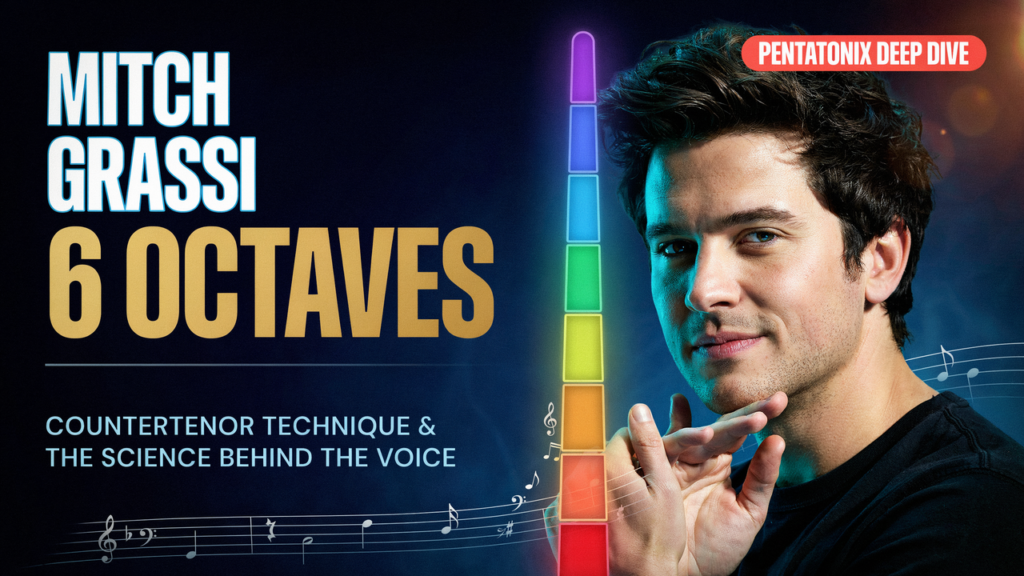
Vocal Range at a Glance
Full documented range: A1 (vocal fry) – B7 (whistle register) Chest voice: A2 – C#5 Mixed voice: to E5 Head voice: to C6 Voice type: High tenor / countertenor (debated — see below) Span: Six octaves and one tone
The Voice Type Question: Tenor or Countertenor?
This is the central analytical question about Grassi’s voice, and it has a more nuanced answer than either label alone provides.
His own identification is tenor. Wikipedia classifies him as having a “high tenor voice.” The Vocalview analysis classifies him as a “light-lyric tenor” with a range of A2–E5–G#5–B7. These sources point to his natural chest voice mechanism as tenor-based — the primary register is chest and mix rather than head voice.
The countertenor argument: the Stupid Vocal Critiques analysis classifies him as a countertenor; the Famous People biography calls him “a counter-tenor with a voice that spans six octaves.” The key technical marker is that he accesses head voice (up to C6) “with ease when changing from chest voice to head voice” — which is the countertenor hallmark. Standard tenors require significant effort to access the soprano register; Grassi moves there without the transition you’d expect.
The most precise answer: he is a high lyric tenor with fully developed countertenor technique. His primary mechanism is tenor-based, but his head voice is developed to the point that it functions as a primary register rather than an extension. Whether you call that a tenor with an exceptional head voice or a countertenor depends on where you locate the definitional boundary — and that boundary is genuinely contested in contemporary pop vocal analysis.
For the full voice type breakdown, the tenor vocal range page covers where high tenors sit, and the does head voice count in vocal range page addresses the specific technical question his voice raises.
His Lower Register: A1, A2, and the Surprising Depth
A1 in vocal fry sits in basso profundo territory — the lowest of the low male registers. For a high tenor to access this is unusual and is the direct result of vocal fry being a separate phonation mechanism from chest voice, using different patterns of vocal fold vibration. It’s not a singing note in any conventional sense, but it extends the documented span to six-plus octaves.
A2 — the chest voice floor — sits at the low end of tenor range. The Stupid Vocal Critiques analysis notes: “For a countertenor Mitch can go quite low. They are always very resonant and easy for him to access, although he rarely uses it.” This is the key distinction: his lower chest voice is functional and supported, not a thin approximation that he strains to reach.
In Pentatonix’s five-voice harmonic architecture, Grassi’s lower chest register is rarely needed — that territory belongs to Avi Kaplan (or his successors as bass). But it exists, it has quality, and it anchors the full span of the instrument.
His Upper Register: Head Voice to C6 and the Whistle to B7
C6 — one octave above soprano high C — is where his head voice sits. For context: that is territory that classically trained sopranos consider a significant achievement. For a male voice to produce it in head voice with the quality and control he demonstrates requires specific physiological conditions — a lighter, shorter vocal fold mechanism — and sustained technical development.
The G#5 in his live performance of “Dance of the Sugarplum Fairy” is documented by vocal analysts as carrying “vibrato” and “great resonance,” which means it’s not a thin falsetto squeak but a genuinely produced head voice note with tonal substance. That’s the countertenor quality: head voice that functions like a primary register rather than a strained extension.
The B7 whistle register ceiling extends the range into territory associated with the highest soprano coloratura extensions — documented in the A1–B7 YouTube vocal range video by Axel Fuentes, one of the most viewed vocal range documents for any male singer on the platform.
Understanding what whistle register is and how it’s produced differently from head voice is covered in detail at the what is whistle register and how to reach it page.
His Role in Pentatonix’s Harmonic Architecture
Pentatonix operates as a five-voice ensemble where each member occupies a specific harmonic territory: Grassi at the top, Kirstin Maldonado (mezzo-soprano) below him, Scott Hoying (baritone-tenor) in the middle, Kevin Olusola (bass and beatbox) and Avi Kaplan/Matt Sallee at the bottom. The full harmonic span from Kaplan’s sub-bass to Grassi’s C6 head voice is one of the widest documented ranges of any a cappella group.
His function is not simply to sing high. In Pentatonix’s arrangements, the top voice carries the melodic line that cuts through the texture — the note that the ear follows above everything else. A voice that sits in C6 head voice with genuine tonal quality gives the group a melodic presence that lighter falsetto voices can’t match. This is why the Stockman comparison to “the prettiest voice” lands as a professional assessment rather than casual praise.
The singer comparison tool lets you see your own range alongside Grassi’s documented span.
Superfruit, Messer, and Life Outside Pentatonix
He co-founded Superfruit with Scott Hoying in 2013 as a YouTube channel that became a pop duo, releasing the album Future Friends in 2017. The Superfruit project places his voice in a pop production context that uses the upper register as the primary melodic instrument rather than the harmonic peak it is in Pentatonix.
His solo project Messer, launched in 2020, moves into electronic and darkwave territory — EPs including Roses (2021) and the full-length Cuts (2025). The Messer work places his voice in heavily processed electronic contexts, exploring what the instrument sounds like stripped of the a cappella context and run through dark synth production.
His uncle Tony was “a high tenor with an incredible range” — a family precedent that may partly explain the physiology.
FAQs About Mitch Grassi’s Vocal Range in Pentatonix
What is Mitch Grassi’s full vocal range?
A1 to B7 — six octaves and one tone — per the Pentatonix Wiki and multiple vocal range analyses. His functional singing range (chest voice to head voice, excluding fry and whistle) spans approximately A2 to C6.
Is Mitch Grassi a tenor or countertenor?
Both labels are accurate depending on your framework. He identifies as a tenor; Wikipedia classifies him as high tenor; vocal analysts frequently classify him as countertenor based on his ease of access to the soprano register through head voice. The most precise description: a high lyric tenor with fully developed countertenor technique.
What did Shawn Stockman say about Mitch Grassi’s voice?
Stockman, the tenor of Boyz II Men and one of R&B’s most respected harmony vocalists, called his voice “the prettiest voice I’ve ever heard in my life” — documented on the Pentatonix Wiki and widely circulated in fan communities.
How does Mitch Grassi’s voice function in Pentatonix?
He occupies the top of the harmonic spectrum — the highest voice in the group’s five-part arrangement architecture. His head voice and upper register carry the melodic lines that sit above the texture, giving Pentatonix a top-voice presence that few a cappella groups can match.
What is Messer?
Messer is Grassi’s solo electronic music project, launched in 2020. It departs significantly from the a cappella aesthetic of Pentatonix, exploring darkwave and electronic production across EPs and the full-length album Cuts (2025).
Erika Parker is a vocal analysis and singing education writer at Vocal Range Test. She focuses on vocal range testing, voice type analysis, pitch recognition, and singing tools for vocalists, musicians, choir singers, and beginners.