
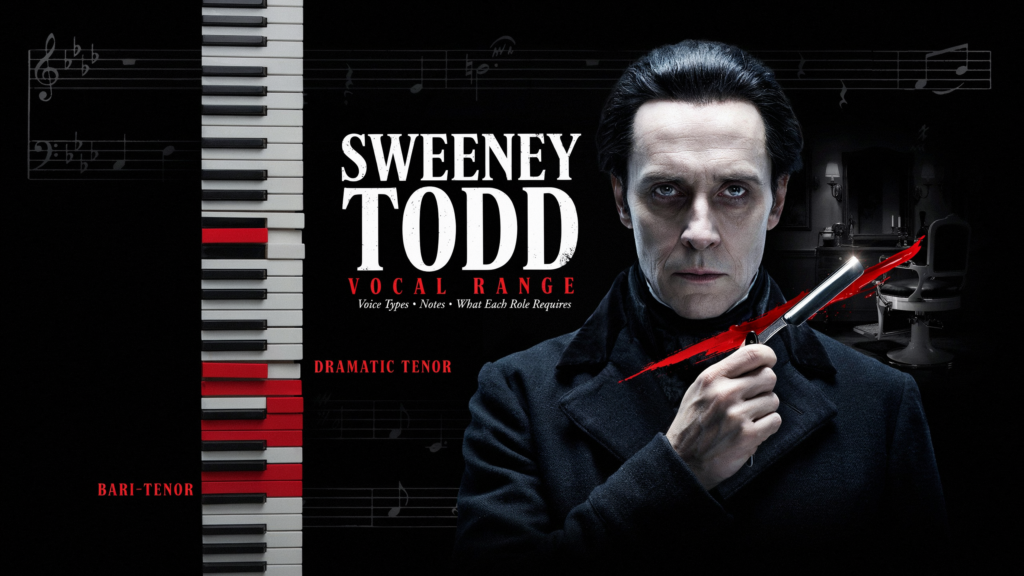
Sweeney Todd: The Demon Barber of Fleet Street is usually cast around a dark baritone or bass-baritone title role, a character mezzo/alto Mrs. Lovett with belt, a lyric soprano Johanna, and several tenor or baritone supporting parts. Exact note ranges can vary by production, edition, transposition, and casting choice, so the ranges below should be read as practical casting references rather than one unchangeable official measurement.
The show is demanding because Stephen Sondheim’s writing asks singers to handle tight text, chromatic harmony, fast ensemble entries, dramatic acting, and sustained character work at the same time. A singer can have the right notes and still struggle if the pitch accuracy, diction, stamina, or acting rhythm is not secure.
Quick Answer: Sweeney Todd Vocal Ranges by Role
| Role | Common Voice Type | Typical Casting Range Reference | Main Vocal Demand |
|---|---|---|---|
| Sweeney Todd | Baritone / bass-baritone | Often listed around low baritone to upper baritone territory | Dark resonance, dramatic speech-singing, stamina |
| Mrs. Lovett | Mezzo-soprano / alto with belt | Often listed around F#3 or G3 to E5 | Character patter, belt, comic timing |
| Anthony Hope | Tenor | Lyric tenor range, production dependent | Clear romantic line and clean upper placement |
| Johanna | Soprano | Upper soprano writing, production dependent | Light tone, purity, pitch control |
| Judge Turpin | Bass-baritone / baritone | Low male range | Authority, menace, controlled phrasing |
| Tobias Ragg | Tenor or high character voice | Flexible by casting | Innocence, clarity, stamina |
| Pirelli | Tenor | Often cast as an operatic or comic tenor | Flashy style, accent, agility |
| Beggar Woman / Lucy | Soprano or mezzo-soprano | Upper female range | Character color and dramatic intensity |
For the official show context, Music Theatre International lists Sweeney Todd as the original Broadway version with music and lyrics by Stephen Sondheim and book by Hugh Wheeler, with nine roles plus ensemble and a two-act structure. You can check the licensing overview on the MTI Sweeney Todd page.
Sweeney Todd: Baritone or Bass-Baritone
The title role needs a singer who can sound grounded, dangerous, and emotionally contained without turning every phrase into a shouted climax. In practical casting, Sweeney is usually treated as a baritone or bass-baritone role. The lower color matters because the character’s authority comes partly from weight in the voice, but the role also needs enough upper baritone strength for moments like “Epiphany.”
This is not a simple low-note contest. The singer must move from quiet intensity to explosive anger while keeping Sondheim’s rhythms clean. If the voice is too light, the role may lose menace. If the voice is too heavy and slow, the text can become muddy.
For singers comparing the role to their own range, start with the difference between a baritone vocal range and a bass vocal range. Sweeney often lives in the dramatic space between those categories.
Mrs. Lovett: Mezzo/Alto With Belt and Character Control
Mrs. Lovett is often described as a mezzo-soprano or alto-leaning character role, but the range label alone does not explain the difficulty. The role needs patter clarity, comic speed, a strong middle voice, and enough belt to cut through busy orchestration and ensemble energy.
Common casting references often place Mrs. Lovett around the lower-middle female range up to E5, but the real challenge is how much she has to do while singing: sell jokes, shift emotional tactics, keep the Cockney-flavored speech rhythm alive, and still land difficult musical cues.
A singer preparing this role should understand the mezzo-soprano vocal range, but also work carefully on healthy belting technique. Lovett should feel sharp and energized, not pressed or shouted.
Anthony Hope: Lyric Tenor
Anthony is the clearest romantic voice in the show. His music, especially “Johanna,” usually calls for a lyric tenor quality: open, sincere, bright, and clean. He does not need Sweeney’s darkness or Pirelli’s comic exaggeration. He needs line, pitch, and emotional directness.
The role can be underestimated because it sounds more conventional than Sweeney or Lovett. But Sondheim’s writing still demands precise rhythm and clean intervals. Anthony’s singing has to feel effortless while the score underneath him remains harmonically alert.
If you are checking whether Anthony fits your voice, compare your comfortable upper notes with a tenor vocal range rather than judging only by your highest possible note.
Johanna: Soprano With Lightness and Control
Johanna is usually cast as a soprano. Her signature material, especially “Green Finch and Linnet Bird,” needs a lighter upper register, secure intonation, and the ability to sound trapped, delicate, and hopeful at the same time.
The role is not about sheer volume. Johanna’s music works best when the voice feels clear and floating, with enough control to keep the phrases elegant. A heavier voice may have the notes but miss the character’s brightness and fragility.
For range context, compare Johanna with a standard soprano vocal range. The important test is not only whether the top notes exist, but whether they can stay clean, expressive, and repeatable.
Judge Turpin, Tobias, Pirelli and the Beggar Woman
Judge Turpin is usually cast in a low male category such as baritone or bass-baritone. His sound should suggest status, control, and threat. The role does not need Sweeney’s central intensity, but it does need a voice that can carry authority without forcing.
Tobias is often handled as a young tenor or high character voice. “Not While I’m Around” needs sincerity more than vocal display. The singer must sound emotionally open and rhythmically secure, especially because the song can easily become sentimental if it loses focus.
Pirelli is commonly cast as a comic or operatic tenor. The role benefits from bright top notes, theatrical exaggeration, and quick character shifts. The Beggar Woman or Lucy is usually a soprano or mezzo-soprano role with sharp dramatic color and enough upper range to cut through tense scenes.
Why Sweeney Todd Is So Hard to Sing
The hardest part of Sweeney Todd is not just the individual ranges. It is the combination of range, rhythm, pitch accuracy, and acting pressure. Sondheim often writes lines that feel like heightened speech, then places them inside harmonies that are less predictable than standard musical theatre progressions.
- Pitch accuracy: singers must hold notes against chromatic or tense harmony.
- Diction: the text moves quickly and carries plot information.
- Stamina: principal roles require sustained dramatic focus across a long score.
- Character timing: comedy, horror, and tragedy often shift within a single number.
- Ensemble precision: entries and harmonies need careful listening, not just loud singing.
For anyone preparing the score, singing in tune is just as important as having the right voice type. Sondheim exposes weak intonation quickly.
Stage Version vs Film Version
The 2007 film adaptation introduced many viewers to the story, but film casting and stage casting are not the same thing. A film can use microphones, close-up acting, edited takes, lower keys, and different orchestration choices. A stage production usually requires singers to sustain the role live, night after night, while projecting through the full score.
That is why a performer who works in the film version may not represent the normal stage vocal demand. For auditions, singers should prepare for the stage score and the director’s specific production needs rather than copying one screen performance.
How to Know Which Sweeney Todd Role Fits Your Voice
Do not choose a role only by the highest or lowest note you can reach once. Use a more practical checklist:
- Can you sing the role’s middle range comfortably for several minutes?
- Can you keep the text clear at performance tempo?
- Can you repeat the difficult notes after a full warm-up without throat tightness?
- Does the tone match the character, not just the note range?
- Can you act the scene while staying rhythmically accurate?
If you are still identifying your category, a general voice types guide can help you separate range, tessitura, tone color, and practical casting fit.
FAQ
What vocal range is Sweeney Todd?
Sweeney Todd is usually cast as a baritone or bass-baritone role. Exact note ranges vary by production and source, but the role needs a dark lower color plus enough upper baritone strength for dramatic climaxes.
What voice type is Mrs. Lovett?
Mrs. Lovett is usually a mezzo-soprano or alto-leaning character role with belt. The part needs comic timing, speech-like patter, a strong middle voice, and secure musical accuracy.
Is Sweeney Todd hard to sing?
Yes. The show is difficult because of Sondheim’s chromatic harmony, fast text, ensemble precision, and intense acting demands. The notes matter, but pitch accuracy and stamina matter just as much.
What voice type is Johanna in Sweeney Todd?
Johanna is usually a soprano. Her music needs lightness, clarity, and clean upper-register control rather than heavy belting.
What voice type is Anthony in Sweeney Todd?
Anthony is usually a lyric tenor. His songs need a bright, sincere sound and smooth phrasing, especially in “Johanna.”
Can a baritone sing Sweeney Todd?
Yes, if the baritone has enough low color, stamina, and dramatic weight. A lighter baritone may need careful casting judgment, while a bass-baritone often fits the role naturally.
Final Thoughts
Sweeney Todd is a role-by-role vocal puzzle. Sweeney needs dark baritone weight, Lovett needs character mezzo energy, Anthony needs lyric tenor clarity, and Johanna needs soprano purity. But the score rewards more than range. The best performances combine the right voice type with clean pitch, precise text, stamina, and a strong dramatic reason for every note.
Erika Parker is a vocal analysis and singing education writer at Vocal Range Test. She focuses on vocal range testing, voice type analysis, pitch recognition, and singing tools for vocalists, musicians, choir singers, and beginners.