
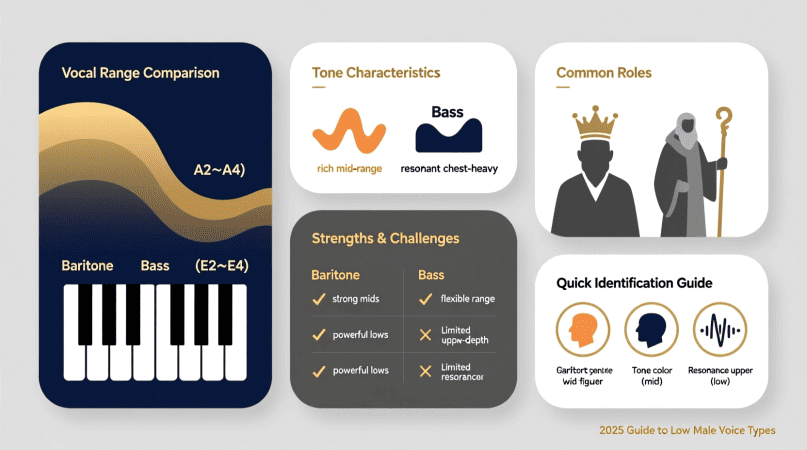
Baritone and bass are the two lowest male voice types, but their differences go far beyond pitch. Many singers misidentify themselves as basses simply because they can sing low notes, while others overlook their natural baritone qualities due to range overlap.
This guide provides the clearest and most accurate explanation of how baritone and bass differ—covering vocal range, tessitura, tone quality, anatomical traits, resonance behavior, fach subtypes, and real methods for identifying your true voice type.
What Is a Baritone Voice?
The baritone is the central male voice type, positioned between tenor (higher) and bass (lower). It is the most common adult male classification.
Core Characteristics
- Warm, rich tone
- Strong mid-range resonance
- Balance of brightness and depth
- Flexible tone suitable for pop, classical, and contemporary styles
Typical Baritone Range
- Standard: G2 – G4
- Extended: F2 – A4
Tessitura (Comfort Zone)
- A2 – E4
Baritone Subtypes
- Lyric baritone
- Dramatic baritone
- Verdi baritone
- Bari-tenor
- Cavernous/low baritone
Baritones have strong tone presence without the extreme depth of a bass voice.
Understanding your full range becomes much easier when you measure both your lowest and highest notes using the Vocal Range Test, especially before exploring more advanced tools like the Octave Range Test. Once you get your results, you can compare them with famous artists through the Singer Comparison Tool and dive deeper into tone analysis using the AI Voice Analysis for even more insights.
What Is a Bass Voice?
The bass voice is the lowest natural male voice type. Basses have unique anatomical features that allow them to produce darker, fuller tones in the low register with ease.
Core Characteristics
- Deep, dark, resonant tone
- Heavy, powerful vocal weight
- Naturally expanded pharyngeal space
- Strong low-frequency presence
Typical Bass Range
- Standard: E2 – E4
- Extended: C2 – G4
- Some basses (basso profundo) reach A1 or below
Tessitura (Comfort Zone)
- E2 – C4
Bass Subtypes
- Lyric bass
- Dramatic bass
- Basso profondo
- Bass-baritone (hybrid)
True bass voices are rare; many singers who believe they are basses are actually baritones with extended low range.
Baritone vs Bass: Complete Comparison
| Feature | Baritone | Bass |
|---|---|---|
| Standard Range | G2 – G4 | E2 – E4 |
| Extended Range | F2 – A4 | C2 – G4 |
| Tessitura | A2 – E4 | E2 – C4 |
| Tone Quality | Warm, rich, mid-focused | Deep, dark, resonant |
| Resonance | Balanced chest + pharyngeal | Strong chest + expanded pharyngeal |
| Vocal Weight | Medium | Heavy |
| Rarity | Common | Rare |
| Low Notes | Less dense | Naturally full and powerful |
| High Notes | More accessible | Limited brightness |
Key insight:
Range overlap exists, but tessitura, timbre, and resonance behavior determine true voice type.
Why Baritone and Bass Are Often Confused
1. Overlapping Ranges
Many baritones can hit F2 or even E2, while some basses can hit F4 or G4.
Range alone does not determine voice type.
2. Choir Placement
Choirs often assign baritones to the bass section because true basses are rare.
3. Misunderstanding “Deep Voice”
A naturally deep speaking voice doesn’t automatically mean bass; tone placement matters.
4. Incomplete Vocal Development
Young singers (teens to early 20s) may not yet reveal full vocal depth or weight.
Tone, Resonance, and Anatomical Differences
Baritone Traits
- Moderate vocal fold thickness
- Balanced resonance across frequencies
- Neutral-to-lowered larynx
- Warm tone, not extremely dark
Bass Traits
- Thicker, heavier vocal folds
- Larger pharyngeal space behind the tongue
- Lower laryngeal posture
- Subglottal pressure naturally suited for low pitches
- Rich, booming resonance even at quiet volume
These internal anatomical differences explain why true bass voices are rare and why their low notes carry unique depth.
Tessitura: The Real Key to Voice Classification
Tessitura—your voice’s comfortable working zone—is more important than total range.
Baritone Tessitura
- Mid-range dominance
- Upper notes (D4–F4) feel manageable
- Lower notes (G2–A2) sound warm but not cavernous
Bass Tessitura
- Lower register dominance
- Mid-high notes feel heavy or resistant
- Low notes sit effortlessly with powerful resonance
Tessitura reveals the true identity of the voice, not how low or high you can occasionally reach.
How to Know Whether You’re a Baritone or a Bass
Use these diagnostic points:
Signs You Are a Baritone
- Speaking voice is moderately low, not extremely deep
- Best resonance occurs in A2–E4
- Low notes lack heavy impact
- Upper-middle notes have warmth and clarity
- Your tone is rich but not cavernous
Signs You Are a Bass
- Speaking voice is naturally deep and resonant
- Best resonance occurs in E2–C4
- Low notes feel natural, full, and effortless
- High notes (E4+) feel heavy, not bright
- Your voice sounds dark even at soft volume
If unsure, evaluating tessitura + timbre + resonance is far more reliable than range alone.
Baritone vs Bass in Choir and Classical Settings
Choir Classification
Most choirs use only:
- Tenor
- Bass
Baritones are often placed in bass sections because:
- True basses are uncommon
- Baritones can reach many bass notes
- Choral writing prioritizes harmony, not fach fidelity
Operatic / Classical Classification
Opera uses precise fachs:
- Baritone (lyric, dramatic, Verdi)
- Bass (lyric bass, dramatic bass, basso profondo)
- Bass-baritone (hybrid)
Opera classification depends on:
- Tessitura
- Tone color
- Vocal weight
- Resonance behavior
- Agility
Examples of Baritones and Basses
Notable Baritones
- Dmitri Hvorostovsky
- Thomas Hampson
- Josh Groban
- John Legend
Notable Basses
- Samuel Ramey
- René Pape
- Kurt Moll
- Avi Kaplan
Listening to these voices clearly shows differences in depth, timbre, and resonance.
Can a Baritone Sing Bass Parts?
Yes—many can.
But:
- Tone will be lighter
- Sustained low tessitura may cause fatigue
- Low notes will lack bass resonance
- Repertoire may not suit the voice’s natural color
A baritone singing bass parts ≠ a true bass.
Can a Bass Sing Baritone Parts?
Sometimes.
But typically:
- Upper-middle notes lack brightness
- Phrases requiring agility may feel strained
- Vocal color may sound too heavy for baritone repertoire
Frequently Asked Questions
Is bass lower than baritone?
Yes. Bass is the lowest natural male voice type.
Which is more common: baritone or bass?
Baritone is far more common.
Can vocal training make you a bass?
Training improves technique, but cannot alter anatomical voice type.
How rare is a true bass?
Quite rare; often less than 10% of adult male singers.
How do I find my voice type?
Measure your range, observe your tessitura, listen to your tone, and test resonance patterns.
Conclusion
Baritone and bass voices differ not only in range, but in tessitura, vocal weight, tone color, and anatomical structure.
A baritone’s voice is warm, full, and versatile, while a bass voice is deep, dark, and resonant—capable of producing the lowest male pitches with natural ease.
- To understand where baritones and basses fit, start with this overview of choral vocal ranges used in classical and modern singing.
- Many low-voice singers build technique through structured beginner singing lessons before specializing in their range.
- Developing depth and power is easier with targeted adult singing lessons designed for mature male voices.
- Extreme examples like Tim Storms’ vocal range show just how low the human voice can go.
- For a more musical bass-baritone reference, study Johnny Cash’s vocal range and how he used resonance.
- Rock singers can compare themselves against Peter Steele’s vocal range to see a darker, heavier low-voice style.
- If you want to actively expand your lower notes, these vocal exercises to increase range are a practical place to start.
Erika Parker is a vocal analysis and singing education writer at Vocal Range Test. She focuses on vocal range testing, voice type analysis, pitch recognition, and singing tools for vocalists, musicians, choir singers, and beginners.