
Classical singers tend to have wider documented vocal ranges than pop singers — but the difference is smaller than most people assume, and the comparison is complicated by the very different ways range is measured, trained and used across the two traditions.
The more meaningful differences between pop and classical singers are not about total range but about where the voice is used, how it is produced, and what demands are placed on different registers.
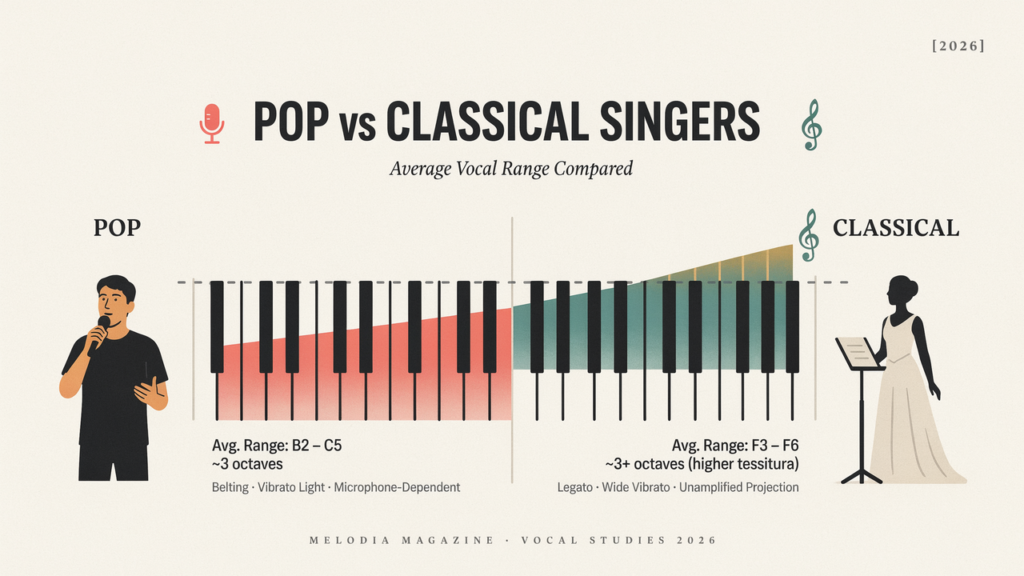
Average Vocal Range: Pop vs Classical
| Voice Type | Classical Average Range | Pop Average Range | Difference |
|---|---|---|---|
| Soprano | C4 – F6 (2+ octaves performed) | E4 – C6 (~1.5 octaves performed) | Classical: wider upper ceiling |
| Mezzo-Soprano | A3 – E6 | A3 – B5 | Similar mid-range, classical extends higher |
| Contralto | F3 – D6 | G3 – A5 | Classical: fuller use of both ends |
| Tenor | C3 – C5 (2+ octaves) | D3 – B4 (~1.5 octaves) | Classical: wider upper chest range |
| Baritone | A2 – A4 | B2 – G4 | Similar; classical extends lower |
| Bass | E2 – E4 | G2 – D4 | Classical: wider lower extension |
Key finding: Classical singers on average access approximately 0.5–1 octave more of their total range in performance than pop singers of the same voice type. However, pop singers often have natural ranges comparable to classical singers — they simply use less of it.
Why Classical Singers Tend to Have Wider Performance Ranges
1. Systematic range training from day one Classical vocal training explicitly targets the full range from the first lesson. Students work exercises specifically designed to expand the low floor, the high ceiling, and the transition zones between registers. This systematic approach to range development is not standard in pop vocal coaching, which tends to focus on the singer’s natural strength zones.
2. No amplification means full body resonance is required Opera singers must project over a full orchestra into a large hall without microphones. This requires developing the full resonance of the instrument — chest, head, nasal, sinus — which naturally encourages range development at both ends. Pop singers use microphones, which means they can reduce their dynamic requirement and work in a narrower, more comfortable zone.
3. The repertoire demands it Classical compositions — particularly operatic roles — are written to explore the full capability of a trained voice. A soprano role in Puccini or Verdi will routinely require C6 and above. Pop compositions are almost always written to sit within the comfortable zone of the target voice type, rarely pushing extremes.
4. Career-long intensive training Classical singers typically train for 8–12 years before professional performance. Pop singers may spend as little as no formal training time before recording. The training gap is enormous, and range development is a direct product of sustained training.
Why Pop Singers Sometimes Have Wider Raw Ranges Than Expected
1. Falsetto freedom Male pop and rock singers often develop their falsetto extensively — a register that classical tenors and baritones are trained to minimise. Artists like The Weeknd, Justin Timberlake and Thom Yorke have upper falsetto ranges that rival or exceed many classical tenors, even though their trained classical range would be classified as conventional.
2. Whistle register Mariah Carey’s whistle register — documented to G#7 — exceeds the practical ceiling of most operatic sopranos in conventional terms, though operatic sopranos achieve those notes through different phonation methods.
3. No range policing Pop singers are not required to stay within a classical tessitura. They can use extreme high or low notes occasionally and dramatically without the sustained consistency required of opera singers. This means their documented range can be wide even if only parts of it are usable in performance.
Tessitura: The More Useful Comparison
Raw range is less useful than tessitura — the zone where a voice sounds best and most comfortable. This is the more practical measure of vocal capability.
| Voice Type | Classical Tessitura | Pop/Rock Tessitura |
|---|---|---|
| Soprano | F4 – A5 | D4 – G5 |
| Mezzo-Soprano | A3 – G5 | G3 – E5 |
| Contralto | E3 – E5 | F3 – C5 |
| Tenor | D4 – B4 | C4 – A4 |
| Baritone | G3 – F4 | F3 – D4 |
| Bass | D3 – D4 | E3 – C4 |
The tessitura comparison shows that classical and pop singers of the same voice type sit in similar zones in practice. The difference is primarily in how the extremes are developed and used.
Famous Pop Singers With Classical-Level Ranges
Some pop singers have ranges that rival trained classical singers:
Dimash Kudaibergen — D2 to D8, approximately 6 octaves. Trained in classical music, performs across pop, classical and folk traditions.
Mariah Carey — F2 to G#7, approximately 5 octaves, including a functional whistle register with musical application.
Christina Aguilera — C3 to E7, approximately 4 octaves, with operatic technique in parts of her range.
Andrea Bocelli — F2 to E5 (approximately), classical training applied to pop crossover.
Josh Groban — C2 to B4, approximately 2.5 octaves, classically trained for a pop career.
Famous Classical Singers and Their Ranges
| Singer | Voice Type | Range | Known For |
|---|---|---|---|
| Luciano Pavarotti | Lyric Tenor | C3 – C6 | “High Cs”, opera |
| Maria Callas | Soprano | F3 – E6 | Dramatic intensity, range |
| Plácido Domingo | Lyric Tenor | A2 – B4 | Dramatic tenor roles |
| Renée Fleming | Soprano | C4 – E6 | Lyric soprano clarity |
| Samuel Ramey | Bass | E2 – E4 | Bass-baritone power |
Key Technical Differences Beyond Range
Vibrato speed and width Classical singers typically have slower, wider vibratos (4–6 Hz) as a default production. Pop singers often use straight tone with vibrato as an expressive arrival. Neither is inherently superior — they serve different aesthetics.
Vowel modification Classical singers modify vowel sounds as they ascend through the range to maintain resonance. Pop singers generally try to maintain the natural vowel sound of the lyric, using microphones to compensate for the resulting volume reduction.
Breath management duration Classical singers train to sustain phrases across longer durations without breath, and to project without amplification. Pop singers can take more frequent breaths and rely on engineering to support the voice.
Style of onset Classical singers use a “balanced onset” — smooth engagement of the breath and cords simultaneously. Pop singers frequently use aspirate onset (breathy beginning) or glottal onset (slight crispness) for expressive purposes.
FAQs
Do classical singers have a wider vocal range than pop singers? On average, yes — classical singers access a wider portion of their range in performance, typically by 0.5–1 octave. However, the natural raw ranges of pop and classical singers of the same voice type are comparable. Training, repertoire and the absence of amplification push classical singers to use more of their full range.
Who has a better voice — pop or classical singers? This is a meaningless comparison. They are different skills serving different aesthetics. An opera singer’s voice would be poorly suited to a pop recording context; a pop singer’s voice would be acoustically insufficient for an opera house. Both represent the peak of what their traditions demand.
What is the average vocal range for a pop singer? Most successful pop singers work within approximately 1.5–2.5 octaves in their recorded material, even if their full tested range is wider. The song material determines what is used, not the singer’s maximum capability.
Can pop singers sing opera? Some can. Singers like Josh Groban, Andrea Bocelli and Michael Bublé have classical training and can move between traditions. Most mainstream pop vocalists lack the specific resonance training and breath management required to project operatically without amplification.
What is the average range for an opera singer? A fully trained operatic soprano typically has a practical performance range of approximately 2.5 octaves (C4–F6), with total tested range up to 3+ octaves. A trained operatic bass has a practical performance range of approximately E2–E4.
Related article:
- Test your vocal range →
- Find your voice type →
- What is the average vocal range? →
- Voice types explained →
- Soprano vocal range →
- Tenor vocal range →
- Dimash vocal range →
- Mariah Carey vocal range →
- Pavarotti vocal range →
Erika Parker is a vocal analysis and singing education writer at Vocal Range Test. She focuses on vocal range testing, voice type analysis, pitch recognition, and singing tools for vocalists, musicians, choir singers, and beginners.