
Breath is the engine of singing. Almost every common vocal problem — weak tone, going flat, cracking on high notes, running out of air mid-phrase — traces back to poor breath control. The exercises below train diaphragmatic breathing and breath support, the two skills that power steady, strong, controlled singing.
Why Breathing Is the Foundation of Singing
When you sing, your vocal folds vibrate as air passes through them. The quality of that airflow determines the quality of your sound. Steady, controlled air produces steady, controlled notes; unsteady air produces wobbly pitch, weak tone, and strain.
Two concepts matter most:
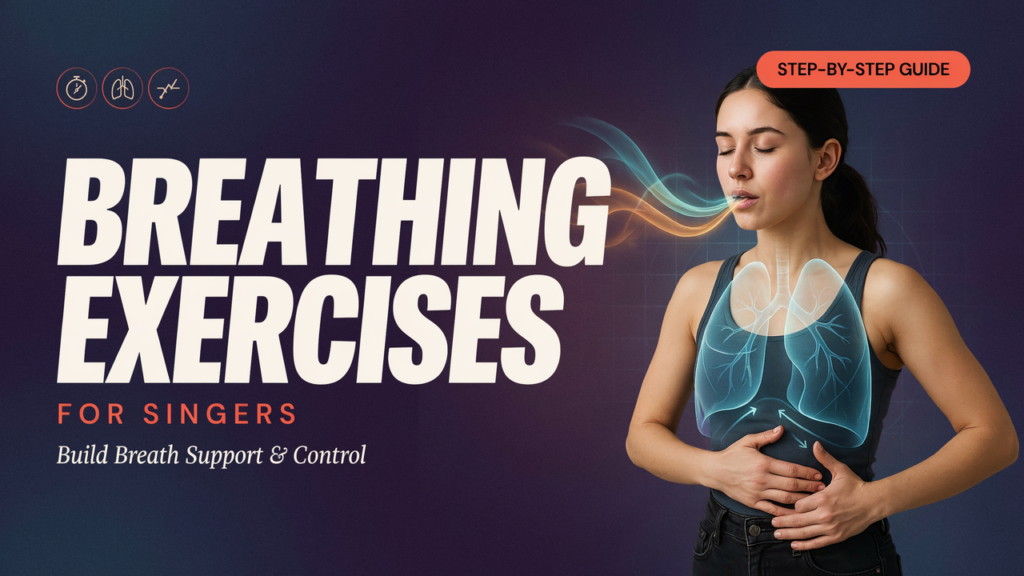
- Diaphragmatic breathing — breathing low so the diaphragm descends and the belly expands, rather than shallow breathing that lifts the chest and shoulders. This gives you deeper, more usable air.
- Breath support — the controlled, gradual release of that air as you sing, so you don’t dump it all at once or run out. Support is what keeps a note steady from start to finish.
Master these and your tone, pitch stability, range, and stamina all improve at once.
How to Tell If You’re Breathing Wrong
Most untrained singers breathe into the chest. Quick self-check: put one hand on your chest, one on your belly, and breathe in. If your chest and shoulders rise and your belly stays flat, you’re chest-breathing — shallow and unsupported. If your belly expands outward while your chest stays relatively still, you’re breathing diaphragmatically — exactly what you want.
Signs of poor breath support while singing include running out of air before the end of a phrase, pitch sagging flat on long or final notes, and tension creeping into the throat as you compensate.
Breathing Exercises to Build Support and Control
Do these daily. They take only a few minutes and form the foundation of any vocal warm-up.
Exercise 1: Diaphragmatic breathing (find the motion)
- Lie on your back with one hand on your belly, or stand tall.
- Breathe in slowly through your nose and feel your belly rise (lying down makes this easier to feel).
- Exhale slowly and feel it fall.
- Repeat for 1–2 minutes until low breathing feels natural.
Purpose: retrains your default breathing to be low and deep instead of shallow.
Exercise 2: The hiss (control your exhale)
- Take a low, diaphragmatic breath.
- Release the air on a steady “sssss,” keeping the hiss as even and controlled as possible.
- Aim to make the breath last longer each time — work up to 20, then 30 seconds.
Purpose: builds breath support by training a slow, controlled release instead of dumping air.
Exercise 3: The pulse hiss (engage the support muscles)
- Take a low breath.
- Release short, sharp “sss-sss-sss” pulses, feeling your lower abdominal muscles engage with each one.
- Keep each pulse crisp and even.
Purpose: activates and strengthens the muscles that manage breath support.
Exercise 4: Counted breaths (build capacity and pacing)
- Inhale low for a count of 4.
- Hold gently for 4.
- Exhale slowly and evenly for 8.
- Gradually extend the exhale count as your control improves.
Purpose: develops breath capacity and teaches you to pace your air across a phrase.
Exercise 5: Sustained “ah” (apply it to singing)
- Take a low, supported breath.
- Sing a single comfortable note on “ah” and hold it as steadily as you can — even tone, even volume, stable pitch.
- Focus on keeping support active so the note doesn’t sag or fade.
Purpose: transfers breath control directly into singing, where pitch stability and steady tone depend on it.
How Breathing Fixes Common Singing Problems
- Running out of air mid-phrase → the hiss and counted-breath exercises build capacity and pacing.
- Going flat on long or final notes → breath support keeps the air steady so pitch doesn’t sag. Pair with our guide on how to sing in tune.
- Weak, breathy tone → controlled airflow lets the vocal folds close efficiently, producing a fuller sound.
- Cracking or straining on high notes → steady support (rather than blasting air) lets the folds stretch freely. See how to hit high notes.
Tips for Better Breathing While Singing
- Breathe low, not high. Let the belly move, not the shoulders.
- Don’t over-breathe. Gulping in too much air creates tension. Take a relaxed, full breath, not a maximum one.
- Stay relaxed. Tension in the chest, shoulders, or throat works against good breathing.
- Support through the whole phrase, especially the last note, where pitch tends to drop.
- Keep tall posture. Slouching collapses the rib cage and limits breath.
How Long Until Breathing Improves Your Singing?
Many singers feel steadier breath control within a couple of weeks of daily practice, and the improvements to tone, pitch stability, and stamina build over the following months. Because breathing is a physical coordination, short daily sessions produce faster, more lasting results than occasional long ones. Breath support, once trained, becomes automatic — and it’s the single biggest upgrade most singers can make. It also underpins everything in our guide on how to sing better.
Frequently Asked Questions
What are the best breathing exercises for singers? The most effective are diaphragmatic breathing to retrain low breathing, the steady “hiss” to build controlled exhalation, pulse hisses to engage the support muscles, counted breaths for capacity and pacing, and sustained “ah” notes to apply breath control directly to singing.
How do singers breathe from the diaphragm? By breathing low so the belly expands outward on the inhale rather than lifting the chest and shoulders. A simple way to learn the motion is to lie down with a hand on your belly and feel it rise and fall, then carry that same low breathing into standing and singing.
Why do I run out of breath when I sing? Usually because you’re breathing shallowly into the chest and releasing air too fast without support. Building diaphragmatic breathing for deeper air, and breath support for controlled release, lets you sustain longer phrases without running out.
How can I increase my breath support for singing? Practice controlled-exhale exercises like the steady hiss and pulse hiss daily, extend your counted-breath exhales over time, and apply the control to sustained notes. Breath support is a trainable muscle coordination that strengthens with consistent practice.
Erika Parker is a vocal analysis and singing education writer at Vocal Range Test. She focuses on vocal range testing, voice type analysis, pitch recognition, and singing tools for vocalists, musicians, choir singers, and beginners.