
The best song to sing is one that fits your voice. Choosing music inside your comfortable range is the fastest way to sound better instantly — it keeps you in tune, prevents strain, and lets you focus on expression instead of fighting for notes you can’t reach. This guide breaks down song ideas by voice type and shows you how to match any song to your range.
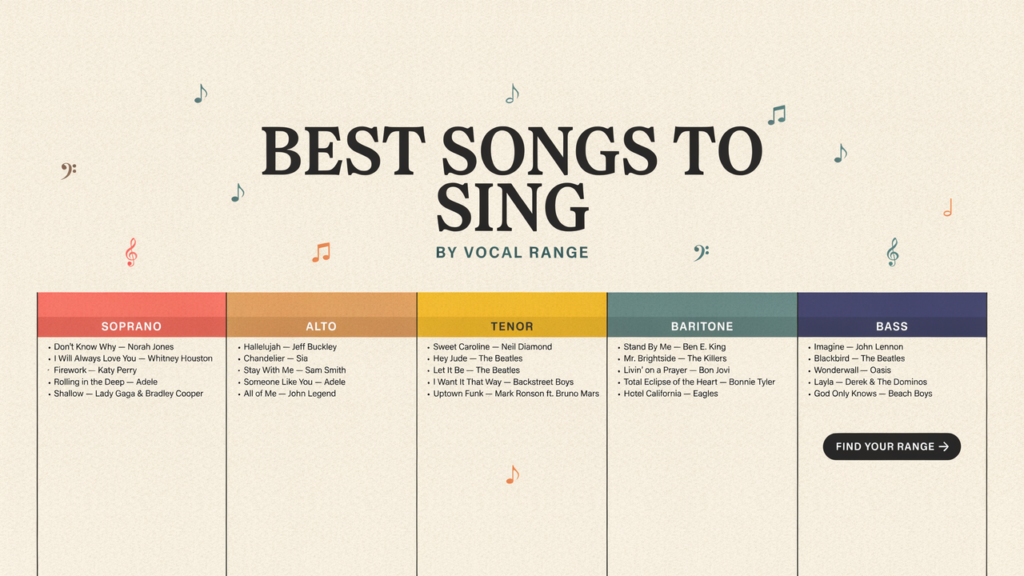
Why Singing in Your Range Matters
Every song has a range — the distance between its lowest and highest notes — and a tessitura, the part of the range where most of the melody sits. When a song’s tessitura matches yours, singing feels comfortable and sounds strong. When it doesn’t, you strain on the high parts, lose power on the low parts, and drift off pitch.
Before picking songs, know two things about your own voice:
- Your vocal range — your lowest to highest comfortable note. Find it fast with the vocal range finder.
- Your voice type — which category your range falls into. Identify yours on our voice types page or with the voice type test.
With those two pieces of information, you can confidently choose songs that fit.
Best Songs to Sing by Voice Type
The categories below are starting points organized by voice type. Within each, look for songs whose tessitura sits in your comfortable middle — not just songs you can technically squeak through at the extremes.
Songs for Soprano (highest female voice)
Sopranos shine on songs with bright, soaring high notes and melodies that live in the upper register. Look for material that showcases a clear, ringing top end. Confirm the fit against our soprano vocal range reference.
Songs for Mezzo-Soprano (middle female voice)
Mezzos have a warm, versatile middle range and are the most common female voice type. The widest variety of pop songs sits comfortably here. Check the typical span on our mezzo-soprano vocal range page.
Songs for Alto / Contralto (lowest female voice)
Altos and contraltos excel on rich, lower melodies with emotional depth, often in keys that strain higher voices. See the contralto vocal range page for your comfortable zone.
Songs for Tenor (highest male voice)
Tenors handle high, energetic male melodies and the soaring choruses common in rock and pop. Confirm your comfortable span on the tenor vocal range page.
Songs for Baritone (middle male voice)
Baritones — the most common male voice type — sound natural on conversational, mid-range melodies, and a huge amount of popular music sits right in this zone. See the baritone vocal range page.
Songs for Bass (lowest male voice)
Basses bring depth and resonance to low, grounded melodies. Look for songs built around a low tessitura that lets your bottom end ring. Check the bass vocal range page for reference.
How to Match Any Song to Your Vocal Range
You don’t have to rely on pre-made lists. Here’s how to test whether any song fits your voice:
Step 1: Know your range
Run the vocal range finder and note your lowest and highest comfortable notes (for example, G2–E4).
Step 2: Find the song’s range and key
Look up the song’s lowest and highest notes, or use the song key finder to identify its key and where it sits.
Step 3: Compare the tessitura, not just the extremes
A song might hit one high note you can reach — but if most of the melody sits above your comfortable zone, it’ll still feel like a strain. Match the bulk of the melody to your comfortable middle, not the one peak note.
Step 4: Transpose if needed
If a song you love sits slightly too high or low, change its key to fit your voice. Singing in a key that suits your range is completely normal and instantly more comfortable. For the full method, see how to find songs that fit your vocal range.
What If a Song Is Just Outside Your Range?
You have three good options:
- Transpose it to a more comfortable key (the easiest fix).
- Extend your range gradually with proper technique — see how to increase your vocal range.
- Use head voice or mixed voice for the high parts instead of straining your chest voice up, and learn to hit high notes without strain.
What you should not do is repeatedly force notes outside your range — that builds strain and bad habits.
Tips for Choosing Songs That Make You Sound Your Best
- Pick songs in your comfortable middle, where your tone is fullest and most reliable.
- Start narrow. Songs with smaller ranges are easier to sing well than those with dramatic high-to-low leaps.
- Match the style to your voice, not just the notes — choose songs that suit your natural tone and energy.
- Don’t choose a song for its one big note. If the rest doesn’t fit, the showpiece note won’t save it.
- Transpose freely. Singing in the right key for your voice is smart, not cheating.
Frequently Asked Questions
How do I find songs that fit my vocal range? First find your range with a vocal range finder, then check each song’s range and key. Match the song’s tessitura — where most of the melody sits — to your comfortable middle, and transpose the song to a better key if it sits slightly too high or low.
What songs should I sing for my voice type? Choose songs whose melody sits mostly in your comfortable range. Sopranos and tenors suit higher, soaring melodies; mezzos and baritones (the most common types) fit the widest variety of mid-range songs; altos and basses shine on richer, lower melodies.
Is it okay to change the key of a song to fit my voice? Yes. Transposing a song to suit your range is a normal, smart practice that makes singing more comfortable and helps you sound your best. Professional singers regularly perform songs in keys adapted to their voices.
How do I know if a song is too high or too low for me? Compare the song’s range to yours. If most of the melody sits above your comfortable high notes or below your comfortable low notes, it’s a poor fit — even if you can reach one or two of the notes. The bulk of the melody, not the extremes, determines comfort.
Erika Parker is a vocal analysis and singing education writer at Vocal Range Test. She focuses on vocal range testing, voice type analysis, pitch recognition, and singing tools for vocalists, musicians, choir singers, and beginners.