
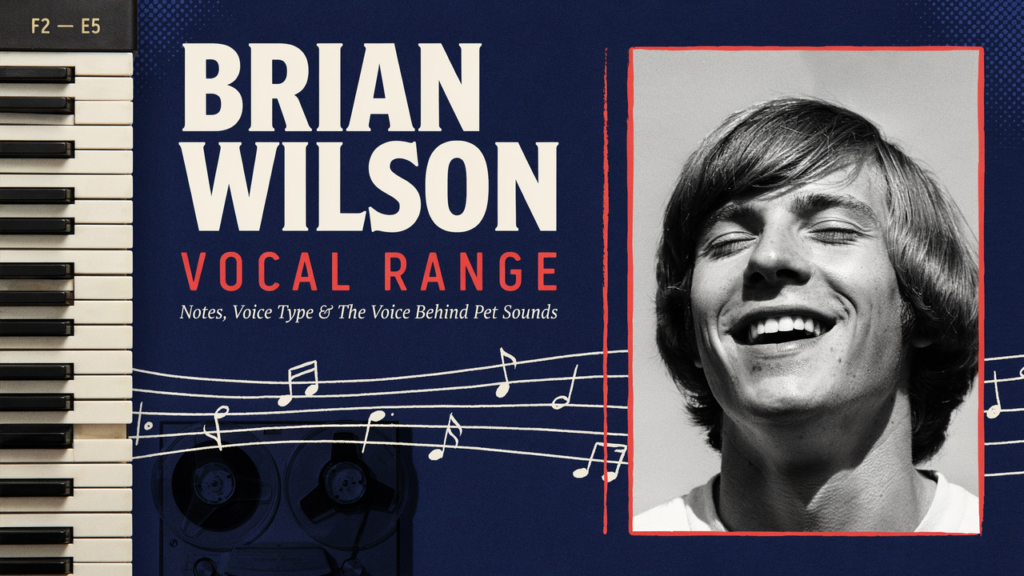
Brian Wilson’s vocal range spanned approximately C3 to F5 in his prime, with a lyric tenor foundation and a falsetto that could soar well above that — a “plaintive tenor and falsetto” that The Ringer described as one of the Beach Boys’ core vocal assets. Wilson, who died on June 11, 2025, co-founded the Beach Boys and spent six decades as one of the most influential figures in popular music, not primarily as a vocalist but as the architect of some of the most complex vocal harmony arrangements the pop idiom has ever produced.
Understanding his voice requires separating two things that are easy to conflate: Brian Wilson the singer, who had a genuinely impressive lyric tenor with exceptional falsetto reach, and Brian Wilson the arranger, who could hear and construct vocal harmonies that went far beyond what his individual range could produce. Both matter, but in different ways.
Brian Wilson’s Vocal Range at a Glance
Vocal range: approximately C3 – F5 (prime years), with falsetto extensions above Voice type: Lyric tenor Vocal registers in use: Chest voice, mixed voice, falsetto/head voice Approximate span: Around 2.5 octaves in chest/mix, wider with falsetto Tessitura (comfortable center): Roughly E3 to C5 Active career: 1961–2024
What Voice Type Was Brian Wilson?
Wilson was a tenor — specifically a lyric tenor, with a voice that Wikipedia describes as notable for its “versatile head voice and falsetto.” His natural chest voice sat in the bright, forward-placed tenor zone, and his falsetto was light, airy, and emotionally affecting rather than powerful or operatically projected.
His timbre had a distinctive quality that multiple analysts have described as plaintive or wistful — a particular emotional coloring that sits at the lighter, more vulnerable end of the tenor spectrum. It was not a big voice in the way that a dramatic tenor or a rock belter is a big voice. It was precise, clean, and emotionally transparent, qualities that made it ideal for the close-harmony arrangements he constructed around it.
All the other Beach Boys — Carl, Dennis, Mike Love, Al Jardine, and later Bruce Johnston — also sang in a tenor-adjacent range, which is part of what made their harmonic blend so distinctive. Wilson arranged around a cluster of similar-timbre voices rather than balancing contrasting voice types the way a classical choir does, and his own voice sat at the top of that cluster in falsetto passages.
For context on where a lyric tenor sits relative to other voice types, the tenor vocal range page covers the full classification, and the vocal range chart places all six voice types side by side.
His Lower Register: Chest Voice and Mid-Range
Wilson’s chest voice floor sits around C3, which is the comfortable lower limit of a lyric tenor instrument. His recorded lead vocals across the Beach Boys catalog show him spending most of his verse time in the D3–G3 zone — a mid-range placement that gave his voice warmth and presence without pushing into the lower baritone territory where a lighter tenor tends to lose resonance.
“Don’t Worry Baby” and “Surfer Girl” both demonstrate his mid-range chest voice in clear, exposed settings — soft, close-harmony arrangements where there’s nowhere to hide. The tone in those passages is warm and emotionally direct, with a naturalness that comes from singing well within the instrument’s comfortable range rather than reaching for anything.
He was not primarily a chest-voice belter. His instinct was always upward — toward the mix and the falsetto — rather than toward the kind of full-chest power associated with rock tenors. That orientation shaped the entire aesthetic of the Beach Boys sound.
The Falsetto: Wilson’s Signature Register
If there’s a single element of Brian Wilson’s voice that defines his contribution to vocal performance, it’s the falsetto. Wikipedia explicitly cites his “versatile head voice and falsetto” as a defining characteristic, and every serious account of his singing highlights the quality and emotional specificity of that register.
Wilson learned to sing falsetto by listening to the Four Freshmen — specifically Bob Flanigan, their lead vocalist — and copying his technique. He’s said directly: “I learned to sing falsetto by listening to their albums and copying Bob Flanigan.” This is not a small detail. The Four Freshmen were jazz vocal harmony specialists, and their approach to falsetto was precise, in-tune, and integrated into close harmony rather than used for theatrical effect. Wilson absorbed that sensibility and built his entire vocal identity around it.
His falsetto in prime form — most clearly heard on Pet Sounds (1966) and the Good Vibrations sessions — is light, clear, and pitch-perfect, with a breathy emotional quality that gives songs like “God Only Knows” and “Caroline, No” their characteristic feeling of controlled vulnerability. It’s not a showy falsetto designed to demonstrate range; it’s a tool for emotional expression deployed with unusual precision.
The question of whether falsetto counts toward a singer’s vocal range, and how to think about it in context, is covered in the does head voice count in vocal range breakdown — which is directly relevant to understanding how Wilson’s total span should be interpreted.
Harmony Arranging: Where His Real Genius Lived
Separating Wilson’s individual voice from his role as a vocal arranger is essential for an honest assessment of his contribution. As a solo vocalist, he was excellent — a clean, emotionally expressive lyric tenor with exceptional falsetto control. As a harmony arranger, he was in a category almost entirely his own.
On the early Beach Boys records, he wrote harmony parts for five or six voices that created a choral texture using a narrow range of similar timbres. Rather than placing voices in classical SATB formation across a wide range, he stacked tightly voiced chords that created a warmth and resonance from homogeneity rather than contrast — all tenors, closely spaced, producing a sound the music press described at the time as something genuinely new.
By Pet Sounds (1966), this had evolved into something more sophisticated. Wilson used the studio as a compositional tool, layering vocal tracks with orchestral instrumentation in ways that treated voices as timbral elements within a larger sonic texture rather than as the primary melodic carriers. Paul McCartney heard Pet Sounds before recording Sgt. Pepper’s Lonely Hearts Club Band and credited it as a direct influence on that album — a line of transmission that’s become one of the most discussed in pop music history.
“Good Vibrations,” recorded across approximately 90 hours of tape at a cost of $50,000 (an extraordinary sum in 1966), is the fullest realization of this approach. Wilson assembled it in sections recorded at different studios, splicing together parts until the arrangement matched what he heard in his head. The vocal parts — particularly the falsetto passages — sit within an electronic and orchestral arrangement so complex that reconstructing it for live performance took his touring band years of work.
How His Voice Changed — and Declined
Wikipedia is direct about this: Wilson’s “vocal range declined significantly amid periods of reclusion, overeating, and substance abuse” following the mid-1960s creative peak. This is an important part of the story, and it’s worth treating honestly.
The Beach Boys’ mid-period recordings and Wilson’s increasingly sporadic appearances through the 1970s and 1980s document a voice that had lost access to its upper falsetto range and struggled with pitch consistency in ways it hadn’t in the 1960s. The causes were not primarily age-related in the conventional sense — they were health-related. Significant weight gain affects the mechanics of breathing and vocal support; substance use affects pitch accuracy and vocal cord function; extended periods of non-performance allow the instrument to deteriorate from disuse.
His comeback performances from the late 1990s onward — documented in Live at the Roxy Theatre (2000) and the Pet Sounds Live tour (2002) — showed a voice substantially different from the 1966 recordings. The falsetto ceiling had come down considerably, and his live sound engineer noted in 2010 that Wilson was “getting back to experimenting with his voice and getting into a higher falsetto range” — suggesting the instrument was partially recovering with sustained performance and sobriety.
This trajectory is a useful real-world illustration of how physical and lifestyle factors interact with vocal range over a career. The how age affects your vocal range over time page covers the physiology of vocal change, though Wilson’s case involved factors beyond normal aging.
Notable Vocal Performances
Surfer Girl (1963): One of the earliest clear showcases of his lyric tenor and falsetto in an exposed, simple arrangement. The doo-wop influence from the Four Freshmen is most audible here.
Don’t Worry Baby (1964): His lead vocal performance is widely cited as among his most emotionally affecting — a gentle, wistful delivery in his natural mid-range that doesn’t reach for effect but lands precisely because it doesn’t.
God Only Knows (1966): Often cited among the most beautiful songs ever recorded. The vocal arrangement is complex, with Wilson’s falsetto threading through orchestral passages in a way that blurs the line between voice and instrument. Paul McCartney has named it his favorite song.
Good Vibrations (1966): The most technically ambitious single recording of his career, and probably of any Beach Boys recording. The vocal parts across all registers — chest, mix, and falsetto — are woven into an arrangement of unusual sophistication.
Caroline, No (1966): Released as a solo single, this track demonstrates his falsetto at its most emotionally precise — light, clean, and affecting without any of the theatrical quality that falsetto can acquire in less controlled hands.
Legacy and Influence
Wilson’s influence on pop vocal production is difficult to overstate. The techniques he pioneered on Pet Sounds — close-harmony stacking, treating the voice as a timbral texture within an orchestral arrangement, using the studio itself as a compositional instrument — became foundational to how pop music was made in the decades that followed.
Vocalists who cite his falsetto as a direct influence include a long and diverse list of artists spanning genres from indie pop to progressive rock. His approach to harmony demonstrated that close-voiced, same-timbre arrangements of tenors could produce something richer and more emotionally complex than the classical SATB balance.
For singers curious about how close harmony works technically, the vocal range and singing techniques page covers harmony construction and register blending in accessible terms.
If you want to test where your own voice sits — whether you share Wilson’s lyric tenor placement or sit somewhere else on the spectrum — the vocal range finder will map your range, and the voice type test will tell you which classification fits your instrument.
FAQs About Brian Wilson’s Vocal Range
What was Brian Wilson’s vocal range?
In his prime years, his range spanned approximately C3 to F5, with falsetto extensions above that in the upper fifth octave. His practical working range across the Beach Boys catalog sits primarily in the E3–C5 zone.
What voice type was Brian Wilson?
He was a lyric tenor — a lighter, more flexible tenor instrument with a bright, forward timbre and exceptional falsetto control. Wikipedia describes his voice as notable for its “versatile head voice and falsetto.”
How did Brian Wilson learn to sing falsetto?
He has said directly that he learned falsetto by listening to the Four Freshmen and copying the technique of their lead vocalist Bob Flanigan. The Four Freshmen were a jazz vocal harmony group whose close-voiced, falsetto-integrated approach became the foundational model for the Beach Boys’ sound.
Did Brian Wilson’s voice decline over his career?
Yes, significantly. Wikipedia notes that his vocal range declined amid periods of reclusion, overeating, and substance abuse following his 1960s creative peak. His comeback performances from the late 1990s onward showed partial recovery, with his live sound engineer noting improvements in his falsetto range in the 2010s.
What is Brian Wilson’s greatest vocal performance?
Most critics and musicians who have addressed this question point to Pet Sounds (1966) as a whole, with “God Only Knows” and “Caroline, No” most often cited as individual highlights. Paul McCartney has named “God Only Knows” his favorite song, and has credited Pet Sounds as a direct influence on Sgt. Pepper’s Lonely Hearts Club Band.
Erika Parker is a vocal analysis and singing education writer at Vocal Range Test. She focuses on vocal range testing, voice type analysis, pitch recognition, and singing tools for vocalists, musicians, choir singers, and beginners.