
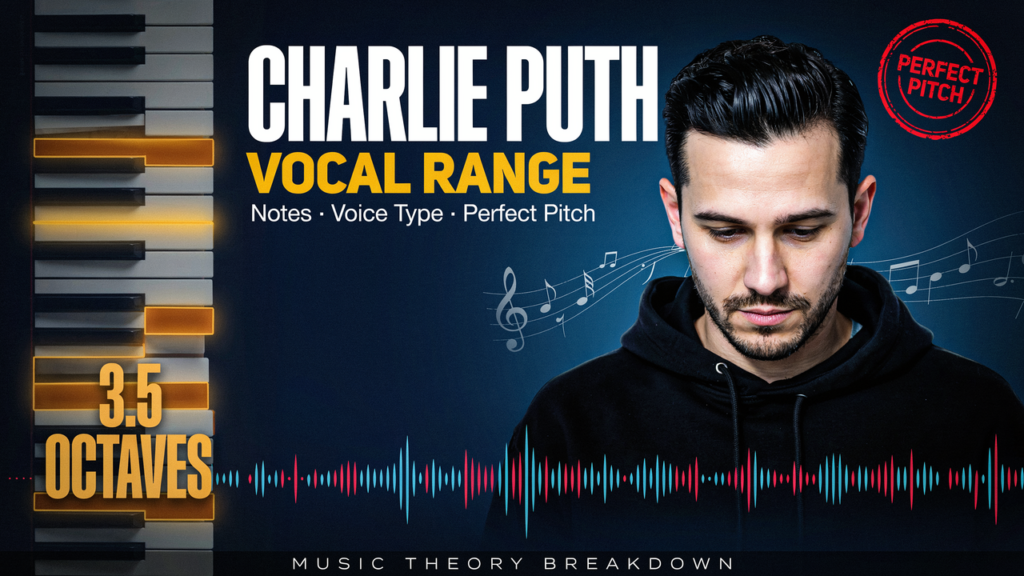
Charlie Puth’s vocal range spans approximately G#2 to F#5 — around two and a half octaves — with a light lyric tenor instrument that Apple Music describes as “falsetto-flaunting” and which has produced some of the most precisely constructed pop vocals of the past decade. The New Jersey–born singer, songwriter, and producer holds a degree in music production and engineering from Berklee College of Music (class of 2013), and his approach to his own voice is inseparable from his approach to production: technically precise, studio-aware, and built around an almost compulsive attention to pitch detail.
That detail is grounded in something genuinely unusual — documented perfect pitch, an ability to identify and reproduce musical pitches without a reference tone. It shapes how he hears his own voice, how he produces his records, and why the tonal accuracy of his recordings has a different quality from most pop artists working in the same commercial space.
Charlie Puth’s Vocal Range at a Glance
Vocal range: approximately G#2 – F#5 Voice type: Light lyric tenor Vocal registers in use: Chest voice, mixed voice, falsetto/head voice Approximate span: Around 2.5 octaves Tessitura (comfortable center): Roughly C3 to D4 Training: Berklee College of Music, music production and engineering; voice study with Livingston Taylor.
What Voice Type Is Charlie Puth?
Puth is a tenor — and within the tenor spectrum, a light lyric tenor: a voice that sits at the brighter, lighter end of the male range rather than the heavier, more powerful end. The SingersAvenue vocal profile classifies him specifically as a “light medium-low tenor,” which captures something important: his natural timbre sits slightly lower and warmer than the brightest pop tenors, while his falsetto and mixed voice give him access to the higher registers that define his musical identity.
The Quora vocal analysis that has circulated widely on the topic describes his usable tessitura in the higher male registers (C3–G4), his bright forward timbre, and his reliance on head voice and mixed voice above the passaggio — all consistent with lyric tenor classification. His songs are written in keys and at melodic heights that reflect a tenor’s working range, which is itself practical evidence of where the instrument naturally operates.
There has been some debate about whether he’s a tenor or a baritone — the “forcing” critique that appears occasionally in discussions of his live performances suggests that some listeners hear strain in his upper range. The honest assessment is that his natural chest voice sits in a comfortable lower-to-mid tenor zone, while his falsetto and mix extend considerably higher. Whether that constitutes a “true” tenor or a lighter baritone with well-developed upper registers is a classification question more than a practical one. Either way, the tenor vocal range page covers where his instrument fits relative to the broader male voice type spectrum.
His Lower Register: G#2 and the Chest Voice Floor
G#2 — between G and A in the second octave — sits at the lower edge of the tenor range, approaching baritone territory. The SingersAvenue profile documents G#2 as his floor, and the Singing Carrots data for “Attention” shows the song starting as low as A#2, which is consistent with that figure.
In practice, his chest voice in the lower register is warm and usable but not where the voice is most comfortable or most characterful. His natural speaking voice sits in the C3–E3 zone, and his chest singing in verse passages tends to live in that same territory — mid-range, grounded, with enough resonance to carry a low-key pop verse without thinning out.
The lower register is where he often deploys the breathy, intimate vocal quality that characterizes his slower songs — a deliberately understated chest voice that creates contrast with the more open head voice and falsetto passages above. “Attention” specifically has been analyzed as requiring “a conversational, almost lazy vocal fry in the verses” — a technique that uses the lower register’s natural intimacy as a tonal choice rather than a statement of range.
His Upper Register: Mix, Falsetto, and the Fifth Octave
F#5 is the documented upper note in his catalog, sitting well into the fifth octave — soprano-adjacent territory for a male voice. This is where his falsetto and mixed voice operate, and where his most recognizable tonal quality emerges: a clean, often breathy upper register that has become his signature sound across hits from “See You Again” to “Attention” to “Light Switch.”
Wikipedia’s sourced data for “Attention” confirms his vocal span in that song as Bb3 to Cb5 — squarely in the upper fourth octave for the peak notes, with the verse sitting lower in the third octave. His “Dangerously” spans A3 to F5, and “How Long” sits in the C#3 to E5 range. Together these data points describe a working range that consistently pushes into the mid-to-upper fifth octave in the falsetto-integrated passages that anchor his choruses.
Apple Music’s description of him as “falsetto-flaunting” is accurate: the falsetto is central to his vocal identity rather than an occasional special effect. Understanding how falsetto integrates with chest and mixed voice is covered in the chest voice vs head voice page, which is directly relevant to how Puth’s upper register functions.
Perfect Pitch: What It Actually Means for His Voice
Multiple sources — including a 2026 music review in the Nacogdoches Journal-Sentinel — confirm that Puth has perfect pitch (also called absolute pitch): the ability to identify and reproduce any musical pitch without a reference tone. This is documented and has been demonstrated publicly on multiple occasions, including on television and in social media videos where he identifies pitches, intervals, and chord qualities instantaneously.
Perfect pitch affects how a singer relates to their own voice in specific ways. A singer without it relies on relative pitch — hearing a reference note and navigating intervals from there. A singer with perfect pitch hears their own voice as sitting at a specific position in absolute pitch space at all times. This produces a particular kind of intonation awareness: the singer doesn’t just hear whether they’re in tune relative to a reference; they hear the exact pitch they’re producing and whether it matches the exact pitch they intend.
The practical consequence is the tonal precision that characterizes Puth’s studio recordings. His vocal pitch is unusually consistent across long phrases, and the interval accuracy in his harmonies — songs he self-produces often feature stacked vocal layers in precise harmony — reflects someone who can hear the exact relationship between pitches rather than approximating it.
His Berklee training with voice professor Livingston Taylor reinforced this natural ability with technique, which is part of why his voice sounds as controlled as it does even in technically demanding passages.
Production and the Voice: An Inseparable Relationship
Puth is unusual among major pop stars in that he produces most of his own records. His Berklee degree is in music production and engineering rather than performance, and his self-described primary instrument is “the recording studio.” This relationship between production and voice shapes how his vocal performances are conceived and captured.
“Attention” famously originated as a beatbox voice note — he beatboxed the groove into his phone, which became the rhythmic foundation of the track. The vocal melody was then built on top of that percussive structure, which is why analysts describe the vocal as “sitting in the pocket” of the groove in an unusually tight way. The voice and the production are conceived together rather than separately, which produces a different result from a singer performing over someone else’s track.
This self-production approach also means Puth can optimize the production context for his voice — choosing keys that favor his tessitura, arranging harmonies that flatter his falsetto, and building sonic environments that make his particular tonal qualities land as intended. The “Professor Puth” persona — where he explains production and arrangement decisions on TikTok and in media appearances — reflects genuine technical knowledge about how all these elements interact.
Notable Vocal Performances
See You Again (with Wiz Khalifa, 2015): The song that broke him commercially. Spent 12 weeks at number one on the Billboard Hot 100, received diamond certification from the RIAA, and earned three Grammy nominations including Song of the Year. The vocal demonstrates his mid-range chest voice and upper falsetto in a straightforward ballad context.
Attention (2017): The song that best demonstrates his production-voice integration. The vocal range spans Bb3 to Cb5 per Wikipedia’s sourced data. The breathy chest voice in the verses and the clean falsetto in the choruses have been analyzed extensively as a model of contemporary pop vocal technique.
Dangerously (2016): Spanning A3 to F5, this track shows his falsetto at its most extended — the upper fifth octave notes are integrated into the melodic hook rather than deployed as a showcase moment.
We Don’t Talk Anymore (with Selena Gomez, 2016): Reached number nine on the Billboard Hot 100. Co-written and produced by Puth himself, it demonstrates the warm, intimate quality of his voice in a production that he built specifically around his instrument.
The Live vs. Studio Distinction
One debate that follows Puth is how his voice holds up live compared to the studio. The critique — that some of his high notes require transposing down for live performance — reflects a genuine characteristic of the light lyric tenor instrument: the falsetto-heavy upper range that sounds effortless in a controlled studio environment is more exposed and sometimes less consistent in live contexts.
This is not unique to Puth. Studio production allows precise pitch correction, multiple takes, and careful microphone placement that live performance doesn’t. What’s notable is that his live performances, when analyzed, generally show solid pitch accuracy in the mid-range and reasonable but sometimes more cautious upper register choices — which is smart repertoire management rather than a vocal failing.
The how to improve vocal range page covers the kinds of training that strengthen upper register consistency in live contexts, which is directly relevant to the challenge Puth’s instrument faces in performance.
If you want to find out where your own voice sits — whether you share Puth’s light tenor profile or fall elsewhere on the male spectrum — the vocal range finder will map your range, and the voice type test will place you in the right category.
FAQs About Charlie Puth’s Vocal Range
What is Charlie Puth’s vocal range?
His documented range spans approximately G#2 to F#5 — around two and a half octaves. Wikipedia’s sourced data for “Attention” confirms a Bb3 to Cb5 span within that song, and “Dangerously” extends to F5. His practical live range tends to sit somewhat lower than his studio ceiling.
What voice type is Charlie Puth?
He’s a light lyric tenor — the SingersAvenue vocal profile classifies him specifically as a “light medium-low tenor.” His natural timbre is bright and forward-placed with a warm quality in the lower-to-mid third octave, while his falsetto extends the range considerably upward.
Does Charlie Puth really have perfect pitch?
Yes — this is documented and has been demonstrated publicly on multiple occasions. Perfect pitch (absolute pitch) allows him to identify and reproduce musical pitches without a reference tone. It directly affects the precision of his vocal intonation and his ability to stack precise vocal harmonies in self-produced recordings.
Where did Charlie Puth train vocally?
He attended Berklee College of Music, graduating in 2013 with a degree in music production and engineering. His voice studies included work with professor Livingston Taylor, who was noted as one of his mentors at Berklee. His primary instrument, as he has said himself, is the recording studio.
How does “See You Again” rank commercially?
It spent 12 weeks at number one on the Billboard Hot 100 in 2015 and received diamond certification from the RIAA — one of the highest certifications available in the US recording industry, representing sales and streams equivalent to ten million units.
Erika Parker is a vocal analysis and singing education writer at Vocal Range Test. She focuses on vocal range testing, voice type analysis, pitch recognition, and singing tools for vocalists, musicians, choir singers, and beginners.