
Chino Moreno’s vocal range spans approximately C2 to C6 — around four octaves when screaming and falsetto extensions are included — with what Wikipedia classifies as a dramatic tenor voice at its melodic core. The lead vocalist and primary lyricist of Deftones since 1988, Moreno has built one of the most versatile and emotionally distinct voices in rock: a voice that can whisper with barely-there intimacy in one phrase and tear into a full-throated scream in the next, often in the same song.
Hit Parader placed him at number 51 in their “Top 100 Metal Vocalists of All Time” in 2007, and Deftones won the Grammy Award for Best Metal Performance in 2001 for “Elite.” But reducing his voice to a metal context undersells what he actually does technically — the dynamic range, the genre-spanning register use, and the emotional precision of his delivery are what make his instrument genuinely unusual.
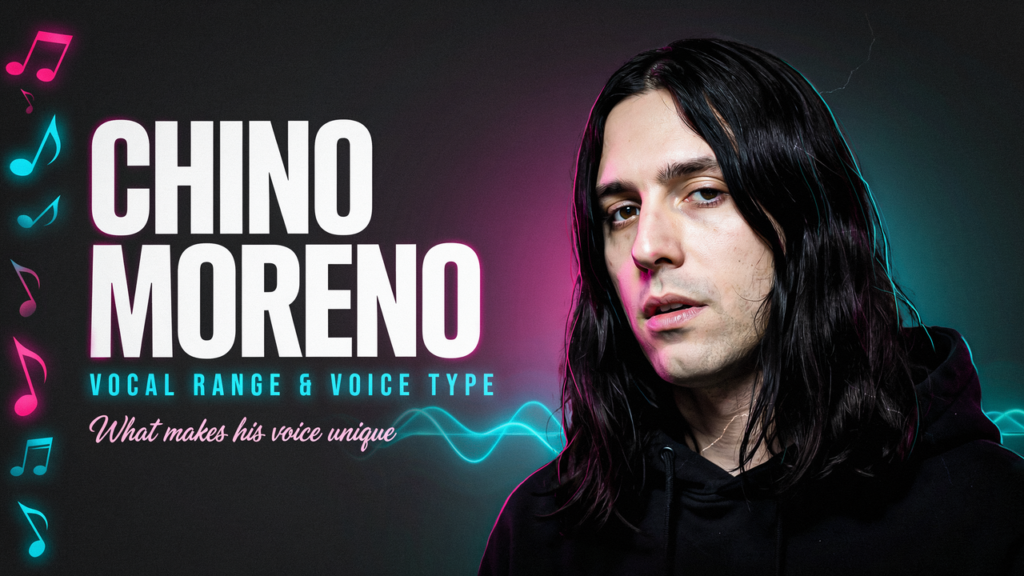
Chino Moreno’s Vocal Range at a Glance
Vocal range: approximately C2 – C6 (including screaming and full falsetto extensions) Voice type: Dramatic tenor Vocal registers in use: Chest voice, mixed voice, falsetto, vocal distortion/screaming Approximate span: Around 4 octaves across all registers Tessitura (comfortable melodic center): Roughly D3 to G4 Active career: 1988–present.
What Voice Type Is Chino Moreno?
Wikipedia classifies Moreno explicitly as a dramatic tenor — a specific subcategory within the tenor voice type that sits at the heavier, more powerful end of the spectrum rather than the light lyric end. The dramatic tenor has more weight and darkness in the mid-range than a lyric tenor, with the power to cut through dense instrumentation without the voice thinning out. In classical opera, dramatic tenors are associated with Wagnerian roles demanding stamina and power over agility; in Moreno’s context, it’s the quality that allows his melodic singing to hold its own against Deftones’ wall of distorted guitars without getting lost.
The dramatic tenor classification is interesting because it runs counter to the surface impression some listeners have of his voice, which emphasizes the light, airy falsetto passages. What the classification captures is the weight and resonance in his mid-range chest voice — the darkness that underlies even his softer passages and makes the quiet moments in songs like “Digital Bath” feel heavy rather than simply gentle.
For context on how a dramatic tenor differs from a lyric tenor or a baritone, the tenor vocal range page covers the full classification in accessible terms.
His Lower Register: The Chest Voice and Its Weight
Moreno’s chest voice floor sits around C2 in full vocal fry and lower-register screaming, though his practical melodic chest voice operates considerably higher — in the D3 to E4 range for most Deftones material. The lower limit in pure chest voice without distortion is probably closer to G2 or A2.
The dramatic tenor classification is most audible in the mid-to-upper chest range, where his voice carries a weight and darkness that most rock tenors don’t produce. On songs like “Be Quiet and Drive (Far Away)” from Around the Fur, the verse vocal sits in the E3–B3 range — a comfortable mid-chest tenor zone — and the heaviness of the tone grounds a relatively sparse arrangement in a way that a lighter tenor instrument wouldn’t.
His lower register across the Deftones catalog tends to be deployed for intimacy rather than power — soft, breathy passages that create tension through understatement before the dynamic climax of the chorus. This dynamic contrast between a quiet low register and an explosive upper range is one of the defining structural features of Deftones songs.
His Upper Register: Falsetto, Mix, and Screaming
Above the chest voice, Moreno’s instrument splits into two distinct upper registers that operate on completely different physical mechanisms.
The first is his falsetto and mixed voice — a high, often breathy head register that extends into the fifth octave and above, giving songs like “Change (In the House of Flies)” their ethereal, floating quality in the higher passages. His falsetto has a quality that reviewers frequently describe as dreamlike or shoegaze-adjacent: relatively thin and airy rather than the full-bodied head voice of a trained classical singer, but emotionally precise and consistent within its register. This is where the The Cure and Depeche Mode influences he cites show up most clearly in his voice — the post-punk tradition of using a light, slightly fragile high register as an emotional delivery mechanism.
The second is screaming — full-throated distorted vocal output that, at its most extreme, extends the range ceiling considerably while operating on entirely different physiology from his clean singing. Healthy screaming technique uses the false vocal folds and supraglottal structures to create distortion without damaging the true cords — the same principle as the distortion technique used by metal and hardcore vocalists generally. Moreno’s 2001 throat injury (inflammation of his right vocal cord and partial paralysis of his left cord), which caused him to miss four shows and required Chi Cheng to handle screaming duties while he managed the melodic lines, is direct evidence that he was pushing beyond safe limits at that point in his career.
The vocal range and singing techniques page covers how these different vocal production modes work technically, which is relevant context for understanding how Moreno’s range functions across both its melodic and distorted dimensions.
The Dynamic Range: What Makes His Voice Architecturally Distinctive
More than the raw range, what defines Moreno’s voice is the dynamic distance he can cover within a single song. Deftones’ song structures are built on a specific kind of tension and release — quiet, intimate verse vocal giving way to explosive chorus — and Moreno’s instrument is optimized for that architecture in a way that most rock vocalists’ aren’t.
The ability to sustain a genuinely soft, breathy chest voice or falsetto at low volume requires different technique than simple quiet singing. Many rock vocalists who turn down the volume also lose tonal quality, producing a thin, uncertain sound. Moreno’s quiet passages maintain consistent tone and emotional presence, which makes the contrast with the loud passages feel dramatic rather than merely louder.
Songs like “Digital Bath” from White Pony demonstrate this most clearly: the verse vocal is almost whispered, and the song doesn’t build to a full-volume scream — the emotional climax comes from tonal intensity at still-restrained volume rather than from sheer loudness. That’s a different kind of vocal skill from the belt-and-scream approach of most metal vocalists.
His influences — The Cure, Duran Duran, Depeche Mode, Smashing Pumpkins — all share this quality of using quiet-to-loud dynamic contrast as a compositional tool, and his vocal range in the functional sense (the distance between his quietest and loudest registers) reflects those influences as directly as any specific note ceiling.
The Throat Injury: A Cautionary Data Point
In 2001, at the height of Deftones’ commercial and critical peak following White Pony, Moreno developed a throat injury due to heavy screaming: inflammation of his right vocal cord and partial paralysis of his left vocal cord. This is a medically significant injury — vocal cord paralysis can permanently alter a voice’s range and quality if not managed carefully.
That Moreno continued performing (with Chi Cheng handling the screaming while Moreno managed the melodic lines) despite doctors recommending rest suggests the kind of pressure that touring puts on a performer’s health decisions. The injury is also a concrete illustration of why unsupported screaming technique carries real risk: the physical stress on the vocal folds and surrounding structures is considerable, and the injury Moreno sustained is not an unusual outcome for vocalists who rely on distorted vocal production without proper technique.
The piece on vocal health for singers covers the principles of protecting the voice across different styles of singing, including the specific considerations for singers who work in heavy vocal styles.
White Pony: The Album That Best Defines His Voice
White Pony (2000) is the recording that most fully documents what Moreno’s voice can do across its full range. The album spans from the heavy, distorted aggression of “Elite” (the Grammy-winning Best Metal Performance) to the dream-pop intimacy of “Digital Bath,” the shoegaze atmospheric “Teenager,” and the falsetto-led “Passenger” (featuring Maynard James Keenan of Tool). No single Deftones album covers more tonal ground, and Moreno’s voice is the thread connecting all of it.
“Passenger” is particularly notable for the range it documents: the duet with Keenan puts both vocalists’ instruments in direct comparison, and Moreno’s falsetto alongside Keenan’s tenor is one of the more interesting juxtapositions in alt-metal — two very different instruments, both working in the upper register, producing a genuinely distinctive blend.
His Side Projects: Different Contexts for the Same Voice
Moreno’s side projects — Team Sleep (2005), Crosses/††† (2011–present), and Palms (2013) — place his voice in contexts that deliberately strip away the metal dimension and emphasize different register qualities.
Crosses, his most active and long-running side project, makes dark electronic and synth-pop music that is essentially built around his mid-range chest voice and falsetto without any screaming. The comparison to The Cure and Depeche Mode is most direct in this context — Crosses records sound like alt-metal influences run through a post-punk/new wave filter, and Moreno’s voice in this register is warm, precise, and emotionally direct in ways that the Deftones context doesn’t always allow.
These projects are useful listening for anyone trying to understand the melodic foundation of his voice separate from the metal presentation.
FAQs About Chino Moreno’s Vocal Range
What is Chino Moreno’s vocal range?
His range spans approximately C2 to C6 across all registers — chest voice, falsetto, and screaming. His comfortable melodic range in clean singing sits primarily in the D3–G4 zone, which is the dramatic tenor’s natural tessitura.
What voice type is Chino Moreno?
Wikipedia classifies him as a dramatic tenor — the heavier, more powerful end of the tenor spectrum. His voice has enough weight in the mid-range to cut through dense distorted guitar arrangements without thinning out, while his falsetto gives him access to the upper fifth octave in melodic passages.
Did Chino Moreno’s throat injury affect his voice?
The 2001 injury — inflammation of his right vocal cord and partial paralysis of his left — was serious and required him to limit screaming during the remainder of that tour. Whether it had lasting effects on the upper range of his screaming register is difficult to assess from recordings alone, but his melodic voice has remained consistent across decades of performance.
What are Chino Moreno’s vocal influences?
He has cited The Cure, Depeche Mode, Duran Duran, Smashing Pumpkins, Bad Brains, and Faith No More as primary influences. The post-punk and new wave references explain the emphasis on dynamic contrast and the falsetto-led upper register that distinguishes him from most metal vocalists.
How does Chino Moreno’s voice compare to other rock tenors?
His dramatic tenor classification places him in different territory from lighter rock tenors like Chris Cornell or Thom Yorke. The weight and darkness of his mid-range, combined with the screaming capability and the dreamy falsetto upper register, produces a combination that doesn’t have many direct vocal equivalents in rock.
If you want to see where your own voice sits relative to Moreno’s range, the vocal range finder will map your notes, and the voice type test will give you a classification.
Erika Parker is a vocal analysis and singing education writer at Vocal Range Test. She focuses on vocal range testing, voice type analysis, pitch recognition, and singing tools for vocalists, musicians, choir singers, and beginners.