
Choral music divides voices into four standard parts: Soprano, Alto, Tenor and Bass — commonly abbreviated as SATB. Each part covers a specific range of notes and is written for a particular type of voice. Understanding choral vocal ranges helps singers identify their correct part, choose appropriate repertoire, and develop the areas of their voice most relevant to ensemble singing.
This guide covers all four choral voice parts with exact note ranges, Hz frequencies, typical characteristics and guidance on which part suits your voice.
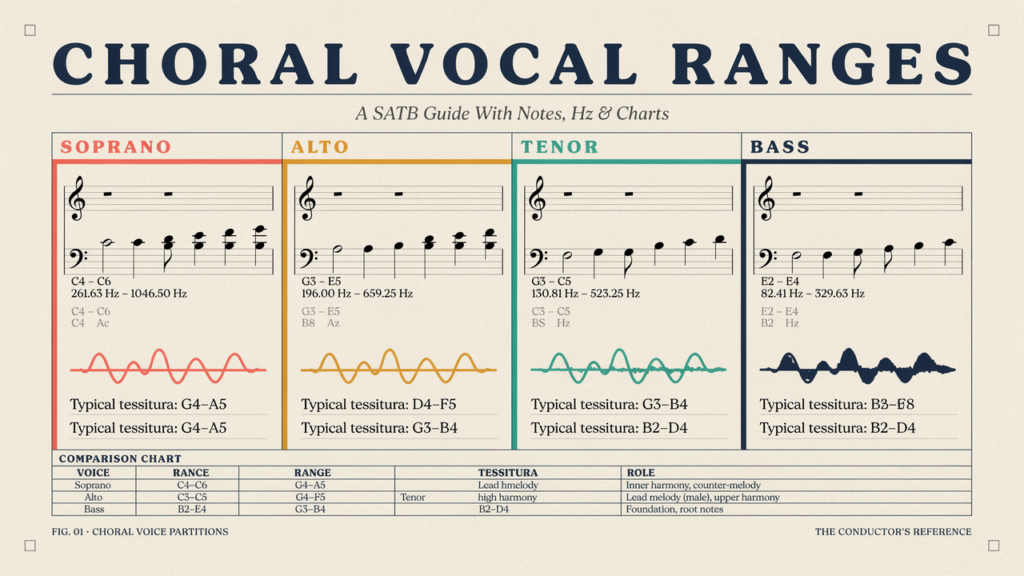
The 4 Choral Voice Parts — Quick Reference
| Part | Full Name | Gender | Range | Notes |
|---|---|---|---|---|
| S | Soprano | Female | C4 – G5 | Highest female part |
| A | Alto | Female | G3 – E5 | Lower female part |
| T | Tenor | Male | C3 – G4 | Highest male part |
| B | Bass | Male | E2 – C4 | Lowest male part |
These are the choral performance ranges — slightly narrower than solo voice ranges because choral parts are written to be comfortable for all singers of that type, not just the most skilled.
Soprano Choral Range
Choral Range: C4 – G5 Tessitura (Best Zone): E4 – E5 Typical Hz: 262 Hz (C4) to 784 Hz (G5)
The soprano is the highest choral voice part and typically carries the melody in most choral compositions. Soprano parts are written for female singers — specifically sopranos and the higher-ranged mezzo-sopranos.
Notes in range:
- Low end: C4 (Middle C, 262 Hz)
- Comfortable zone: E4 (330 Hz) to E5 (659 Hz)
- Upper limit: G5 (784 Hz)
What soprano choral parts demand:
- Clear, bright tone in the upper register (above E4)
- Ability to sustain notes in the F4–E5 zone for extended passages
- Strong breath support for long melodic phrases
- Blend easily with other soprano voices — individual tone must not dominate
Who sings soprano in choir:
- Classical sopranos (solo voice type: soprano)
- Higher-ranged lyric mezzo-sopranos who can comfortably reach G5
- Girls in treble choirs (unchanged voice)
Famous soprano choral works: The soprano part in Handel’s Messiah peaks around F5. Bach’s soprano cantata arias regularly touch G5. Mozart’s Requiem soprano solos reach A5 — above standard choral range.
Alto Choral Range
Choral Range: G3 – E5 Tessitura (Best Zone): B3 – C5 Typical Hz: 196 Hz (G3) to 659 Hz (E5)
The alto is the lower of the two female choral parts. In SATB writing, the alto provides harmonic support below the soprano melody and often carries inner harmonies that give choral music its richness and depth.
Notes in range:
- Low end: G3 (196 Hz)
- Comfortable zone: B3 (247 Hz) to C5 (523 Hz)
- Upper limit: E5 (659 Hz)
What alto choral parts demand:
- Full, resonant tone in the lower female register (below C4)
- Ability to blend under the soprano — supporting rather than dominating
- Reliable lower notes around A3–B3 that do not thin out
- Inner harmony awareness — alto lines rarely have the melody
Who sings alto in choir:
- Mezzo-sopranos (solo voice type: mezzo-soprano) — most common alto singers
- Contraltos — naturally suited to the lower end of the alto part
- Occasionally, lower-ranged sopranos can sing alto in less demanding repertoire
Note on “alto” vs “contralto”: In choral music, “alto” is a choral part. In solo classical voice classification, “contralto” is the voice type. All true contraltos sing alto, but most alto singers in practice are mezzo-sopranos. The two terms are often used interchangeably in non-specialist contexts.
Tenor Choral Range
Choral Range: C3 – G4 Tessitura (Best Zone): E3 – E4 Typical Hz: 131 Hz (C3) to 392 Hz (G4)
The tenor is the highest male choral voice part and often carries the melody in male-voice or mixed-voice choral writing. Tenor parts typically sit an octave below soprano parts in SATB scores.
Notes in range:
- Low end: C3 (131 Hz)
- Comfortable zone: E3 (165 Hz) to E4 (330 Hz)
- Upper limit: G4 (392 Hz)
What tenor choral parts demand:
- Bright, forward-placed tone in the E3–E4 zone
- Ability to reach G4 in chest voice or a well-supported mix without strain
- Clear diction and pitch accuracy — tenor lines are often exposed
- Stamina for sustained upper-register passages in demanding repertoire
Who sings tenor in choir:
- Classical tenors (solo voice type: tenor)
- High baritones who can comfortably reach G4 with clean tone
Tenor in SATB notation: In choral scores, the tenor part is often written in treble clef with an “8” below the clef symbol, indicating it sounds an octave lower than written. This is called the octave treble clef or vocal tenor clef.
Famous tenor choral works: The tenor in Verdi’s Requiem (“Ingemisco” aria) reaches B4, above standard choral range. Bach’s tenor arias regularly push G4–A4. Most standard SATB church music stays within E3–F4 for practical reasons.
Bass Choral Range
Choral Range: E2 – C4 Tessitura (Best Zone): G2 – G3 Typical Hz: 82 Hz (E2) to 262 Hz (C4)
The bass is the lowest choral voice part and provides the harmonic foundation of any choir. In SATB writing, the bass line determines the harmonic structure — the other three parts build above it.
Notes in range:
- Low end: E2 (82 Hz)
- Comfortable zone: G2 (98 Hz) to G3 (196 Hz)
- Upper limit: C4 / Middle C (262 Hz)
What bass choral parts demand:
- Deep, full, resonant tone in the G2–G3 zone
- Reliable low notes down to E2 that do not lose body or resonance
- Ability to blend with the baritone voices singing the same part
- Pitch accuracy in the lower register — bass inaccuracy is immediately audible to the whole choir
Who sings bass in choir:
- True basses (solo voice type: bass)
- Baritones — most choir “bass” singers are actually baritones who cover the lower end of the bass choral part
- Bass-baritones
Note on baritone vs bass in choir: In SATB choral music, there is no separate baritone part. Baritones typically sing the bass choral part, with the true basses covering the lower extremes. This is why some choirs use the term “bass/baritone” for this section.
Full SATB Range Chart
| Part | Low Note | Low Hz | High Note | High Hz | Span |
|---|---|---|---|---|---|
| Soprano | C4 | 262 Hz | G5 | 784 Hz | ~1.5 octaves |
| Alto | G3 | 196 Hz | E5 | 659 Hz | ~2 octaves |
| Tenor | C3 | 131 Hz | G4 | 392 Hz | ~1.5 octaves |
| Bass | E2 | 82 Hz | C4 | 262 Hz | ~1.75 octaves |
| Full SATB | E2 | 82 Hz | G5 | 784 Hz | ~3.5 octaves |
The full SATB system covers approximately 3.5 octaves from the lowest bass note to the highest soprano note.
SATB vs Solo Voice Type Ranges
Choral ranges are narrower than solo voice ranges because choral writing must be accessible to all singers of each part. Solo ranges include the extremes that only the most skilled singers can reach. Here is the comparison:
| Voice | Solo Range | Choral Range | Difference |
|---|---|---|---|
| Soprano | C4 – C6 | C4 – G5 | Choral stops a 4th lower |
| Alto/Contralto | F3 – F5 | G3 – E5 | Similar, choral slightly higher floor |
| Tenor | C3 – C5 | C3 – G4 | Choral stops a 4th lower |
| Bass | E2 – E4 | E2 – C4 | Choral stops a major 3rd lower |
Types of Choir by Voice Combination
SATB (Mixed Choir) Soprano, Alto, Tenor, Bass — the most common choir formation, used in the majority of choral music from Bach to Brahms to contemporary a cappella. Standard for church choirs, community choirs and professional ensembles.
SSA (Female Choir) Two soprano parts and one alto part. Used in women’s choirs and girls’ choirs. Repertoire includes folk arrangements, pop a cappella and original works for female voices.
TTBB (Male Choir) Two tenor parts and two bass parts (often labelled baritone and bass). Used in men’s choirs and barbershop quartets. Strong tradition in college glee clubs and military choirs.
SSAATTBB (Double Choir / 8-Part) Two full SATB choirs written separately. Used in Renaissance polyphony (Gabrieli, Palestrina) and large Romantic choral works. Produces a rich, multi-layered sound.
Treble Choir Sopranos and altos only — used in children’s choirs and some women’s ensembles. Often written in SSA format.
How to Find Your Choral Part
Identifying your correct choir part is slightly different from identifying your solo voice type. In a choir, the key question is not just what your range is but where your voice blends most comfortably with others.
Step 1 — Establish your comfortable range Use the free vocal range calculator to find your highest and lowest notes. This gives you the data needed to match your voice to a choral part.
Step 2 — Match your range to a part
- If your comfortable range is C4–G5 and you are female → Soprano
- If your comfortable range is G3–E5 and you are female → Alto
- If your comfortable range is C3–G4 and you are male → Tenor
- If your comfortable range is E2–C4 and you are male → Bass
Step 3 — Consider your tessitura Your tessitura — where your voice sounds best — matters more than your ceiling or floor. If you are a female singer who can reach G5 but your voice sounds most resonant and comfortable around B3–C5, you are more naturally an alto than a soprano.
Step 4 — Ask your choir director Experienced choral directors hear placement issues immediately. If you are uncertain between two parts, a 5-minute audition or even just singing a scale for your director will resolve it quickly.
Vocal Health in Choral Singing
Choir singing presents specific vocal health considerations different from solo singing:
Matching pitch vs volume — In a choir, blending matters more than projecting. Singers who push their volume to hear themselves over others are more prone to vocal fatigue. Train yourself to listen to the section while you sing.
Sustained rehearsals — Long rehearsals without adequate breaks tire the voice significantly. Drink water consistently throughout rehearsal and rest the voice after particularly demanding sessions.
Part assignment strain — Singing a part outside your comfortable range is a common cause of choir-related vocal problems. If your assigned part consistently feels too high or too low, speak to your director about reassignment or adjustment.
Warm-up before rehearsal — Many choirs begin rehearsal with a group warm-up. If yours does not, do 5 minutes of individual warm-up (lip trills, humming, gentle scales) before the rehearsal begins.
FAQs
What are the choral vocal ranges? The four choral vocal ranges are: soprano (C4–G5), alto (G3–E5), tenor (C3–G4) and bass (E2–C4). Together these cover approximately 3.5 octaves and form the SATB system used in most choral music.
What is the difference between choir vocal ranges and solo vocal ranges? Choral ranges are narrower than solo voice ranges because choral parts are written to be comfortable for all singers of that type. Solo ranges include the extremes only the most skilled singers can access. A soprano soloist might reach C6; a soprano choral part typically stays at or below G5.
What does SATB stand for? SATB stands for Soprano, Alto, Tenor, Bass — the four standard choral voice parts. It is the most common choir formation in classical and contemporary choral music.
What is the difference between alto and contralto in choir? In choral music, “alto” is a voice part — the lower female section in SATB writing. In solo classical voice classification, “contralto” is a voice type — the lowest category of female voice. All contraltos sing alto in choral contexts, but most alto singers are actually mezzo-sopranos. The terms are often used interchangeably in non-specialist settings.
Can a baritone sing bass in choir? Yes — and most do. In SATB choral writing there is no separate baritone part. Baritones cover the upper portion of the bass part while true basses cover the lower extremes. Many choirs label their lowest male section “bass/baritone” to reflect this reality.
What is the hardest choral part to sing? Tenor is often considered the most demanding choral part because it requires male singers to sustain notes in the upper part of the male range (around E4–G4) for extended periods. The soprano part is the highest-profile but its upper demands are more manageable relative to the natural soprano range.
What voice type sings alto in choir? Mezzo-sopranos are the most common alto singers in SATB choirs. True contraltos also sing alto, typically covering the lower end of the alto part. Occasionally, lower-ranged sopranos may sing second soprano/alto in less demanding repertoire.
Related page:
- Test your vocal range →
- SATB vocal ranges — detailed guide →
- Voice types explained →
- Soprano vocal range →
- Mezzo-soprano vocal range →
- Contralto vocal range →
- Tenor vocal range →
- Baritone vocal range →
- Bass vocal range →
- Alto vs contralto →
- Difference between soprano, alto, tenor and bass →
- Vocal warm-up exercises →
Erika Parker is a vocal analysis and singing education writer at Vocal Range Test. She focuses on vocal range testing, voice type analysis, pitch recognition, and singing tools for vocalists, musicians, choir singers, and beginners.