
Cyndi Lauper’s vocal range spans approximately C3 to C7 — a documented four-octave span — with a soprano instrument that the Songwriters Hall of Fame specifically cites as central to her identity: she is “recognized for her four-octave range and unique singing style.” Wikipedia reinforces it directly, describing her as “known for her powerful four-octave vocal range.” It’s one of the few cases where the official institutional biography and the Wikipedia article agree with the vocal analysis community on the basic number.
Born June 22, 1953 in Queens, New York, Lauper holds Grammy, Emmy, and Tony Awards — one of only about twenty artists to achieve that combination. She was the first female artist to have four top-five hits on the Billboard Hot 100 from a debut album (She’s So Unusual, 1983), and in 2013 became the first solo woman to win a Tony for Best Original Score for Kinky Boots. By most measures she belongs in the first tier of pop vocal history, yet the specific qualities of her voice — that combination of child-like sweetness, gritty rock power, and upper-register flight — remain genuinely difficult to categorize.
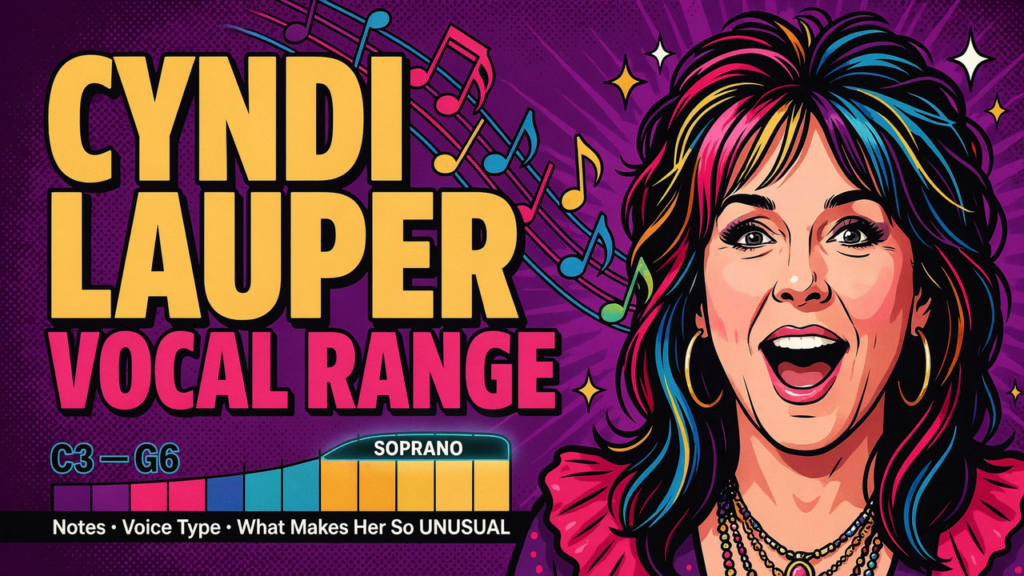
Cyndi Lauper’s Vocal Range at a Glance
Vocal range: approximately C3 – C7 (with upper register including whistle notes) Voice type: Soprano (lyric to dramatic, depending on analysis) Vocal registers in use: Chest voice, mixed voice, head voice, whistle register Approximate span: Around four octaves Tessitura (comfortable centre): Roughly E4 to B5 Active career: 1978–present.
What Voice Type Is Cyndi Lauper?
Multiple vocal analysis communities have attempted to pin down Lauper’s voice type, and the disagreement is instructive. Diva Devotee classifies her as a lyric soprano; SingersAvenue argues dramatic soprano; The Range Planet labels her “So Unusual Soprano” — which is essentially a joke classification acknowledging that the standard categories don’t quite fit.
The honest answer is that she sits somewhere between lyric and dramatic soprano, with characteristics of both. Her upper register has the brightness and agility of a lyric soprano; her lower and mid-range chest voice carries the weight and power associated with the dramatic type. The tonal versatility — her ability to sound simultaneously innocent and gritty, sweet and abrasive — is what makes simple categorization difficult.
The Diva Devotee profile captures her tonal range well: the voice “can switch from sounding innocent and sweet like a child to coarse and throaty like a rock star to crystal clear and dramatic like a diva extraordinaire all within the space of a lyric.” That description is more useful than any single voice type label, because it’s describing what makes her voice functionally unique rather than where she sits on a classification chart.
Her Lower Register: C3 and Chest Voice Depth
C3 sits comfortably within soprano range as a lower limit — it’s not the contralto depth that an unusually wide soprano would need to reach to justify a dramatic label, but it gives her enough chest voice presence in the lower third octave to ground ballads without thinning out.
Her lower chest register has a distinctive gravelly quality in certain contexts — particularly in her earlier recordings and in live performances where she pushed into a more rock-adjacent vocal style. This darker, rougher edge in the lower register is part of what generates the dramatic soprano classification: a lyric soprano typically sounds uniformly bright across the range, while Lauper’s chest voice carries character and texture that aren’t simply “light” and “bright.”
“Time After Time,” sitting primarily in the E4–B4 range, keeps her well within the soprano comfort zone, while some of her blues and rock-influenced material reaches further downward and draws on that grittier chest quality.
The Upper Register: Into the Sixth and Seventh Octave
This is where Lauper’s voice becomes exceptional even by soprano standards. The Range Planet documents her upper limit at Bb6, Diva Devotee at C7 — both sit in whistle register territory, above the conventional soprano ceiling of C6.
Whether the very highest extensions are produced as whistle notes (the same register used by Mariah Carey and Minnie Riperton) or as extreme head voice depends on precise phonation, which is difficult to determine from recordings alone. What’s established is that she can access the sixth octave in performance — not merely in vocal exercises — which places her in a small group of pop singers with documented high register extensions above soprano high C.
Her mid-upper range, sitting between C5 and G5, is where the voice sounds most naturally at home: bright, resonant, with the vibrato and tonal clarity that made her immediately identifiable from the first bars of “Girls Just Want to Have Fun” (1983). This zone is where her soprano instrument is fully realized rather than being tested at its limits.
The widest vocal range page gives context for where four-octave spans sit relative to the broader population of documented singers.
The Tonal Identity: What Makes Her Sound Unmistakable
More than any specific note ceiling, what defines Lauper’s vocal identity is the combination of qualities she can access within a single performance. The Diva Devotee analysis describes it as the ability to move from “innocent and sweet” to “coarse and throaty” to “crystal clear and dramatic” — and the crucial point is that these aren’t separate modes she switches between strategically. They emerge organically from how she phrases, where she places her breath, and how she shapes vowels.
The child-like quality in her upper register — a deliberate placement of the voice that creates a particular sweetness associated with her 1980s pop material — was partly a stylistic choice and partly a natural characteristic of how her soprano sits in the higher register. Lyric sopranos in the upper range naturally sound more open and bright; Lauper amplified this into a signature. It is, as Diva Devotee notes, “an acquired taste” — some listeners find it irresistible, others jarring.
The gritty, rock-forward quality in her lower chest voice is equally distinctive: it’s the sound of a soprano who grew up listening to Billie Holiday and Judy Garland, absorbed rock and punk influences, and found a way to bring both into the same instrument. The result is a voice that doesn’t sit comfortably in any one genre category, which is arguably why her career has been able to span them.
She’s So Unusual: The Album That Established Everything
Her 1983 debut She’s So Unusual remains one of the most commercially successful and critically significant debut albums in pop history. It was the first debut album by a female artist to produce four top-five hits on the Billboard Hot 100: “Girls Just Want to Have Fun,” “Time After Time,” “She Bop,” and “All Through the Night.” The album won the Grammy for Best New Artist at the 27th Grammy Awards in 1985 and was inducted into the Library of Congress National Recording Registry in 2019 for its “cultural, historical, and aesthetic importance.”
Each of those four singles demonstrated a slightly different facet of her range. “Girls Just Want to Have Fun” showcases the bright, vibrant mid-upper soprano that became her public identity. “Time After Time” is a ballad that relies on tonal warmth and emotional nuance rather than range demonstration. “She Bop” places the voice in a more rhythmically playful context where the quirky placement of her upper register is foregrounded. “All Through the Night” draws on more legato soprano technique. One album, four approaches to the same instrument.
Kinky Boots and the Songwriter’s Range
In 2013, Lauper won the Tony Award for Best Original Score for Kinky Boots — making her the first solo woman to win that category. The musical also won the Grammy for Best Musical Theater Album, giving her a combined Grammy/Tony achievement in the theatrical scoring world that placed her in extremely selective company.
Writing a complete musical score is a different kind of vocal and musical achievement than performing one. It requires understanding how voices work across different voice types, how melodic lines serve character and narrative, and how harmony creates emotional context. The fact that Lauper — a rock-pop singer trained entirely outside conservatory settings — produced a score that won both Broadway’s top prize and its Grammy equivalent says something about the depth of her musical intelligence beyond her own performing range.
She is one of approximately twenty artists to hold the Grammy, Emmy, and Tony simultaneously, a combination sometimes described informally as GET status (the subset of the EGOT that excludes film’s Oscar).
How Her Voice Has Evolved
Lauper’s voice in her seventies is audibly different from the early recordings: the extreme upper range has softened, the chest voice has settled into a slightly darker quality, and the overall instrument sits lower and fuller than it did on She’s So Unusual. This is the normal trajectory for a soprano voice aging — the light, bright upper register is usually the first thing to change, while the mid-range deepens and gains character.
Live concert footage from the 2010s and 2020s shows a voice that has adapted rather than declined: she transposes material where needed, leans more heavily on the rich chest-to-mid range that remains in full strength, and uses the residual upper register selectively rather than relying on it as a showcase. That’s intelligent vocal management rather than defeat.
For singers curious about how soprano voices typically change with age and how to manage that transition, the piece on does vocal range change with age covers the physiology in detail.
FAQs About Cyndi Lauper’s Vocal Range
What is Cyndi Lauper’s vocal range?
Her documented range spans approximately C3 to C7 — around four octaves. The Songwriters Hall of Fame, Wikipedia, and multiple vocal analysis communities all cite a four-octave range as one of her defining characteristics. Her upper extensions reach into the sixth or seventh octave depending on the source.
What voice type is Cyndi Lauper?
She’s a soprano — described variously as lyric soprano, dramatic soprano, or simply “unusual soprano” by different analysis communities. Her voice combines the brightness of a lyric soprano in the upper register with the weight and grit of a more dramatic instrument in the chest range, making standard classification somewhat imprecise.
Does Cyndi Lauper have whistle notes?
Multiple sources confirm access to the whistle register in her upper range, with documented notes in the sixth octave. Whether the highest extensions are produced as whistle notes or extreme head voice is debatable from recordings alone, but the upper register facility is well established.
What awards has Cyndi Lauper won?
She holds Grammy (Best New Artist, 1985; Best Original Score for Kinky Boots, 2013), Emmy, and Tony Awards — placing her among approximately twenty artists to achieve that combination. She was inducted into the Rock and Roll Hall of Fame and the Songwriters Hall of Fame, and has a star on the Hollywood Walk of Fame.
What made She’s So Unusual historically significant?
It was the first debut album by a female artist to produce four top-five hits on the Billboard Hot 100: “Girls Just Want to Have Fun,” “Time After Time,” “She Bop,” and “All Through the Night.” It was inducted into the Library of Congress National Recording Registry in 2019 and appears on Rolling Stone’s list of the 500 Greatest Albums of All Time.
Erika Parker is a vocal analysis and singing education writer at Vocal Range Test. She focuses on vocal range testing, voice type analysis, pitch recognition, and singing tools for vocalists, musicians, choir singers, and beginners.