
Cynthia Erivo’s vocal range spans approximately C#3 to D6 — around three octaves and one semitone — with an instrument that sits somewhere between a lyric soprano and a high mezzo-soprano depending on which qualities you weight most heavily. The Diva Devotee vocal profile, one of the more rigorous analyses available, places her at C#3–D6 with a tessitura centered around F4–F5 and describes her voice as having “a full and dark lower register, identifiable and weighty middle, and a booming and broad upper register.”
Born January 8, 1987 in Stockwell, London, Erivo trained at the Royal Academy of Dramatic Art (RADA) — where she later became a vice president — and has built one of the most celebrated careers in contemporary musical theatre and film. Her role as Celie in the Broadway revival of The Color Purple earned her the Tony Award for Best Actress in a Musical (2016), a Grammy for Best Musical Theater Album, and a Daytime Emmy. She received two Academy Award nominations for Harriet (2019) — for Best Actress and Best Original Song — and a third Oscar nomination for Wicked (2025). She is one of a small number of artists to have won a Grammy, Emmy, and Tony, needing only an Oscar win to complete the EGOT.
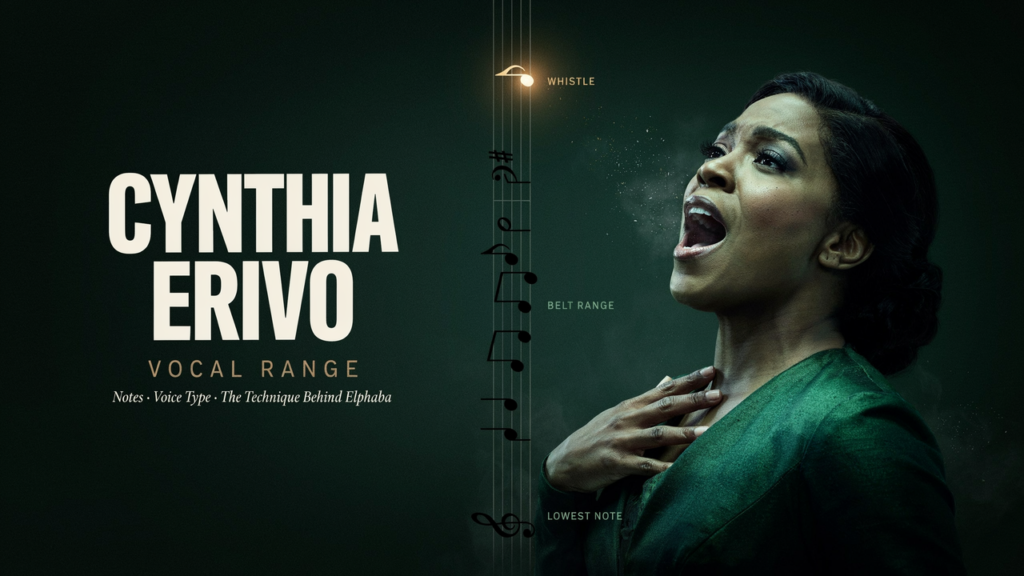
Cynthia Erivo’s Vocal Range at a Glance
Vocal range: approximately C#3 – D6 Voice type: Lyric soprano (with mezzo-adjacent qualities) Vocal registers in use: Chest voice, mixed voice/belt, head voice Approximate span: Around three octaves and one semitone Tessitura (comfortable centre): Roughly F4 – F5 Training: Royal Academy of Dramatic Art (RADA), London
The Voice Type Debate: Lyric Soprano or High Mezzo?
This is a genuine analytical question rather than a minor labelling dispute, and it’s worth engaging with properly.
The case for lyric soprano: Her upper register reaches D6, which is firmly in soprano territory — two full tones above soprano high C. Her timbre in the upper range is bright and forward-placed, with the resonance and projection associated with soprano instruments. Classic FM describes the majority of her roles as requiring “a soprano voice with the ability to cut through the orchestra and carry to the back of the hall.” The press and industry consistently call her a soprano.
The case for high mezzo: Her tessitura — the range where her voice lives most comfortably and most naturally — sits around F4–F5, which is mezzo-soprano territory rather than the higher tessitura of a pure lyric soprano. Her lower register has a darkness and weight that is more mezzo-adjacent than a typical lyric soprano’s bottom end. Multiple technical analyses argue she functions as a mezzo-leaning instrument with strong upper extension through mix and belt.
The most accurate answer is that she sits at the border — a voice with genuine lower weight that can access full soprano upper range through trained technique. In the musical theatre context, where the soprano/mezzo distinction is less codified than in classical opera, she functions as a soprano in repertoire terms while carrying mezzo-adjacent qualities in her mid-range. The mezzo-soprano vocal range and soprano vocal range pages cover both classifications in detail if you want to map where she sits between them.
Her Lower Register: C#3 and the Chest Voice Foundation
C#3 sits just above middle C — comfortable lower territory for a high mezzo or lyric soprano. What’s notable about Erivo’s lower register is not how far down it goes but the quality it carries there. The Diva Devotee analysis observes that the voice “has weight and color down to D3 and can be made round and projected beginning at E3” — meaning she produces genuine resonance in the lower third octave rather than the thin approximation that high sopranos often produce below middle C.
This lower chest voice weight is the quality that grounds her dramatic performances. “I’m Here” from The Color Purple — the climactic solo that effectively won her the Tony — sits primarily in the mid-fourth octave but draws its emotional power partly from the chest voice foundation that makes the higher passages feel earned rather than effortless. Erivo uses the lower register to establish presence before ascending, which is a dramatically intelligent use of the instrument.
The Middle Register: Where Her Voice Sounds Fullest
The Diva Devotee analysis notes that “mid-belts begin at F4” for Erivo — meaning the voice begins producing its most powerful, forward-placed resonance from the F just above middle C upward. This is where the “weighty middle” description applies: the voice in the F4–C5 zone has a fullness and authority that carries over large orchestra without microphone amplification.
For musical theatre performers, this mid-belt zone is the workhorse register. It’s where the majority of melodic material in contemporary musical theatre sits, and where vocal stamina matters most — the ability to produce that sound eight times a week without fatigue or deterioration. Erivo’s RADA training built the technical foundation for this stamina: breath support, vowel placement, and the mix technique (blending chest and head resonance) that sustains power in the belt zone without the vocal cord wear that pure chest belt produces.
Understanding how mix belt technique works is directly relevant here — the mixed voice page covers how chest and head resonance blend in the kind of belt Erivo uses for the climactic moments of “I’m Here” and “Defying Gravity.”
Her Upper Register: D6 and the Belt Ceiling
D6 is two tones above soprano high C — the benchmark for classical soprano range — and reaching it with the power and tonal quality Erivo demonstrates in performance places her in a genuinely small group of contemporary musical theatre sopranos.
“Defying Gravity” from Wicked is the most widely heard document of her upper range. The climactic belt at the end of the song requires a soprano (or high mezzo with soprano facility) to produce a powerful, open sound in the high fifth octave over a full orchestra. The requirement is not merely to reach the note — any trained soprano can hit E5 or F5 in practice — but to do it with the theatrical projection and emotional weight the moment demands, in a film context where the performance is recorded for permanent audio-visual record.
Her Grammy win alongside Ariana Grande for “Defying Gravity” as Best Pop Duo/Group Performance (for Wicked: For Good) in 2025 gives the upper-range work formal recognition beyond critical praise.
“I’m Here”: The Vocal Performance That Won the Tony
Before Elphaba, the role that established Erivo’s reputation was Celie in The Color Purple. The climactic solo “I’m Here” — a song about claiming one’s own existence and identity — is the kind of piece that can carry an entire show’s emotional weight on its own if delivered correctly, and Erivo’s performance became the defining moment of the Broadway revival.
Vocally, “I’m Here” is as demanding as it is emotionally exposed. It builds from an intimate, quiet opening in the lower-to-mid register through a series of expanding phrases to a full-voice climax in the upper fifth octave — the entire journey of the character compressed into a single song. Executing that arc eight times a week, with the same emotional presence each time, is the benchmark test for a stage soprano, and Erivo cleared it consistently enough to win the Tony, Grammy, and Daytime Emmy for the role.
RADA Training and What It Built
Erivo trained at the Royal Academy of Dramatic Art in London — one of the most prestigious dramatic training institutions in the world, though one known primarily for acting rather than music. Her vocal development happened in a theatrical context rather than a conservatory one, which is part of why her voice has the dramatic specificity and character-service quality it does: she learned to use her voice as an actor uses it, in service of text and character, rather than as a pure instrument to be demonstrated.
She has since returned to RADA as a vice president — a role that reflects both her professional standing and her commitment to the training traditions that shaped her instrument. The institution that trained her now counts her among its most distinguished alumni.
Wicked and Elphaba: The Role That Brought Global Attention
Playing Elphaba in the 2024 and 2025 film adaptations of Wicked extended Erivo’s reach to a global audience well beyond the Broadway and film-circuit audiences who already knew her work. The role is vocally demanding in specific ways: “Defying Gravity” requires a belt-capable soprano with strong upper register; “No Good Deed” demands dramatic intensity in the chest-to-mix transition; and “For Good” (as a duet with Ariana Grande) asks for tonal blend rather than solo power.
Erivo was the second Black woman to play Elphaba in a major production. Her own words on the performance illuminate the connection she drew between the character and broader experience: “I hope it’s a bit of a love letter to everyone who feels different, who feels out of place, to all of the Black women who have walked into rooms and felt like they haven’t been welcomed.”
That framing — the role as emotional testimony rather than vocal showcase — is consistent with how she approaches the voice throughout her career: always in service of meaning rather than demonstration.
FAQs About Cynthia Erivo’s Vocal Range
What is Cynthia Erivo’s vocal range?
Her documented range spans approximately C#3 to D6 — around three octaves and one semitone. Her comfortable working tessitura sits in the F4–F5 zone, where her voice produces its most natural power and resonance.
What voice type is Cynthia Erivo?
She’s most often described as a lyric soprano, though multiple technical analyses argue she functions more accurately as a high mezzo-soprano with strong soprano upper extension through trained mix and belt technique. Her tessitura and lower register weight are mezzo-adjacent; her upper range is soprano.
Where did Cynthia Erivo train?
She trained at the Royal Academy of Dramatic Art (RADA) in London, where she later became a vice president. Her vocal development was grounded in dramatic training rather than classical conservatory study, which shapes how she uses her voice as a character instrument.
What awards has Cynthia Erivo won?
She holds a Tony Award (Best Actress in a Musical, The Color Purple, 2016), a Grammy (Best Musical Theater Album, The Color Purple), and a Daytime Emmy. She has received three Academy Award nominations — two for Harriet (2019) and one for Wicked (2025). A Grammy win alongside Ariana Grande for “Defying Gravity” came in 2025. She needs an Oscar win to complete the EGOT.
How does Cynthia Erivo’s voice compare to Ariana Grande’s in Wicked?
Erivo (Elphaba) operates as the more belt-forward instrument, with her power centred in the mid-to-upper chest and mix belt. Grande (Glinda) sits higher and lighter with more coloratura soprano agility in the upper register. The roles are written to contrast those qualities, and the casting matched the voices to the characters with precision. For Grande’s range specifically, the Ariana Grande vocal range page covers her instrument in full.
Erika Parker is a vocal analysis and singing education writer at Vocal Range Test. She focuses on vocal range testing, voice type analysis, pitch recognition, and singing tools for vocalists, musicians, choir singers, and beginners.