
Damon Albarn’s vocal range spans approximately G2 to C5 — just over two octaves in practical performance — with a baritone instrument that sits at the darker, more conversational end of the male spectrum. The founder of Blur and co-creator of Gorillaz, born March 23, 1968 in Whitechapel, London, has built one of the most distinctive and deliberately used voices in British pop: a voice that shapes itself around character and atmosphere rather than technique demonstration, capable of moving from deadpan spoken delivery to melancholic falsetto without ever feeling like it’s reaching.
He has described his preferred vocal territory directly, in the context of his 2014 solo album Everyday Robots: “my more melancholic, introspective soulful side, which is where I love to sing.” That self-description captures the instrument’s centre of gravity better than any classification could — not a showcase voice, not a power voice, but a voice that serves mood and meaning with precision.
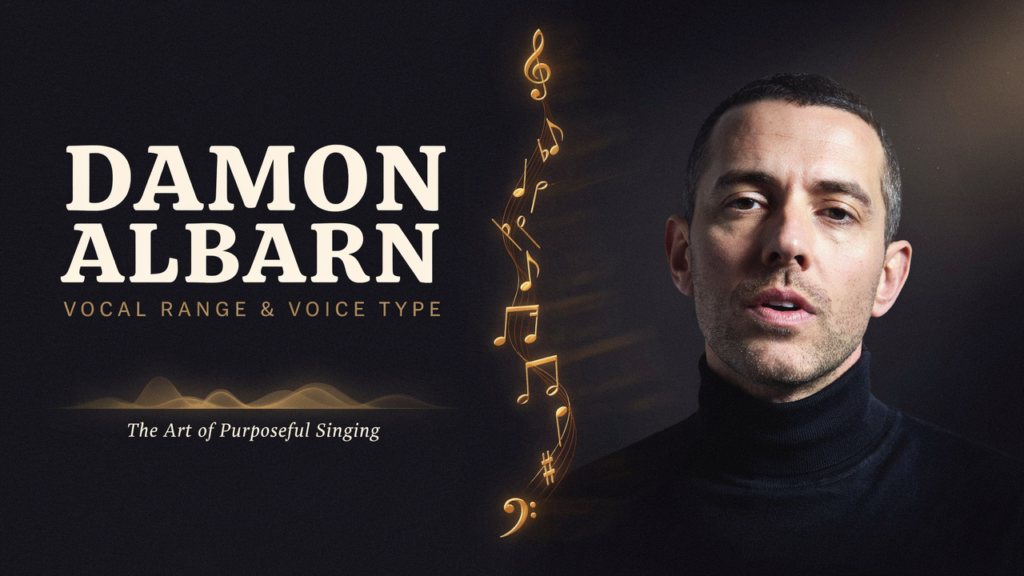
Damon Albarn’s Vocal Range at a Glance
Vocal range: approximately G2 – C5 Voice type: Baritone Vocal registers in use: Chest voice, mixed voice, falsetto, spoken/character delivery Approximate span: Just over two octaves Tessitura (comfortable centre): Roughly C3 to G4 Active career: 1988–present
What Voice Type Is Damon Albarn?
Albarn is a baritone — the most common male voice type, sitting between bass and tenor in the male vocal spectrum. His natural timbre is warm and slightly dark, with the quality that characterises a lyric baritone: not the deep resonance of a dramatic baritone or bass, but a relaxed, mid-weight instrument with warmth in the lower third octave and a comfortable ascent into the fourth octave.
What makes him unusual as a baritone is how deliberately he uses the voice’s character rather than its range. Most baritones in pop and rock push toward the upper end of their chest voice range for power and presence. Albarn frequently does the opposite — he sings in the lower-to-mid range of his baritone in a near-spoken, slightly nasal placement that creates intimacy and wry distance simultaneously. The Britpop accent singing that defined Blur’s early catalogue (“Girls & Boys,” “Parklife”) is the most extreme version of this: the voice as social character rather than musical instrument.
The baritone vocal range page covers where his voice type sits in the full male voice spectrum.
His Lower Register: G2 and Chest Voice Weight
G2 sits at the lower end of the baritone range — comfortable territory for the voice type, where Albarn can produce warm, grounded tone without effort. He doesn’t frequently descend to the floor of his range in performance, but his natural speaking voice placement in the C3–D3 zone gives his lower chest register a presence that anchors even his most understated deliveries.
The chest voice in the third octave is where much of Blur’s catalogue lives: the verses of “To the End,” the verses of “The Universal,” and large swathes of Gorillaz material sit in this lower-to-mid chest zone. The tone is warm, slightly husky in texture, and conversational in placement — which is precisely why it works as well as it does for lyric-forward material where the listener needs to hear the words rather than be impressed by the sound.
His Upper Register: Mix, Falsetto, and the Tenor Zone
Above the mid-third octave, Albarn accesses a mixed voice and falsetto that give him access to C5 territory — the upper fourth and lower fifth octave — without the forced quality that a heavier baritone instrument would produce there.
His falsetto is a significant part of his tonal palette. The Gorillaz wiki observes that his voice ranges “from baritone to falsetto,” and the most emotionally affecting moments in his catalogue frequently deploy this register: “On Melancholy Hill” from Gorillaz’ Plastic Beach, “To the End” from Blur’s Parklife album, and extended passages of Everyday Robots all use the falsetto as a texture for vulnerability and introspection rather than a demonstration of range.
This is a different use of falsetto than the athletic upper-register showcasing associated with pop tenors. Where a pop tenor’s falsetto is often the climactic high point of a song, Albarn’s tends to sit in the mid-range of a phrase as a colouristic choice — the voice going lighter and more breathy to signal emotional exposure rather than dramatic intensity. The head voice vs falsetto page covers the technical distinction between these registers that Albarn navigates across his catalogue.
The Character Voice: Britpop Accent Singing
Perhaps the most widely discussed aspect of Albarn’s vocal technique in British music criticism is his use of exaggerated Estuary English accent in Blur’s Britpop period — a deliberate adoption of working-class London speech patterns applied to pop singing as a kind of social commentary and genre statement.
“Parklife” is the fullest expression of this: the song’s speaking-vocal sections (performed by actor Phil Daniels) frame Albarn’s own singing, and together they constitute a kind of documentary of a specific British social type in the mid-1990s. Albarn’s singing on the Britpop albums — “Girls & Boys,” “Tracy Jacks,” “Charmless Man” — uses the accent not as a natural expression of his own background but as a character technique, deploying his voice as an actor deploys theirs.
This distinction matters technically. Singing in a deliberate accent involves different vowel shaping, different resonance placement, and different breath management than singing in one’s natural voice. Albarn’s facility with it — and his ability to shift completely between this mode and the more naturalistically emotional delivery of Blur’s later records and his solo work — reflects genuine vocal flexibility even within a relatively modest range span.
Opera and the Wider Voice
AllMusic describes Albarn as “a distinctive vocalist who fronted indie stalwarts Blur before diversifying with a host of projects ranging from trip-hop to opera” — and the opera work is worth taking seriously as a component of his vocal history.
His first full opera, Monkey: Journey to the West, debuted at Manchester International Festival in 2007. His second, Dr Dee — based on the life of the Elizabethan alchemist and philosopher John Dee — premiered in 2011 and was co-created with theatre director Rufus Norris. Both were composed by Albarn, meaning his vocal relationship to the material was that of composer rather than featured soloist, but the compositional choices in opera require a deep understanding of how voices work across their full range and in acoustic settings without amplification.
Writing for other voices — tenors, sopranos, baritones — and hearing those choices realised in performance is a different kind of vocal education than performance itself, and it has visibly influenced how Albarn conceives the voice in his own recordings. The Everyday Robots album, described by one reviewer as “soft-shoe sorrow,” has a compositional sophistication in its vocal writing that goes beyond standard singer-songwriter territory.
Blur, Gorillaz, and How Context Shapes the Voice
Albarn’s voice sounds different across his projects not primarily because the range is different but because the context shapes how the instrument is used. The baritone is the same; the deployment changes.
In Blur — particularly the Britpop era of Parklife (1994) and The Great Escape (1995) — the voice is foregrounded and character-driven, with accent, staccato phrasing, and deliberate plainness in the delivery. In the later Blur records — 13 (1999) and Think Tank (2003) — the voice becomes more emotionally exposed, with the accent largely dropped and the baritone used for genuine feeling rather than social observation.
In Gorillaz — operating behind the fiction of the cartoon band — the voice has a different relationship to its own identity. The anonymity of the project (initially at least) gave Albarn permission to be more melodic and less self-conscious, and the Gorillaz catalogue contains some of his most purely vocal performances: “On Melancholy Hill,” “Empire Ants,” “Feel Good Inc.” In Everyday Robots, the voice is at its most nakedly personal — the baritone without armour, doing what he described as leaning toward “my more melancholic, introspective soulful side.”
Across all of it, the voice is the same instrument in a slightly different costume.
His Awards and Career Context
Albarn has won six Brit Awards, two Ivor Novello Awards, and a Grammy — the Grammy coming through Gorillaz. He has been nominated for the Mercury Prize (for Everyday Robots in 2014). His output across Blur, Gorillaz, The Good the Bad and the Queen, his solo work, and his opera projects constitutes one of the most varied and sustained creative careers in British music.
For singers looking to understand the range he works in — or to test whether their own voice sits in baritone territory — the vocal range finder will map your notes, and the average vocal range page gives useful context for where a two-octave baritone span sits relative to the general population of singers.
FAQs About Damon Albarn’s Vocal Range
What is Damon Albarn’s vocal range?
His practical range spans approximately G2 to C5 — just over two octaves. His comfortable working territory across most of his repertoire sits in the C3–G4 zone, which is characteristic of a lyric baritone instrument.
What voice type is Damon Albarn?
He is a baritone — specifically a lyric baritone, with a warm, relatively relaxed instrument that sits at the mid-weight end of the male voice spectrum. His voice has more conversational warmth than dramatic weight.
How does Albarn’s voice work differently across Blur and Gorillaz?
The instrument is the same; the character is different. Blur’s Britpop era used deliberate Estuary English accent singing as social commentary. Gorillaz, operating behind the cartoon band fiction, allowed for more purely melodic delivery. His solo work as himself is the most emotionally direct use of the baritone.
Did Damon Albarn write and compose his operas?
Yes — Monkey: Journey to the West (2007) and Dr Dee (2011) are both composed by Albarn. He functioned as composer rather than featured soloist in these productions, which gave him a composer’s relationship to vocal writing across different voice types and acoustic contexts.
What is Albarn’s most vocally exposed performance?
Most critics and fans point to Everyday Robots (2014), his debut solo album, as the most personal and vocally direct work in his catalogue. He described it as leaning toward “my more melancholic, introspective soulful side, which is where I love to sing.” “On Melancholy Hill” from Gorillaz’ Plastic Beach is also frequently cited for its delicate falsetto delivery.
Erika Parker is a vocal analysis and singing education writer at Vocal Range Test. She focuses on vocal range testing, voice type analysis, pitch recognition, and singing tools for vocalists, musicians, choir singers, and beginners.