
Dan Vasc’s vocal range spans approximately C2 to C5 in clean singing, with additional upper extensions in falsetto and lower extensions in distorted metal technique — a spread that allows him to inhabit the deep resonance of a dramatic baritone in one phrase and ascend into natural tenor territory in the next. The Brazilian heavy metal singer and songwriter, born Daniel Vasconcelos on October 13, 1989, built a YouTube following of over 800,000 subscribers by doing something deceptively simple: taking well-known songs from any genre and delivering them with a voice that most listeners didn’t know existed.
His “Toss a Coin to Your Witcher” cover has over 27 million views. His “Amazing Grace” amassed 3.25 million views in its first month. Reaction videos from vocal coaches — including Ken Lavigne and others with significant followings — consistently highlight breath control, range, and the specific quality that one reviewer described as “starting in the baritone, moving into the tenor, bringing in the rocker growl.”
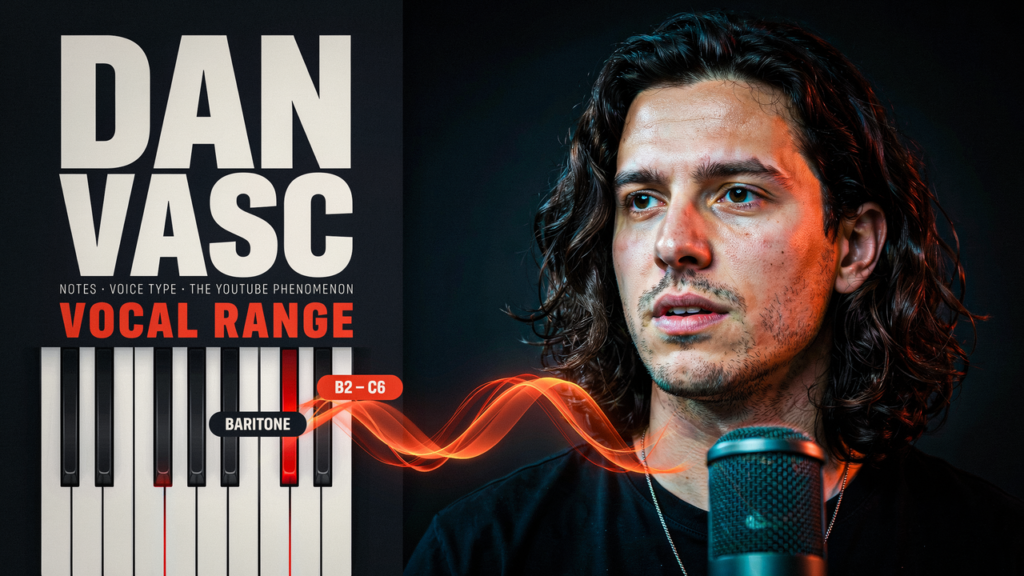
Dan Vasc’s Vocal Range at a Glance
Vocal range: approximately C2 – C5 (clean singing), with distortion and falsetto extensions Voice type: Dramatic baritone with tenor upper register Vocal registers in use: Chest voice, mixed voice, falsetto, vocal distortion/growl Approximate span: Around 3 octaves across all registers Tessitura (comfortable centre): Roughly E2 to A4 Background: Brazilian; began serious vocal training in 2007; independent YouTube artist
What Voice Type Is Dan Vasc?
The voice type classification question is genuinely interesting for Vasc because different observers reach different conclusions depending on which part of his range they’re responding to. A blind reaction video reviewer described the movement in his Amazing Grace performance as “starting in the baritone, moving into the tenor” — which is accurate as a description of his vocal arc within a single song, but doesn’t capture which is the natural home.
His speaking voice offers the clearest answer. One profile notes that “the deep, resonant baritone that you hear when he sings is not present in his speaking voice, which is a more high-pitched tenor and often excitable, almost juvenile.” This is a revealing data point: a singer whose speaking voice is naturally lighter and higher than their singing voice is typically doing something deliberate in the lower register — deepening the timbre, adding resonance, and pushing toward a more dramatic baritone sound than their natural instrument would default to.
The most accurate classification is probably a dramatic baritone: a voice with genuine lower register resonance and weight, capable of dark, full chest tone in the second and third octave, but with enough upper register facility to access tenor-adjacent notes cleanly when the material demands it. The baritone vocal range page covers the full classification in context.
His Lower Register: Baritone Depth and Dark Resonance
Vasc’s chest voice in the lower range — the territory that vocal coach Juliette Lyons described as reflecting “huge lungs” and “great breath support” — is the foundation his YouTube reputation is built on. Songs like “Amazing Grace” and “Nessun Dorma” open in this lower baritone zone, where the voice carries the kind of dark, authoritative resonance that makes hymns and operatic arias feel appropriately weighty.
The comparison to Disturbed’s cover of “Sound of Silence” that reviewers make repeatedly is instructive: David Draiman’s voice also opens in a low, deliberate baritone before building dynamically upward. The “formula” both performances share is using a relatively dark, slow-building lower register as a structural device — establishing depth before ascending — and it works because the lower register has genuine quality rather than being a strained approximation.
Vasc’s metal band work with Fearless — including the 2019 album Chronicles of Ancient Wisdom — gives him additional lower-register texture through distortion and growl techniques. These are produced through different physiology than clean chest singing (false vocal fold engagement rather than true cord vibration) and extend the perceived lower range further while adding the sonic character associated with metal performance.
The Baritone-to-Tenor Transition: His Most Distinctive Technical Quality
What separates Vasc from a competent heavy metal vocalist is the range arc his performances cover within a single song. The “Amazing Grace” performance that went viral demonstrates this most clearly: reviewer E.A. Curran noted that “in verse three he sings an octave higher in a natural, beautiful tenor with no difficulty whatsoever.”
Moving a full octave upward during a performance — from a chest-voice baritone phrase to a tenor-register phrase — while maintaining consistent tonal quality and avoiding the break or thinning that typically marks this transition in an undertrained voice, is a genuine technical accomplishment. It requires both registers to be well-developed and for the passaggio — the transition zone between them — to be navigated smoothly.
This is the specific quality that vocal coach Ken Lavigne praised in his reaction to Vasc’s “Nessun Dorma” cover. “Nessun Dorma” is a tenor aria, written for a voice that naturally lives in the fourth octave and reaches into B4 and A4 on the climactic “Vincerò!” — territory that a pure baritone would find genuinely difficult to produce with operatic quality. Vasc’s ability to deliver it convincingly indicates a trained voice rather than simply a powerful one.
Understanding how the passaggio — the break between chest and head register — works technically is covered in the how to transition smoothly between chest voice and head voice page, which maps the exact kind of register navigation Vasc’s performances demonstrate.
The Role of Training
Multiple vocal coaches and reviewers have noted that Vasc’s technique reflects “serious training” — and this is worth examining because his origin story (independent YouTube artist, failed record label negotiations, career built from scratch after his father’s death in 2017) might suggest a purely self-taught voice.
His official biography states he began working seriously on his singing in 2007, before the YouTube career. His connection to the concept album The Omens of Death — which featured the late Christopher Lee — came through producer Juan Aneiros taking notice of him through his work with Fearless, suggesting his technical level was already sufficient to attract professional attention in the metal world. The vocal coach community on YouTube, which is famously discerning and often brutally honest, has consistently praised rather than critiqued his technique.
The specifics of his training background aren’t publicly documented in detail, but the technical evidence across his performances — clean passaggio navigation, consistent vibrato, controlled distortion that doesn’t appear to damage the clean voice, and the breath support required for sustained classical material — all point to systematic development rather than purely intuitive singing.
Viral Reach and the YouTube Model
Vasc’s career trajectory is a case study in what it means to build an audience by matching a distinctive voice to high-recognition material across genres. His most-viewed covers work because they offer something specific: a voice with genuine operatic and classical training credentials, performing in contexts (metal, gaming soundtracks, folk) where that level of vocal development is genuinely unusual.
“Toss a Coin to Your Witcher” went viral immediately after The Witcher’s second episode aired in 2019, at a moment when fans of the show were searching for versions of the bard’s song. Vasc’s cover — which applied full metal production and his dramatic baritone-to-tenor arc to a song originally performed in a gentle folk style — captured the zeitgeist and accumulated 27 million views. It introduced a large new audience to a singer they had never heard of.
The subsequent growth to 800,000+ subscribers came through the same approach applied consistently: 18 videos with over a million views each, and ten with over two million, across a catalogue that spans folk, Disney, Broadway, opera, and metal. The voice is the constant; the genre is the variable.
Notable Vocal Performances
Toss a Coin to Your Witcher (The Witcher cover): Over 27 million views. The defining viral moment that established his YouTube reach. Demonstrates the baritone-to-tenor arc in a widely accessible pop-cultural context.
Amazing Grace (rock arrangement): 3.25 million views in the first month of release. The performance that drew the most vocal coach reactions and demonstrated both classical technique and metal power in explicit combination.
Nessun Dorma (Puccini): The classical benchmark performance, covering one of the most demanding and recognisable tenor arias in the repertoire. Praised specifically by vocal coaches including Ken Lavigne for technical accuracy.
Gethsemane (Jesus Christ Superstar): Described by one reviewer as “the most wrenching, dramatic cover I’ve ever seen.” The song’s dramatic arc — from mid-range verse to climactic high note — maps directly onto his natural voice’s strengths.
I’ll Make a Man Out of You (Mulan): A high-energy metal arrangement of the Disney song that showcases the upper register and distortion techniques.
How His Voice Compares to Similar Artists
The Disturbed comparison that reviewers repeatedly invoke — specifically to David Draiman’s “Sound of Silence” — identifies something real about the structural approach both voices use: slow-building baritone opening, dramatic ascent, climactic power. Both voices also combine genuine tonal beauty in clean singing with controlled aggression in metal technique.
The difference is timbre: Draiman’s voice has a darker, more aggressive chest quality throughout, while Vasc’s moves more visibly between the operatic and the metal, covering a wider stylistic range within a single performance.
For context on where other vocalists with similar dramatic baritone-to-tenor range profiles sit, the Josh Groban vocal range page offers a comparison in the classical crossover space, and the David Draiman vocal range page covers the specific comparison that reviewers most frequently make.
If you want to test your own range and find out whether you share Vasc’s baritone foundation or sit differently in the male vocal spectrum, the voice type test will give you a classification.
FAQs About Dan Vasc’s Vocal Range
What is Dan Vasc’s vocal range?
His range spans approximately C2 to C5 in clean singing — around three octaves — with distortion and growl extending the perceived lower range further and falsetto adding upper extensions. His comfortable working range in clean performance sits primarily in the E2–A4 zone.
What voice type is Dan Vasc?
He’s a dramatic baritone with a well-developed upper register that allows him to access tenor-adjacent material. His speaking voice is naturally lighter and higher than his singing voice, suggesting his baritone sound involves deliberate timbral deepening and heavy chest resonance.
How did Dan Vasc build his YouTube following?
He began posting weekly cover videos in October 2017, with only 4,000 subscribers at the time, after failed negotiations with record labels and following the death of his father. His “Toss a Coin to Your Witcher” cover accumulated 27 million views after going viral in 2019, and consistent posting across multiple genres built his subscriber base to over 800,000.
Is Dan Vasc classically trained?
He began serious vocal training in 2007 and has been praised by multiple vocal coaches for technically accurate delivery of classical material, including Puccini’s “Nessun Dorma.” His specific training background isn’t fully documented publicly, but the technical evidence across his performances — particularly his clean passaggio navigation and vibrato control — indicates systematic vocal development.
What is Dan Vasc’s most popular video?
His cover of “Toss a Coin to Your Witcher” from the Netflix series The Witcher has over 27 million views, making it by far his most-viewed video. His cover of “Amazing Grace” with a rock/metal arrangement is his most discussed in vocal coach reaction contexts.
Erika Parker is a vocal analysis and singing education writer at Vocal Range Test. She focuses on vocal range testing, voice type analysis, pitch recognition, and singing tools for vocalists, musicians, choir singers, and beginners.