
Ethel Cain’s vocal range spans approximately A2 to E5 — around two and a half octaves — with a voice that sits at the darker, more atmospheric end of the female vocal spectrum: haunting in its lower passages, capable of soaring in its upper register, and shaped by an upbringing in Southern Baptist church choir that is as present in her sound as any formal training could produce. Born Hayden Silas Anhedönia on March 24, 1998 in Tallahassee, Florida, she came out as a trans woman on her 20th birthday in 2018 and shortly afterward began writing the material that would become Preacher’s Daughter (2022) — one of the most critically acclaimed debut albums of recent years, described as “alternative slowcore with gospel, rock, folk, doom metal, and dark ambient influences.”
Barack Obama included “American Teenager” from the album on his 2022 year-end favourites list. The record garnered a cult following and considerable critical praise. Behind all of it is a voice shaped by the specific conditions of her childhood — church choir, Gregorian chant, Karen Carpenter, horror films watched through stair slats, and the particular weight of Southern Baptist religiosity turned against itself.
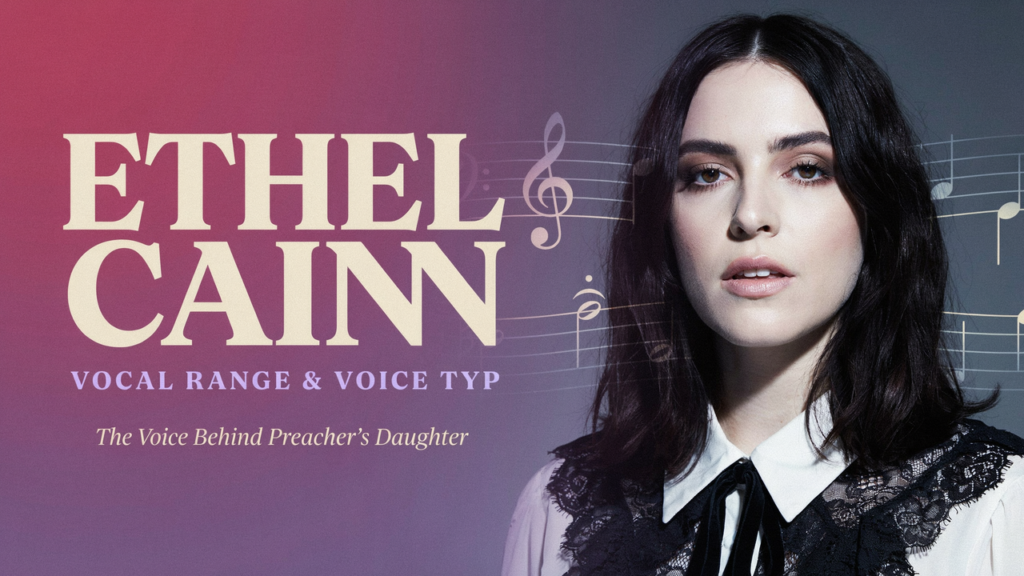
Ethel Cain’s Vocal Range at a Glance
Vocal range: approximately A2 – E5 Voice type: Soprano (with mezzo-adjacent lower register qualities) Vocal registers in use: Chest voice, mixed voice, head voice/falsetto Approximate span: Around 2.5 octaves Tessitura (comfortable centre): Roughly D3 to C5 Active career: 2017–present
What Voice Type Is Ethel Cain?
The voice type question for Cain is similar to the one that arises for other artists whose sound prioritises atmosphere over technical display — the voice serves the music and the character before it serves classification. TikTok vocal analyses describe her as a soprano; others note the mezzo-adjacent weight in her lower and mid register. The most honest answer is a soprano with unusual lower register depth and a deliberately restrained production approach that keeps the full technical extent of the voice partially obscured.
Her church choir background is relevant here. Southern Baptist choral singing trains singers across a wide dynamic range — from congregational hymns to more demanding gospel material — and it builds a particular kind of vocal flexibility that doesn’t follow the classical soprano/mezzo division neatly. The choir experience gave her technical grounding without the classical conservatory context that would produce clearer voice type categories.
The soprano vocal range and mezzo-soprano vocal range pages together give context for where her instrument sits relative to the two classifications she straddles.
Her Lower Register: A2 and the Gothic Depth
A2 is the documented lower note from vocal analysis content — a pitch that sits in baritone territory for male voices and is unusually low for female voice types. In Ethel Cain’s context, this lower range serves the atmospheric darkness of her Southern Gothic aesthetic: the hushed, gravelly quality of her lower chest voice contributes to the sense that the music is speaking from somewhere subterranean, personal, and slightly dangerous.
Her lower register isn’t primarily a technical showcase; it’s a tonal palette. When she drops into the lower third octave in quieter passages of Preacher’s Daughter, the effect is intimate in the way that a whisper is intimate — the listener leans toward the voice rather than the voice projecting outward. This dynamic, where quieter means more intense rather than less present, is a specific aesthetic choice that requires genuine breath support and cord control to execute rather than simply receding into inaudibility.
The Gregorian chant influence she has cited is audible in this lower register: chant is produced in a forward, resonant placement at relatively low pitches, and the way Cain’s voice sits in the low-to-mid range has some of that modal, resonant quality.
Her Upper Register: Soaring Through the Gothic Atmosphere
The upper end of Cain’s range — estimated around E5 in head voice — is where the “haunting” quality that critics consistently invoke becomes most audible. The voice opening up into the upper register doesn’t function as a climactic belt in the conventional pop sense; it functions as an emotional breaking point, a moment when the emotional pressure of the lyric exceeds what the lower register can contain and the voice ascends into something more exposed.
“Family Tree” has been cited in fan vocal analysis for its mid-range belts, described as “full and pretty.” The voice in these passages has warmth and substance rather than the thin brightness of an untrained soprano pushing into the upper register — a quality consistent with a voice that developed through sustained choral singing rather than sheer natural ability.
The production context of her recordings shapes how the upper register lands. Heavy reverb, layered vocals, and dense sonic atmospheres mean that individual high notes are often more textural than demonstrative — they sit within the arrangement rather than cutting above it, which produces a different listening experience from more conventionally transparent pop production.
Church Choir, Gregorian Chant, and Karen Carpenter
The specific vocal influences Cain has cited and that have been documented in profiles of her work are worth examining for what they built technically.
Southern Baptist church choir taught her to sustain tone across extended phrases, to use breath as the primary vehicle of emotion, and to navigate from intimate to expansive dynamics within a single phrase. It also gave her the gospel ornamental vocabulary — the small decorations and pitch bends at the end of phrases — that appear in her recorded work without ever sounding like conscious technique.
Gregorian chant exposure — the “diet of Christian music and Gregorian chants” that Vogue documented — cultivated a relationship to the voice as a resonant, sustained instrument rather than a flexible, agile one. Chant doesn’t bend to the melody; the melody serves the resonance. This orientation toward sustained tone rather than ornamentation is audible in how Cain handles long phrases.
Karen Carpenter — her documented childhood fascination — is a specific and revealing reference. Carpenter was a contralto with exceptional lower register warmth and an unusually natural, unforced quality to her delivery; her voice never appeared to be performing. Cain’s voice has some of that same quality: the sense that you’re hearing something unguarded, not something prepared.
Preacher’s Daughter and the Voice as Character
The debut album functions as a concept narrative — the story of Ethel Cain, a twenty-year-old trans woman in a 1991 Southern Baptist community. The voice throughout the album is not simply a delivery mechanism for the story; it is the story, in the same way that a gothic novel’s prose style is as much a part of the text as its plot.
The hushed tones in the quieter passages convey vulnerability and surveillance — the sense of someone speaking in a space where being overheard has consequences. The soaring passages convey the opposite: the release of something held too long. The way the voice moves between these modes is structurally identical to how Southern Gothic fiction moves between domestic restraint and eruption.
This is a different use of vocal range from pop or classical performance. Cain uses the full span of her range — low to high — as emotional architecture for the album’s narrative arc rather than as technical demonstration. The how vocal range affects singing page covers how range functions as an expressive tool in this way, rather than simply as a measurement.
FAQs About Ethel Cain’s Vocal Range
What is Ethel Cain’s vocal range?
Her documented range spans approximately A2 to E5 — around two and a half octaves. Her A2 lower note is documented in fan vocal analysis; her upper register reaches into the fifth octave in head voice passages across the Preacher’s Daughter album.
What voice type is Ethel Cain?
She’s most often classified as a soprano in vocal analysis communities, though her lower register has a mezzo-adjacent weight. Her voice sits at the border between the two classifications, with a soprano’s upper range and a darker, more resonant quality in the lower register than a pure lyric soprano typically produces.
Where did Ethel Cain develop her singing?
Her primary vocal development came through the Southern Baptist church choir where her father was a deacon — a foundation she has described and that multiple profiles have documented. She also began studying classical piano at age 8 and has cited Karen Carpenter and Gregorian chant as early influences.
Is Ethel Cain a trans artist?
Yes — Hayden Silas Anhedönia publicly came out as a trans woman on her 20th birthday, March 24, 2018. Her trans identity and her childhood departure from her Southern Baptist community are central to the narrative of Preacher’s Daughter.
What is the significance of “American Teenager”?
“American Teenager” from Preacher’s Daughter was included on Barack Obama’s 2022 year-end favourites list, broadening the album’s reach significantly. The song is an anti-war single that uses the iconography of American patriotism against itself — consistent with the broader Southern Gothic project of the album.
Erika Parker is a vocal analysis and singing education writer at Vocal Range Test. She focuses on vocal range testing, voice type analysis, pitch recognition, and singing tools for vocalists, musicians, choir singers, and beginners.