
Eva Noblezada’s vocal range spans approximately A3 to E5 — just over an octave and a half in her primary working register, with chest belt extensions above and head voice access further up — with a mezzo-soprano instrument that critics consistently describe as “enchanting” and “versatile.” Born Eva Maria Noblezada on March 18, 1996 in San Diego, California, of Mexican-Filipina American heritage, she made her professional debut at 17 in the West End revival of Miss Saigon (2014) and has since accumulated a Grammy Award (Hadestown original Broadway cast recording), two Tony Award nominations (Miss Saigon Broadway, Hadestown), and a WhatsOnStage Award for Best Actress in a Leading Role in a Musical.
She is, in other words, one of the most decorated young musical theatre voices of her generation — and what she has done with a mezzo-soprano instrument in roles demanding both dramatic power and emotional vulnerability is the core of what makes her technically interesting.
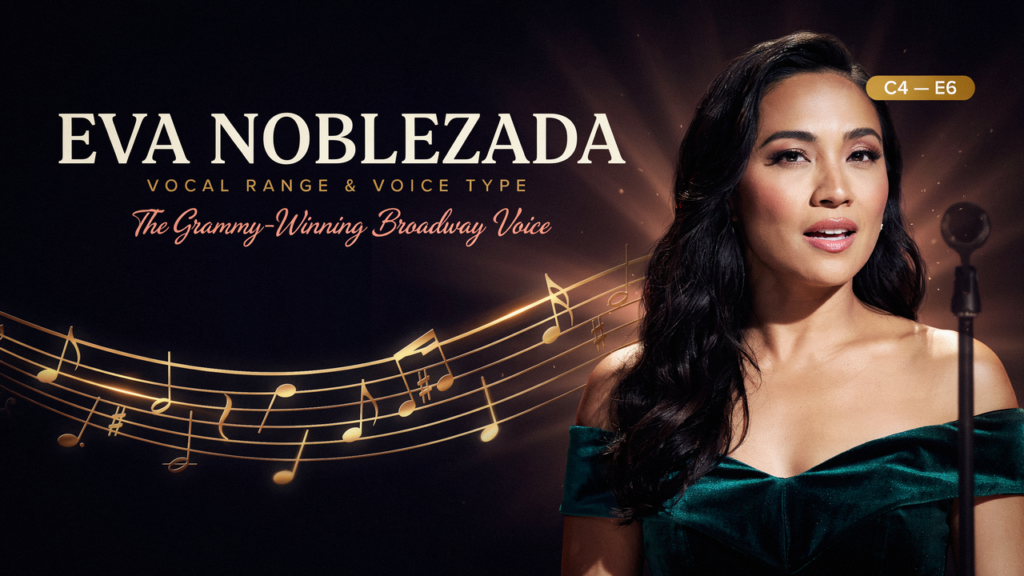
Eva Noblezada’s Vocal Range at a Glance
Vocal range: approximately A3 – E5 (practical range), with extensions in chest belt and head voice Voice type: Mezzo-soprano Vocal registers in use: Chest voice, mixed voice/belt, head voice Approximate span: Around 1.5–2 octaves in primary working range Tessitura (comfortable centre): Roughly D4 to B4 Active career: 2013–present
What Voice Type Is Eva Noblezada?
Multiple independent sources classify Noblezada as a mezzo-soprano — the YLWRNGR profile describes her “mezzo-soprano voice” as “enchanting, filling the room with light and warmth,” and the Musical Manda review of her Crazy Coqs cabaret show notes that “if you listen to her voice on cast recordings of Hadestown and Miss Saigon I think you’d probably class her as mezzo but she is very versatile.”
The mezzo-soprano in musical theatre — particularly in the contemporary Broadway idiom — is defined as much by timbre and tessitura as by raw range. Noblezada’s voice has the characteristic warmth and weight in the mid-range belt zone that distinguishes mezzo instruments from higher sopranos: it’s a voice that sounds most natural and authoritative in the C4–B4 range, with a chest belt that carries real emotional weight rather than the lighter, more floated quality of a lyric soprano.
The roles she has been cast in confirm this. Kim in Miss Saigon is conceived as a belt-capable mezzo role; Eurydice in Hadestown requires a voice that can navigate between intimate, fragile passages and full-voiced emotional climaxes. Both sit in mezzo territory rather than soprano.
The mezzo-soprano vocal range page covers the full classification in detail.
Her Lower Register: Warmth and Mid-Range Authority
The lower end of Noblezada’s practical range — around A3 to C4 — is where the mezzo warmth is most present. Her chest voice in this zone has a rounded, full quality that gives dramatic dialogue-adjacent passages their emotional weight. In quieter, more exposed moments of the Hadestown material — songs like “Wait for Me” and “All I’ve Ever Known” — the lower passages create intimacy and vulnerability rather than power, which requires the voice to sustain tone at soft dynamics without losing presence.
This quality — tonal presence at low volume — is a specific skill separate from simply having a low voice. Many singers can produce volume; producing warmth and presence while being quiet enough to convey a whispered confession is more technically demanding.
Her early idol Amy Winehouse — identified in the Crazy Coqs cabaret review as a favourite — is a useful reference for the emotional orientation of this lower register. Winehouse’s voice had similar qualities: warmth, directness, and an emotional nakedness in the mid-to-lower range that prioritised feeling over technique.
Her Upper Register: Belt and the Dramatic Peak
Noblezada’s belt ceiling — the upper limit of her chest/mix register — sits in the E5 zone, with the emotional climaxes of Miss Saigon and Hadestown placing her in the upper fourth octave repeatedly across sustained performance runs.
Kim’s material in Miss Saigon requires the voice to build dynamically across long scenes, sustaining belt-level intensity in climactic moments that come after extended dramatic arcs. Doing this eight times a week — which Noblezada did across both the West End and Broadway runs — is the measure of whether a voice is genuinely built for the role rather than capable of it on a good day. Her consistent critical praise across both productions indicates the former.
The Hadestown material for Eurydice is technically different: quieter, more intimate, and requiring emotional agility rather than sheer belt power. The juxtaposition between these two roles — both mezzo, both demanding, but in completely different ways — demonstrates the range of her instrument’s capabilities beyond the raw note ceiling.
The how to belt page covers the technical principles behind sustainable belt technique, which is directly relevant to how voices like Noblezada’s manage the physical demands of eight shows a week.
From Jimmy Awards to Broadway: A Compressed Timeline
The speed of Noblezada’s professional ascent is worth documenting as biographical context. In 2013, at 17, she was a student at the Northwest School of the Arts in Charlotte, North Carolina, performing in local productions and competing in the National High School Musical Theatre Awards (the Jimmy Awards) at New York’s Minskoff Theatre — nominated for her role in Footloose and reaching the finals with “With You” from Ghost.
That single performance was noticed by a casting director. The following year, she was making her professional West End debut as Kim in Miss Saigon — one of the most demanding lead soprano/mezzo roles in the contemporary musical theatre repertoire. She was 17 at the time of the Jimmy Awards, 18 at her West End debut.
This compressed timeline — from high school competition to West End lead in under a year — is unusual even by the standards of musical theatre, where prodigious young talents occasionally emerge. What it required was a voice already at professional standard without the benefit of conservatory training or years of professional development.
Grammy, Tony Nominations, and the Hadestown Legacy
The Hadestown original Broadway cast recording won the Grammy for Best Musical Theater Album in 2020. As Eurydice — one of the central characters in the show — Noblezada’s vocal contribution is integral to the recording rather than peripheral.
Her two Tony Award nominations — for Miss Saigon (Broadway) and Hadestown — represent recognition in the Best Leading Actress in a Musical category for two very different types of mezzo roles in two very different productions, demonstrating the breadth of what her voice can serve rather than typecast repetition.
More recent credits — the Broadway revival of Cabaret and The Great Gatsby on Broadway — demonstrate continued development rather than career consolidation, with each new production requiring different calibrations of the same instrument.
FAQs About Eva Noblezada’s Vocal Range
What is Eva Noblezada’s vocal range?
Her practical working range spans approximately A3 to E5, with the most natural and authoritative zone in the D4–B4 area. Her chest belt and head voice extend beyond this practical working range in both directions.
What voice type is Eva Noblezada?
She is a mezzo-soprano — the classification that appears consistently across critical reviews and analysis of her work in Miss Saigon and Hadestown. Her warm, weighty mid-range and powerful belt characterise the mezzo instrument rather than the lighter lyric soprano.
What awards has Eva Noblezada won?
She holds a Grammy Award (Hadestown Original Broadway Cast Recording, Best Musical Theater Album, 2020) and a WhatsOnStage Award for Best Actress in a Leading Role in a Musical (Miss Saigon, West End). She has received two Tony Award nominations for Best Leading Actress in a Musical.
How did Eva Noblezada get her start?
She was 17, attending the Northwest School of the Arts in Charlotte, North Carolina, when a casting director noticed her performance at the Jimmy Awards in New York. She was cast as Kim in the West End revival of Miss Saigon the following year — making her professional debut at 18 in one of the most demanding mezzo lead roles in the contemporary repertoire.
What is Hadestown, and what was her role?
Hadestown is a Broadway musical based on the Greek myth of Orpheus and Eurydice, created by Anaïs Mitchell. Noblezada played Eurydice — the female lead — in both the original London production and the original Broadway production. The show won the Grammy for Best Musical Theater Album and received 14 Tony nominations, winning eight.
Erika Parker is a vocal analysis and singing education writer at Vocal Range Test. She focuses on vocal range testing, voice type analysis, pitch recognition, and singing tools for vocalists, musicians, choir singers, and beginners.