
Mitch Grassi’s vocal range spans from A1 in vocal fry to B7 in the whistle register — six octaves and one tone — with a chest voice operating from A2 to C#5, mixed voice extending to E5, and head voice to C6. The Pentatonix Wiki confirms this range and documents Shawn Stockman of Boyz II Men calling his voice “the prettiest voice I’ve ever heard in my life.” Born Mitchell Coby Michael Grassi on July 24, 1992 in Arlington, Texas, he grew up with a mix of Italian, Scottish, Irish, and Welsh heritage, and began his musical life doing sing-alongs with his older sister Jessa.
He is one of the lead singers of Pentatonix — the a cappella group whose YouTube channel has surpassed 18 million subscribers and 2 billion views — and half of the pop duo Superfruit with Scott Hoying. He is openly gay and has discussed his voice type directly, calling himself a tenor while analysts frequently classify him as a countertenor.
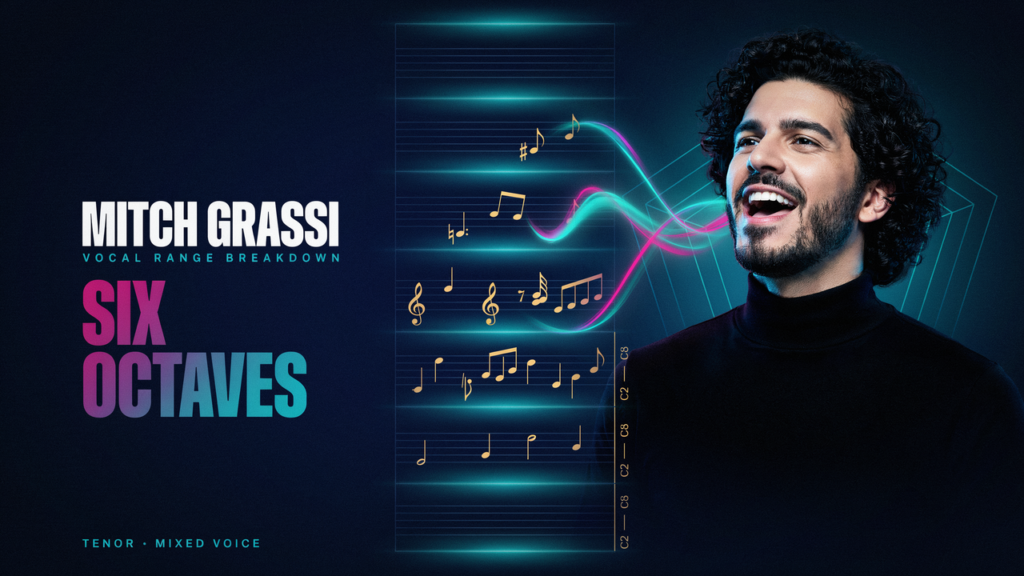
Mitch Grassi’s Vocal Range at a Glance
Vocal range: A1 (vocal fry) – B7 (whistle register); six octaves and one tone Chest voice: A2 – C#5 Mixed voice: to E5 Head voice: to C6 Voice type: Light lyric tenor (countertenor classification also supported) Active career: 2011–present
The Voice Type Debate: Tenor or Countertenor?
This is genuinely the most interesting question about his voice, and Mitch himself has commented on it: he calls himself a tenor. Vocal analysis communities are split. The Vocalview analysis classifies him as a “light-lyric tenor” with an exceptionally developed head voice; the Stupid Vocal Critiques Tumblr classifies him as a countertenor; SingersAvenue describes him as a male alto with a five-octave range who is considered a countertenor.
The technical distinction matters: a tenor’s natural mechanism in the upper register is chest voice and mix; a countertenor’s is head voice, which allows access to the female range. Mitch’s head voice — which extends to C6, well into the soprano range — is used as a primary register rather than an occasional effect. This is more consistent with countertenor technique than standard tenor technique.
However, as the Vocalview analysis notes: “So while it wouldn’t be incorrect to call Mitch a countertenor… I am going to classify him by his natural voice, as really anyone with a light and well developed head voice can be a countertenor.” The most accurate framing is: a light lyric tenor with countertenor facility — a voice that functions in both categories depending on what register you’re evaluating.
The tenor vocal range page covers the tenor classification, and the question of how head voice access functions in male vocalists is addressed in the does head voice count in vocal range breakdown.
His Lower Register: A2 and Baritone-Adjacent Depth
A2 — the chest voice floor — sits at the low end of the tenor range, approaching baritone territory. For a singer whose identity is primarily associated with high notes, the A2 foundation is notable: it gives the voice genuine lower register warmth rather than the thin, unsupported low range of a voice built purely for height.
The Stupid Vocal Critiques analysis notes: “For a countertenor Mitch can go quite low. They are always very resonant and easy for him to access, although he rarely uses it.” The A1 in vocal fry — at the extreme bottom — is a register technique rather than a conventional singing note, but the A2 chest floor is genuine.
The Head Voice and Whistle Register: His Signature Territory
The head voice to C6 — and the whistle register documented to B7 — is where Grassi’s voice becomes genuinely unusual. C6 is a note that trained operatic sopranos approach as their upper extension. Accessing it in head voice with the resonance and control that his performances document requires a specific kind of vocal development that goes well beyond typical male falsetto.
His whistle notes — documented in covers and live performances — have a quality that vocal analyses describe as “feisty” with “great resonance,” distinguishing them from the thin, fragile whistle notes some singers produce at extreme upper limits. The G#5 in “Dance of the Sugarplum Fairy” (per the Stupid Vocal Critiques analysis) is cited as a specific documented moment of upper register access with vibrato and control.
The what is whistle register and how to reach it page covers the technique involved in the upper extensions his voice can access.
Pentatonix and the Harmonic Architecture
In Pentatonix’s five-voice a cappella system, Grassi functions as the high end of the harmonic architecture — the voice that reaches above what mezzo-soprano Kirstin Maldonado can access, covering the soprano-adjacent territory that the arrangements need in their highest parts. Without his ability to function in the upper register, Pentatonix’s harmonic range would be significantly narrower.
His range in the group contrasts with Avi Kaplan’s bass (previously) and Kevin Olusola’s bass/beatbox — the full span from A1 to B7 in one group is extraordinary even by a cappella standards. The singer comparison tool lets you see how your range compares to Grassi’s and other documented singers.
FAQs About Mitch Grassi’s Vocal Range
What is Mitch Grassi’s vocal range?
The Pentatonix Wiki documents his range as A1 to B7 — six octaves and one tone — spanning vocal fry at the bottom through whistle register at the top. His chest voice runs A2 to C#5, with mixed voice to E5 and head voice to C6.
What voice type is Mitch Grassi?
He calls himself a tenor; analysts variously classify him as a light lyric tenor, a countertenor, or a male alto. The most accurate framing is a light lyric tenor with countertenor facility — a voice that uses head voice as a primary register in the upper range rather than relying on chest voice and mix.
Who called Mitch Grassi “the prettiest voice I’ve ever heard in my life”?
Shawn Stockman of Boyz II Men made that assessment, as documented on the Pentatonix Wiki. It’s a significant compliment from one of the most respected harmony vocalists in R&B history.
Is Mitch Grassi the highest voice in Pentatonix?
Yes — he handles the highest harmonic parts in Pentatonix’s arrangements, accessing soprano-adjacent territory through his developed head voice and whistle register. Kirstin Maldonado, the group’s mezzo-soprano, sits below him in the harmonic architecture.
Erika Parker is a vocal analysis and singing education writer at Vocal Range Test. She focuses on vocal range testing, voice type analysis, pitch recognition, and singing tools for vocalists, musicians, choir singers, and beginners.