
“Best vocal range” is a question that sounds simple but splits immediately into two different questions: who has the widest documented range, and who uses their range most effectively? These don’t always point at the same singer. A six-octave span documented in a YouTube video and a three-octave span deployed with perfect emotional precision in a Grammy-winning performance are different kinds of achievement. Both matter; neither fully substitutes for the other.
This page covers both: the singers who have documented the widest spans, and the singers whose range — however wide or narrow — is most consistently praised for quality, technique, and emotional impact. If you want to know where your own voice fits, the vocal range finder will map it.
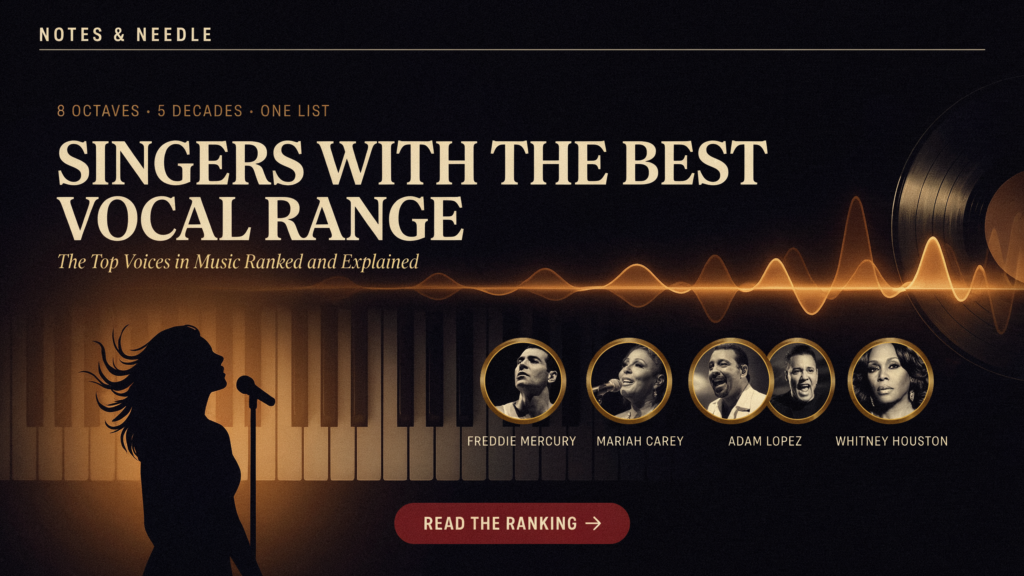
The Widest Documented Ranges in Music
These are the singers with the largest documented spans, confirmed by multiple independent analyses:
Mariah Carey: The most discussed extreme range in popular music. Her documented span extends from B2 to G7, incorporating the whistle register she deployed most famously in the 1990s. Her five-octave practical range is the broadest of any commercially successful mainstream pop singer, and her technical control across that span — particularly her whistle register precision — has influenced a generation of singers. Full breakdown at Mariah Carey’s vocal range.
Dimash Kudaibergen: The Kazakhstani singer who holds one of the most documented extreme ranges in contemporary music — six octaves spanning from C#2 to D8 in documented performances, using vocal fry at the bottom and whistle register at the top. His range has been the subject of serious acoustic analysis. Full breakdown at Dimash’s vocal range.
Mitch Grassi (Pentatonix): Six octaves and one tone, from A1 in vocal fry to B7 in whistle register, with a chest voice running A2 to C#5 and head voice to C6. The Pentatonix tenor whose countertenor technique gives him access to the full male-to-soprano span. Full breakdown at the Mitch Grassi vocal range page.
Mike Patton (Faith No More, Mr. Bungle): Documented at six octaves across clean and extended vocal techniques. The most versatile vocal technician in rock, capable of opera, death metal growling, jazz crooning, and everything between. Full breakdown at Mike Patton’s vocal range.
Axl Rose: The Guns N’ Roses vocalist documented at F1 to B6 — a five-octave span that combines genuine low bass extensions with the upper tenor range. Rolling Stone placed him among the greatest singers in rock history.
Singers With the Widest Classical Range
In classical music, the benchmark is different: not extreme extensions into fry and whistle, but a full modal range deployed with consistent quality across every octave.
Yma Sumac: The Peruvian soprano documented with a five-octave range in full voice — not including extreme register extensions — which remains one of the most remarkable natural instruments on record. Full breakdown at Yma Sumac’s vocal range.
Minnie Riperton: Five-octave soprano with a whistle register that was both technically astonishing and musically integrated rather than merely displayed. “Lovin’ You” documents the instrument at its most characteristic. Full breakdown at Minnie Riperton’s vocal range.
The Singers With the Best Range Deployment
Wide range means nothing if the voice lacks quality, control, or emotional resonance. These singers have ranges that are not always the widest documented but are consistently praised for excellence across their full span:
Whitney Houston: Not the widest range on this list, but perhaps the most complete quality of voice across a three-plus octave soprano instrument. The power, clarity, and emotional command in the upper register (documented to E6) is the benchmark for female pop-gospel singing.
Freddie Mercury: Four-octave documented range (F2–G5) with extraordinary tonal quality and control across every register. His range was praised specifically for consistency — equal quality at both extremes. Full breakdown at Freddie Mercury’s vocal range.
Celine Dion: Three-plus octave soprano with documented precision, vibrato control, and emotional range across a career spanning five decades. The Celine Dion vocal range page covers her instrument in detail.
Aretha Franklin: A contralto-to-mezzo soprano who is most often cited not for width of range but for the consistent quality, emotional power, and technical command within her approximately three-octave span. The voice that shaped gospel, soul, and R&B vocal aesthetics for two generations.
Why Range Alone Doesn’t Define “Best”
Frank Sinatra had a relatively modest two-octave range and is consistently ranked among the greatest singers of the 20th century. Bob Dylan has an even smaller comfortable range and has influenced more singers than almost anyone. Patsy Cline’s contralto worked within two octaves and is described by Britannica as “exceptional.”
What range enables is repertoire: a wider range allows more musical contexts, more key options, and more expressive choices within a single phrase. What range doesn’t provide is the emotional intelligence to use those options well, the technical precision to sustain quality across them, or the artistic identity that makes a voice sound unmistakably itself.
The singers with the “best” range are those who maximise what they have — regardless of whether “what they have” is two octaves or six.
Use the singer comparison tool to see how your range compares to any singer on this page, and the vocal range test to find where you sit in the full map of human vocal capability.
FAQs: Singers With the Best Vocal Range
Who has the widest documented vocal range?
Dimash Kudaibergen and Mitch Grassi are among the most widely cited for documented extreme ranges spanning six-plus octaves. Mariah Carey holds the widest documented range of any commercially dominant mainstream pop singer, at approximately five octaves including her whistle register.
Does a wider range make you a better singer?
No. Range is one dimension of vocal capability. Quality, control, emotional expression, and tonal identity are equally or more important. Many of the greatest singers in history worked within relatively narrow ranges.
What is a good vocal range for a singer?
Most professional singers work within two to three octaves. The average vocal range page covers what most singers can expect, and what professional singers typically work within.
How do I find my vocal range?
Take the vocal range finder on this site — it maps your specific notes and gives you a voice type classification based on the results.
Erika Parker is a vocal analysis and singing education writer at Vocal Range Test. She focuses on vocal range testing, voice type analysis, pitch recognition, and singing tools for vocalists, musicians, choir singers, and beginners.