
Sienna Spiro’s vocal range spans approximately A2 to E5, with a deep, raspy mezzo-soprano or contralto instrument that Interview Magazine describes as “jazzy mezzo-soprano” and the Sienna Spiro Fandom Wiki calls “distinct and powerful contralto.” Born September 28, 2005 in London, England, she began posting viral singing videos to TikTok in 2021 at age 15 and dropped out of school at 16 to pursue music full time. Her debut single “MAYBE.” accumulated over 143 million Spotify streams; “Die on This Hill” reached number nine on the UK Singles Chart in November 2025; and her total Spotify streams by mid-2026 have exceeded 800 million. Her debut album Visitor was released in July 2026.
At 20, she has already received endorsements from Elton John and Sam Smith, a BRIT Awards 2026 Critics’ Choice nomination, and recognition as one of SiriusXM’s “Future Five for 2026.” The comparisons to Adele and Amy Winehouse — which critics reach for almost automatically — are earned by specific vocal qualities rather than vague similarity: the deep, raspy timbre, the soul-gospel phrasing, and the emotional directness that makes her voice feel confessional rather than performed.
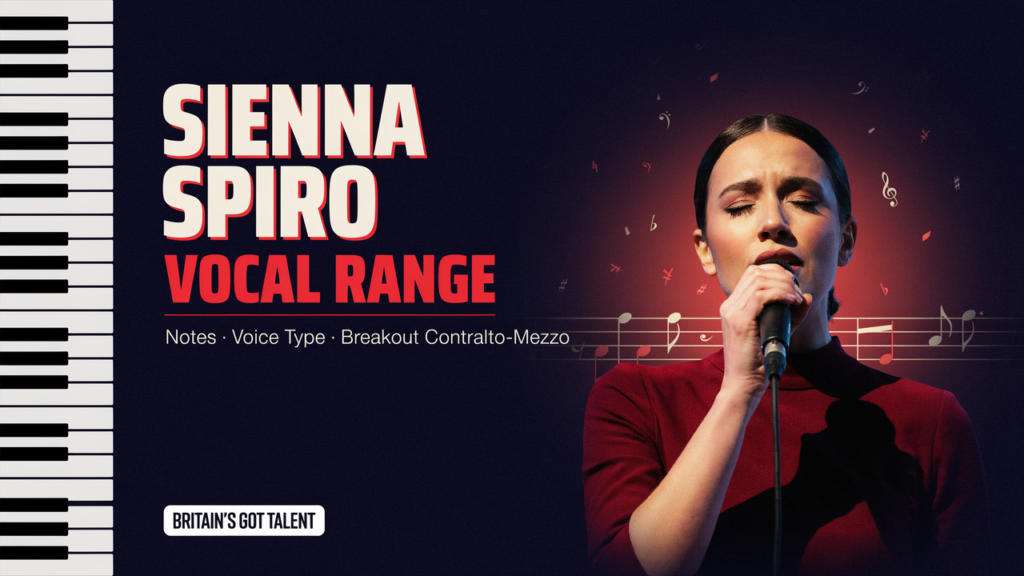
Sienna Spiro’s Vocal Range at a Glance
Vocal range: approximately A2 – E5 Voice type: Mezzo-soprano or contralto (sources vary; “jazzy mezzo-soprano” most recent) Vocal registers in use: Chest voice, belt, mixed voice, head voice Approximate span: Around 2.5 octaves Active career: 2021–present
What Voice Type Is Sienna Spiro?
Three different sources give three different answers: Interview Magazine calls her “jazzy mezzo-soprano”; the Sienna Spiro Fandom Wiki says “distinct and powerful contralto voice”; Miraheze describes “her distinct deep alto voice”; a profile biography says her voice sits between contralto and mezzo territory. The Grokipedia entry describes “a distinctive raspy, soulful voice characterized by its coarse texture and powerful range.”
The most accurate single label for general use is mezzo-soprano with contralto tendencies — a voice whose lower register has genuine darkness and weight (the contralto quality) but whose upper register accesses higher territory than a true contralto typically can. The “jazzy mezzo-soprano” description from Interview Magazine captures both the tonal character (jazz-inflected, warm, slightly dark) and the voice type placement most precisely.
What all analyses agree on is the raspy, soulful quality that gives the voice its character. This is partly natural timbre and partly the product of her specific influences: Etta James, Aretha Franklin, Nina Simone, Amy Winehouse, Frank Sinatra — all voices that prioritise emotional directness and textural character over technical smoothness.
The mezzo-soprano vocal range page covers the classification in detail.
The Lower Register: Darkness and Emotional Weight
The lower register — A2 to C4 — is where the contralto quality is most present. The Grokipedia assessment describes “full-throated belts and intricate riffs that convey raw emotion and gravitas,” which in the lower range translates to a specific kind of chest resonance: warm, rounded, and slightly husky rather than bright and forward.
Her biography notes she was “raised on a diet of jazz, soul, and blues records curated by her parents” — Aretha Franklin, Nina Simone, Etta James, Ella Fitzgerald, Donny Hathaway, Marvin Gaye, Sarah Vaughan. These are all voices that prize lower register warmth as the primary emotional carrier. The lower chest voice in “You Stole The Show” — which Grokipedia describes as having “a mournful, operatic delivery” — demonstrates this warmth functioning as emotional storytelling rather than simple low-note demonstration.
She started songwriting at 10 as “a therapeutic outlet to process intense emotions, including those stemming from bullying experiences.” That personal connection to the material she writes is part of what gives the lower register its confessional quality — the voice isn’t just producing notes there, it’s carrying something.
The Upper Register: Belt and Emotional Peak
Her bio profile describes the typical arc of her performances: “She often starts songs in a more intimate, almost conversational voice, then gradually opens up into soaring high notes in the chorus. This gives each track a sense of cinematic build.” The upper belt — which critics describe as “soaring” and “cathartic” — is the emotional release point of that build.
The A5 high note territory is where the mezzo quality is most apparent: the voice in the upper register has brightness and power without losing the warmth that characterises the lower register. This continuity — the voice sounding like the same instrument at both extremes — is the technical marker of a well-supported instrument rather than a register-switching voice.
“MAYBE.” and the TikTok Breakthrough
“MAYBE.” is the song that defined her public presence before she had a record deal. The 600 million TikTok views accumulated before her debut EP release reflect the same dynamic that drove Olivia Rodrigo and Lewis Capaldi’s early careers: a specific emotional quality in the voice connecting directly with a young audience that recognises authentic feeling over polished production.
The 143 million Spotify streams make it her signature track by a significant margin, and it’s the document of her voice that most listeners encounter first. Its success led to her deal with Capitol/Universal and the structured commercial release path that followed.
For comparison with other British soul voices in the same mezzo territory, the singer comparison tool maps her range against documented singers.
The Adele and Amy Winehouse Comparisons
These two comparisons appear in almost every piece of criticism about Spiro, and they’re worth unpacking rather than simply noting. The Adele comparison is primarily timbral: both voices are deep, powerful, and carry a quality of controlled emotional intensity. The Amy Winehouse comparison is more stylistic: both blend jazz phrasing, soul power, and a retro-referencing aesthetic with deeply personal lyric content.
What Spiro has said about her influences confirms both: she lists Etta James, Aretha Franklin, Frank Sinatra among her primary formative influences — exactly the cross-genre combination that shaped Winehouse’s sound. The 1960s vintage aesthetic she has developed visually reinforces the sonic connection.
The vocal health for singers page covers the maintenance considerations relevant to a young voice generating the output that 800 million streams requires.
FAQs About Sienna Spiro’s Vocal Range
What is Sienna Spiro’s vocal range?
Her estimated range spans approximately A2 to E5 — around 2.5 octaves — based on her voice type classification and the characterisation of her performances across multiple sources.
What voice type is Sienna Spiro?
Sources vary between “jazzy mezzo-soprano” (Interview Magazine), “contralto” (Fandom Wiki), and “deep alto” (Miraheze). The most precise single label is mezzo-soprano with contralto tendencies — a voice whose lower register carries genuine darkness and weight alongside upper-register power.
How did Sienna Spiro become famous?
She began posting viral singing videos to TikTok in 2021 at age 15. Her cover videos built a following that turned into commercial success when she started releasing original music in 2024. “MAYBE.” accumulated 600 million TikTok views and 143 million Spotify streams before her debut EP release.
Has Sienna Spiro won any awards?
She received a BRIT Awards 2026 Critics’ Choice nomination and recognition as one of SiriusXM’s “Future Five for 2026.” She has received public endorsements from Elton John and Sam Smith.
When was Sienna Spiro’s debut album released?
Visitor was released in July 2026, following her debut EP Sink Now, Swim Later (February 2025).
Erika Parker is a vocal analysis and singing education writer at Vocal Range Test. She focuses on vocal range testing, voice type analysis, pitch recognition, and singing tools for vocalists, musicians, choir singers, and beginners.