
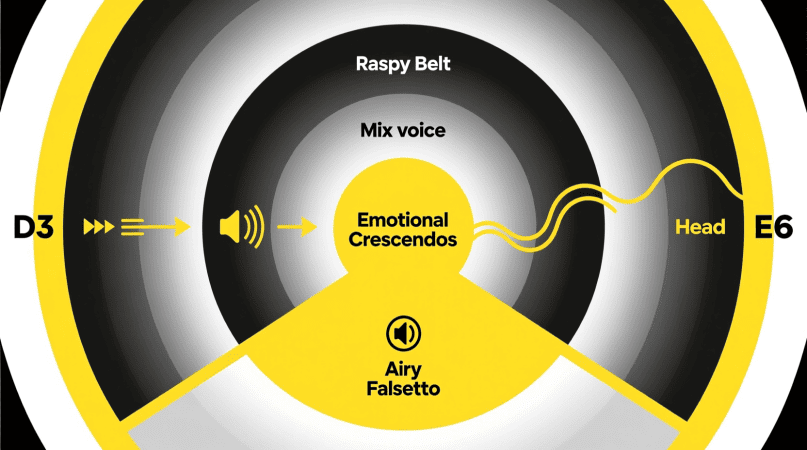
Sia’s voice is one of the most recognizable sounds in modern pop. It’s raw. It’s explosive. It’s emotional. And it’s full of that unmistakable rasp that makes every high note feel like a confession shouted from the edge of a cliff.
But behind that wild, almost chaotic sound is a surprisingly technical singer—one who knows exactly how to manipulate tone, distortion, breath, and emotion.
So what is Sia’s vocal range, what voice type does she have, and why does her singing feel so powerful?
Let’s break it all down clearly—and since I’ve personally attempted to sing Sia’s songs (with varying success), I’ll share the honest challenges I faced, too.
Sia’s Vocal Range: D3 – E♭6
Sia’s known range spans:
- Lowest note: D3
- Highest note: E♭6
This gives her just over three octaves—but focusing on the number alone doesn’t explain why her voice feels so massive.
Sia’s secret is not how high she sings…
but how intensely and emotionally she delivers every note.
Her voice has a volcanic quality: calm one second, erupting the next.
Sia’s Voice Type: A Powerhouse Mezzo-Soprano
Sia is classified as a mezzo-soprano, but she frequently belts in ranges where many sopranos would hesitate.
Her voice type is characterized by:
- A strong middle register
- A slightly darker, warmer lower tone
- Explosive belts around C5–E♭5
- A natural cry-like rasp
- Incredible emotional phrasing
Sia’s tessitura sits high for a mezzo, which is why she can attack those soaring pop choruses with such fierce energy.
My Attempt at Singing Sia
Like many people, I thought: “Okay, Sia’s songs sound intense, but I bet I can handle at least the chorus of ‘Chandelier.’”
No.
Absolutely not.
The song humbled me in three different ways:
1. Her belting sits much higher than you expect.
The chorus lives around C5–D5, which is hard territory for amateur or even intermediate singers.
When I pushed for those notes, my throat tightened instantly.
Sia’s sound there is:
- Supported
- Forward-placed
- Twangy
Mine was:
- Strained
- Shaky
- And honestly, embarrassing
2. Her rasp is not “strain”—it’s controlled distortion.
When I tried to add rasp to mimic her tone, I felt the wrong type of tension.
Sia’s rasp comes from:
- Cry-tone
- Distortion technique
- Years of controlled practice
My rasp came from… well, bad decisions.
3. She uses massive breath support without sounding like she’s working hard.
I realized I had to inhale deeper than usual just to attempt her phrasing.
Sia doesn’t just belt high—she sustains those belts with emotional intensity.
Trying her music taught me that her “chaotic” voice is actually the result of very structured technique.
Before committing to lessons, see what’s possible by reading the 30-Day Singer Review. You can practice daily with the Daily Vocal Warm-Up, measure results using the Vocal Range Test, and analyze performance through the AI Voice Analysis.
Sia Vocal Range Breakdown by Register
Sia’s voice stretches across three distinct, expressive regions:
| Register | Notes | Vocal Quality | Song Examples |
|---|---|---|---|
| Low Register | D3 – G3 | Warm, smoky, intimate | “Breathe Me,” “Day Too Soon” |
| Middle Register | A3 – C5 | Raspy, emotional, textured | “Elastic Heart,” “Alive” |
| Belting Range | C5 – E♭6 | Explosive, gritty, powerful | “Chandelier,” “Cheap Thrills,” “Unstoppable” |
| Head Voice | D5 – F5 | Soft, vulnerable | “Bird Set Free” (live), acoustic sets |
Sia’s belting range is the star of the show. She lives at C5–E♭5 with more power than many singers can muster on their highest days.
Sia’s Highest Notes Explained
Sia often hits:
- C5–E♭5 during standard belting
- F5–G5 in live scream-like ad-libs
- E♭6 in emotional climaxes
These high notes aren’t clean and operatic—they’re intentionally distressed.
Her technique blends:
- Twang
- Distortion
- Cry
- Forward placement
It’s controlled chaos.
Sia’s Lowest Notes
Her lower register doesn’t get much spotlight but deserves appreciation:
- D3 – rare but rich
- E3–G3 – frequently used
Songs like “Breathe Me” show the soft vulnerability she carries in her lows.
Why Sia’s Voice Sounds So Emotional
Sia’s voice sounds like she’s tearing her heart open because she blends technique + emotion, not one or the other.
Here’s what creates her signature sound:
1. Cry-Tone Infusion
Her voice often has a “crying” quality.
It’s a vocal technique that adds urgency and sadness.
2. Controlled Distortion
Her rasp is deliberate.
It adds intensity without destroying her vocals.
3. Massive Breath Compression
She uses high breath pressure to fuel her belts.
4. Forward/Nasal Resonance
Gives her voice cutting power so you feel it more than you hear it.
5. Emotional Phrasing Patterns
She stretches or clips notes to heighten emotional impact.
The result?
A voice that sounds like a storm breaking open.
How Sia’s Voice Has Evolved Over Time
Early Career (Pre-2010)
- Softer, cleaner, jazz-influenced tone
- Less rasp
- More acoustic vulnerability
Breakout Era (2013–2017)
- Powerhouse belts emerge
- Heavy rasp becomes signature
- High emotional intensity
- Massive hits like “Chandelier” push her upper limits
Recent Era
- Slightly warmer tone
- More control, less reckless rasp
- Mature phrasing
Her evolution reflects both personal growth and vocal adaptation.
How Sia Compares to Other Belting Powerhouses
| Artist | Vocal Range | Voice Type | Strength |
|---|---|---|---|
| Sia | D3–E♭6 | Mezzo-Soprano | Explosive, emotional belts |
| Adele | C3–C6 | Mezzo-Soprano | Clean, resonant belts |
| Beyoncé | C3–E6 | Mezzo-Soprano | Precision + agility |
| Ariana Grande | D3–E7 | Soprano | High agility + whistle tones |
| Demi Lovato | A2–B5 | Mezzo-Soprano | Powerful belts |
Sia sits in the “emotional belter” category—but with a rasp that sets her apart.
Comparing Your Voice to Sia’s
When I tested my range against Sia’s, I was shocked by two things:
1. My belts were nowhere near her intensity.
Even when I hit the notes, I didn’t have her fire.
2. My rasp was untrained and risky.
Imitating her directly felt dangerous.
Real rasp requires technique—not force.
A vocal range test helped me understand:
- My comfort zone
- Why Sia’s choruses felt unreachable
- Where I needed to strengthen breath support
It’s an eye-opening way to understand your vocal identity.
- Sia’s dramatic shifts between soft and powerful vocals are easier to understand when you explore the difference between falsetto and head voice.
- Her ability to sustain emotional high notes connects closely with the techniques described in how to sing high notes without straining.
- Many of her wide-spanning melodies fit into the framework outlined in how many octaves is a normal vocal range.
- To see how voices like hers compare across music history, vocal range of famous singers provides clear examples.
- Her vocal placement makes more sense when you review what is tessitura in singing.
- The way she moves between chest and head voice is explained in how to transition smoothly between chest voice and head voice.
- If you want to build a similar expressive range, vocal range and singing techniques shows how singers train their voices.