
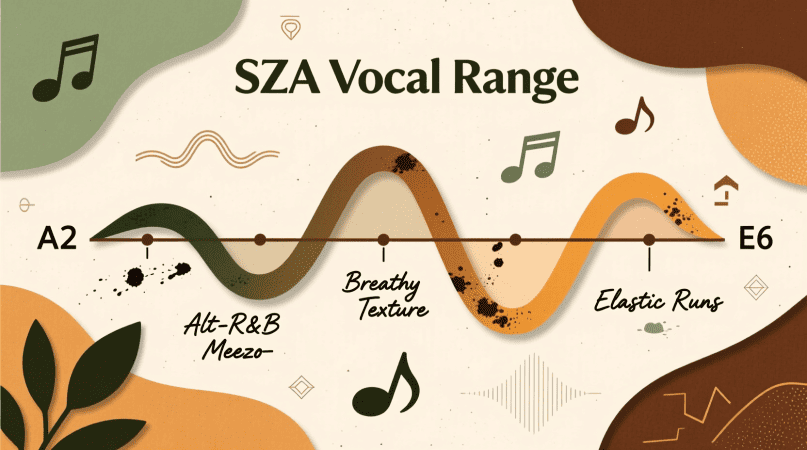
SZA has one of the most recognizable voices in modern R&B—soft, airy, conversational, emotional, and unpolished in the best possible way. She doesn’t rely on vocal gymnastics or powerhouse belts. Instead, she uses tone, breath, vulnerability, and honesty to shape a sound that feels deeply personal.
If Beyoncé is a hurricane and Ariana Grande is a laser beam, SZA is a warm breeze at 2 a.m.
Her voice feels like a confession whispered straight into your ear.
But what exactly is SZA’s vocal range, what voice type does she have, what makes her tone so hypnotic—and why do so many singers struggle to imitate her?
Because yes… I tried singing SZA too.
And let’s just say the reality check was immediate.
Let’s break it all down.
SZA’s Vocal Range: D3 – F#5 (About 2.5 Octaves)
SZA’s approximate vocal range is:
- Lowest note: D3
- Highest note: F#5
This places her comfortably within a 2.5-octave range, but the magic of her voice has nothing to do with wide range.
SZA’s uniqueness comes from:
- Her feather-light breathy tone
- Her emotionally raw delivery
- Her pitch slides (“SZA glides”)
- Her conversational phrasing
- The intimate way she blends singing and speaking
Her voice feels like you’re listening to her internal diary.
What Voice Type Is SZA? (Light Lyric Mezzo-Soprano)
SZA is best categorized as a light lyric mezzo-soprano—a voice type known for warmth, agility, and a gentle upper register.
Characteristics of her voice include:
- Soft, breathy timbre
- Strong comfort in the mid-range
- Reliance on head voice & falsetto for higher notes
- Low chest voice that’s warm but not heavy
- A gentle, floating quality rather than bright or sharp resonance
She has no interest in sounding like a traditional “vocalist.”
She sounds like herself—and that’s her power.
My Honest Experience Trying to Sing Like SZA
I made the classic mistake:
Assuming SZA would be “easy” to sing because she sounds soft and chill.
Wrong.
Very wrong.
Here’s what happened when I actually tried it:
1. Breathiness is a technique—not a weakness.
I tried singing “Good Days” with that airy tone.
Instant breath loss.
My notes got wobbly, my pitch dropped, and I sounded like I was running out of oxygen.
SZA uses controlled airflow.
I was basically whispering into the void.
2. Her pitch slides require precision.
SZA rarely sings notes straight on—she slides into them.
When she does it, it sounds emotional.
When I did it, it sounded like “oops, wrong note.”
3. Quiet singing exposes every flaw.
Belting can hide technique issues.
Soft singing highlights everything—breath, pitch, tone, tension.
I couldn’t hide behind volume.
SZA never uses volume.
She uses vulnerability.
4. Her emotion shapes her tone.
She sings like she’s thinking out loud.
It’s raw, conversational, almost fragile.
Trying to copy her without tapping into emotion felt unnatural.
This taught me something important:
SZA’s voice isn’t delicate.
It’s intentionally intimate.
Understand your vocal strengths with the vocal range analysis tool.
SZA Vocal Range Breakdown (With Song Examples)
| Register | Note Range | Song Examples | What It Sounds Like |
|---|---|---|---|
| Low Register | D3 – F3 | “Kill Bill” | Cozy, warm, talk-like singing |
| Mid Register | G3 – C5 | “Snooze,” “The Weekend” | Airy, emotional, smooth |
| Upper Register | C5 – F#5 | “Good Days,” “Nobody Gets Me” | Light, floating, ethereal |
| Head Voice/Falsetto | Widely used | Live versions of “Drew Barrymore” | Soft, angelic, breath-infused |
Her voice is built around the mid-to-high head register, not belting.
SZA’s Highest Notes
Her highest notes typically appear in emotional climaxes:
F#5 — Good Days
Used in melodic runs and layered harmonies.
E5–F5 — Nobody Gets Me
Pure head voice, soft and exposed.
C#5–D5 — Snooze
Her signature mid-upper tone.
Her highs aren’t loud—they’re floating and weightless.
SZA’s Lowest Notes
Her best low notes appear in:
- D3 — in “Kill Bill” verses
- E♭3–F3 — in “Supermodel”
- D#3 — in acoustic sessions
Her lows aren’t booming—they’re warm, vulnerable, and intimate.
Why SZA’s Voice Sounds So Unique
SZA’s voice is built from four technical pillars:
1. Controlled Breathiness
Breathiness isn’t a flaw—it’s a technique.
SZA deliberately lets extra air through the cords, creating:
- Soft edges
- Warm tone
- Intimacy
- Emotional weight
But controlling pitch with breathy tone?
That’s the hard part.
2. Pitch Slides (“SZA Glide”)
She rarely attacks a note directly.
Instead, she:
- Slides into pitch
- Adds micro-inflections
- Lets notes bend naturally
This gives her music a dreamy, almost floating quality.
3. Conversational Delivery
SZA’s singing feels like talking to a friend during a late-night drive.
She blends speaking and singing—sometimes switching mid-sentence.
This looseness makes her feel authentic and relatable.
4. Emotional Imperfection
SZA doesn’t try to sound “perfect.”
Her voice cracks, flips, sighs, trails off—and that’s exactly why people love her.
She sings like she’s living the lyrics in real time.
How SZA’s Voice Has Evolved From CTRL to SOS
CTRL Era (2017)
- Very breathy
- More whispery
- Less pitch-stable
- Raw and emotional
SOS Era (2022)
- More consistent tone
- Stronger head voice
- Improved pitch control
- More stylistic versatility
Her technique improved, but her personality stayed intact.
How SZA Compares to Other Modern Singers
| Singer | Vocal Range | Voice Type | Vocal Strength |
|---|---|---|---|
| SZA | D3–F#5 | Light Mezzo | Breathy, emotional phrasing |
| H.E.R. | A2–F#5 | Mezzo | Clarity + control |
| Rihanna | B2–C#6 | Mezzo | Distinct tone + attitude |
| Summer Walker | C3–G5 | Mezzo | Smooth, effortless R&B tone |
| Doja Cat | C3–E6 | Mezzo/Soprano mix | Power + flexibility |
SZA stands out because she makes softness powerful.
Want to Compare Your Voice to SZA’s?
When I tested my range against hers, I realized:
- Singing breathy while staying on pitch is incredibly hard
- Her mid-range requires emotional delivery, not force
- Her head voice transitions are smoother than they sound
- Her conversational tone is a skill, not an accident
- SZA’s blend of breathy lows and airy highs fits well within the modern vocal range trends in pop and classical singers.
- Her soft falsetto-style notes make more sense when you explore the difference between falsetto and head voice.
- Many of her smooth upper notes overlap with what’s outlined in the mezzo soprano vocal range.
- To see how her voice compares with other stars, the vocal range of famous singers provides clear charts.
- Her emotional phrasing sits inside the concept explained in what is tessitura in singing.
- If you want to find songs that suit a similar vocal style, how to find songs that fit your vocal range gives practical steps.
- To understand how voices like hers physically create pitch, how vocal cords produce different pitches breaks down the science.
Erika Parker is a vocal analysis and singing education writer at Vocal Range Test. She focuses on vocal range testing, voice type analysis, pitch recognition, and singing tools for vocalists, musicians, choir singers, and beginners.