
Chappell Roan’s vocal range in her breakthrough single “Good Luck, Babe!” spans A3 to F#5 — a confirmed range from Wikipedia’s sourced sheet music data — with a soprano instrument that critics and fellow artists have consistently singled out as one of the most compelling voices in contemporary pop. Kelly Clarkson, covering the song on her talk show alongside Miranda Lambert, put it simply: “Her voice is insane. Her range, how she goes from head voice to chest voice.”
Born Kayleigh Rose Amstutz on February 19, 1998 in Willard, Missouri, Roan won the Grammy for Best New Artist in 2025 after one of the most rapid rises in recent pop history — from being dropped by Atlantic Records in 2020 to having “Good Luck, Babe!” surpass one billion Spotify streams by the end of 2024. The voice was central to all of it.
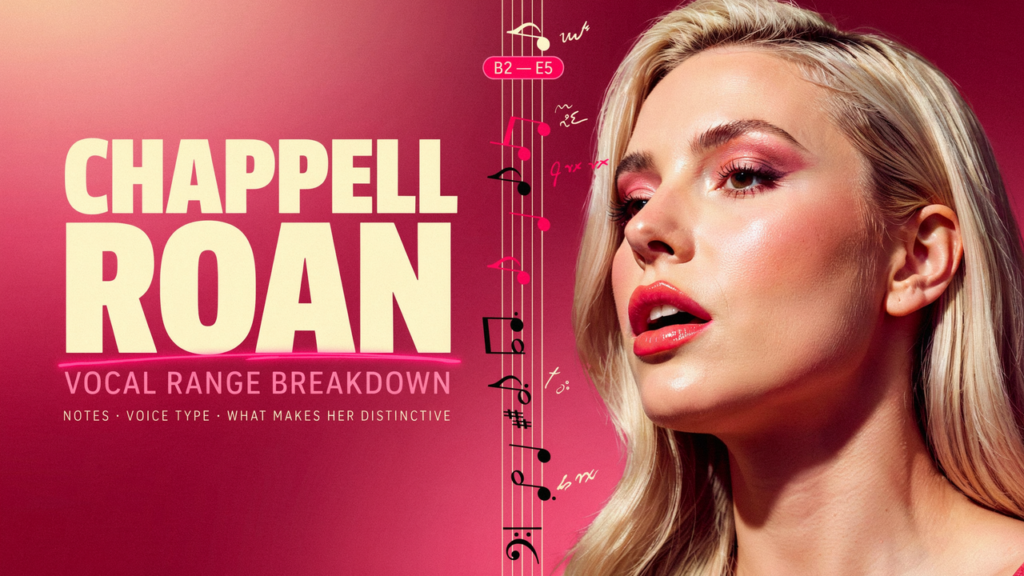
Chappell Roan’s Vocal Range at a Glance
Vocal range: approximately A3 – F#5 (documented in “Good Luck, Babe!”), with extensions across her full catalog Voice type: Soprano (mezzo-soprano by some analyses) Vocal registers in use: Chest voice, mixed voice, head voice Approximate span: Just over 2 octaves in documented performance Tessitura (comfortable center): Roughly D4 to C5 Known for: Powerful belt, theatrical head-to-chest register transitions, sustained high notes
What Voice Type Is Chappell Roan?
This is where a genuine debate exists, and it’s worth engaging with honestly.
The soprano classification appears most often in vocal analysis videos, concert reviews, and TikTok vocal showcases — the Tennessee concert review described “soprano warbles” and “soaring wails,” and multiple TikTok vocal coaches classify her specifically as a high soprano. On the other hand, some vocal analysts argue for mezzo-soprano based on the weight and darkness of her mid-range tone and where her voice seems most naturally at ease.
The honest answer is that she sits at the upper end of the mezzo-soprano range or the lower-mid end of the soprano range, depending on which characteristics you weight more heavily. Her chest voice has a fullness and warmth that’s more mezzo-adjacent than the light, bright classical soprano, but her upper register — the part that produces the climactic belts in “Good Luck, Babe!” — reaches cleanly into soprano territory. In the pop context, where tessitura matters less than in classical classification, “soprano” is the more practical label for how she uses her voice.
The mezzo-soprano vocal range and soprano vocal range pages cover both classifications in detail, and the difference between them — particularly in a pop rather than classical context — is worth understanding if you’re trying to place your own voice.
Her Lower Register: A3 and the Chest Voice Foundation
A3 — the A just above middle C — is the documented floor of “Good Luck, Babe!” and sits comfortably in mezzo-soprano chest voice territory. Roan’s chest voice in this register has a fullness and theatrical weight that’s been widely noted: it doesn’t thin out or sound tentative in the lower-mid range the way a lighter soprano instrument might.
That chest voice foundation is part of what gives her the power to belt convincingly in a theatrical pop idiom. The voice has genuine chest resonance in the lower-to-mid range, which means the transitions upward carry real momentum rather than the thinning that happens when a light soprano voice tries to maintain chest sound above its natural limit.
Her lower notes in live performance tend to ground verses in a way that makes the chorus peaks feel earned rather than sudden — the dynamic arc from lower chest voice to upper belt is part of her vocal storytelling.
Her Upper Register: F#5 and the Belt Ceiling
F#5 — the F# in the fifth octave — is the documented upper note in “Good Luck, Babe!” and sits solidly in soprano territory. For context, F#5 is a note that most trained female pop singers work toward as an upper belt landmark; reaching it with the power and clarity that Roan does in performance, repeatedly and consistently, is a genuine technical accomplishment.
The climactic belt moments in “Good Luck, Babe!” — particularly the bridge — are what generated much of the initial excitement around her voice. When she performed the song at Coachella in April 2024 in a pink butterfly costume, videos of the performance circulated widely, and the vocal specifically was cited as a reason. The note isn’t just high — it’s full-voiced and carrying genuine chest resonance rather than thinning into a barely-there head voice approximation.
Concert reviewers have consistently noted her ability to hold these peaks for extended phrases. One Tennessee concert reviewer specifically mentioned that she holds certain sustained notes longer with each performance — a detail that suggests deliberate development of stamina and breath support rather than relying on the same fixed approach every night.
The Head-to-Chest Transition: Kelly Clarkson’s Observation
Kelly Clarkson’s comment — “her range, how she goes from head voice to chest voice” — identifies the specific technical quality that distinguishes Roan from many of her pop contemporaries. The transition between registers, the passaggio, is where most singers reveal their training (or lack of it). A smooth transition sounds effortless; a rough one sounds like a gear change.
Roan’s transitions are audibly smooth. The shift from her mid-range chest voice into the upper belt doesn’t announce itself with a tonal break — the voice maintains consistent quality across the transition, which is exactly what Kelly Clarkson is describing. This is the hallmark of a well-integrated technique, whether that technique was developed through formal training, natural aptitude, or the kind of intensive live performance experience that Roan accumulated on her slow-burn path to breakthrough.
The chest voice vs head voice breakdown covers the mechanics of how these registers interact, which is directly relevant to understanding what makes Roan’s transitions work the way they do. The how to transition smoothly between chest voice and head voice page goes further into practical technique.
The Theatrical Dimension: More Than Technical Range
Roan’s voice is inseparable from her theatrical performance context. Her music and stage persona — the dramatic costumes, the drag-influenced aesthetics, the explicitly queer camp sensibility — create a performance frame in which vocal power reads as emotional and narrative rather than purely technical.
This matters for understanding how her voice lands. A F#5 belt in isolation is a data point. A F#5 belt at the climax of “Good Luck, Babe!” — a song about watching someone you love deny their own feelings — is an emotional event. The best voices in pop history don’t just demonstrate range; they use range in service of the song’s meaning, and Roan’s theatrical instinct for that connection is what separates her from pop singers who have comparable technical equipment but produce less impact.
Her stage presence at Coachella 2024 — described as “commanding” — and the viral circulation of those performance videos demonstrated that the vocal and the theatrical are operating together rather than separately.
Notable Vocal Performances
Good Luck, Babe! (2024): The documented A3–F#5 range in a single song, with belt peaks in the bridge that concert reviewers and fellow singers specifically cited. One billion Spotify streams by November 2024. Peak of number four on the Billboard Hot 100.
Pink Pony Club (2020, breakout 2023–24): The song that established her initially underground reputation and eventually became her longest-running radio hit, surpassing “Good Luck, Babe!” on the Adult Contemporary chart with 26 weeks. The vocal on the original recording showcases her upper register in a more synth-pop production context.
The Grammy Performance (2025): Her performance of “Pink Pony Club” at the 2025 Grammy Awards — where she won Best New Artist — with rodeo clowns and theatrical staging, was widely described as a standout of the ceremony both visually and vocally.
NPR Tiny Desk Concert: Consistently cited by vocal analysts as one of the cleaner documents of her voice in a stripped-back acoustic setting, where the production doesn’t mask the instrument and the range and register transitions are most clearly audible.
Her Rise: The Vocal Timeline
The trajectory from Atlantic signee at 17 to Grammy winner at 26 involved a significant gap — Atlantic dropped her in August 2020, and she spent two years working odd jobs while “Pink Pony Club” slowly built an audience organically. That period, in which she was performing and writing without a label, likely contributed to the vocal development that made her breakthrough so convincing. Singers who develop their voices under low-pressure conditions — without the demands of rapid commercialization — sometimes emerge with more authentic and integrated techniques than those who are rushed.
The voice that performed at Coachella in 2024 was not the voice of a debut artist finding herself — it was a voice that had been developing over nearly a decade of writing, recording, and performing. That developmental arc is part of why the technique sounds as solid as it does.
If you want to test where your own voice sits relative to Roan’s documented range, the vocal range finder will map your notes, and the voice type test will give you a classification. The singer comparison tool can place your range alongside Roan’s and other documented pop artists.
FAQs About Chappell Roan’s Vocal Range
What is Chappell Roan’s vocal range?
In “Good Luck, Babe!” — her most analyzed performance — her range spans A3 to F#5, a confirmed figure from Wikipedia’s sourced sheet music data. Her full catalog likely extends this range in both directions, with lower chest voice notes in certain songs and higher head voice passages in others.
What voice type is Chappell Roan?
She’s most often classified as a soprano, particularly in vocal analysis communities and concert reviews. Some analysts argue for mezzo-soprano based on the fullness of her mid-range chest voice. She sits at the border between the two classifications, with a chest voice that has mezzo warmth and an upper register that reaches into soprano territory.
How does Chappell Roan reach such high notes?
Kelly Clarkson specifically praised her head-to-chest transitions, which is the key technical element. Her upper belt notes are produced with integrated chest and head resonance — mix voice — rather than a pure falsetto or strained chest voice. The smoothness of her register transitions is what makes the high notes sound powerful rather than thin or forced.
Did Chappell Roan have formal vocal training?
Her path was largely self-taught and developed through years of independent performance rather than conservatory training. She was signed to Atlantic at 17 after posting YouTube videos, dropped in 2020, and spent two years building her voice and audience independently before her breakthrough.
What is Chappell Roan’s biggest hit?
“Good Luck, Babe!” peaked at number four on the Billboard Hot 100, hit number one on the Pop Airplay chart, and surpassed one billion Spotify streams by November 2024. “Pink Pony Club” has outlasted it on the Adult Contemporary chart, running 26 weeks as of recent data.
Erika Parker is a vocal analysis and singing education writer at Vocal Range Test. She focuses on vocal range testing, voice type analysis, pitch recognition, and singing tools for vocalists, musicians, choir singers, and beginners.