
Thom Yorke’s vocal range spans from C3 to A5, covering approximately 2.5 octaves. He is classified as a lyric tenor, though his voice is more accurately described as a countertenor-influenced tenor — one whose natural power sits in the upper-middle register and whose falsetto is seamlessly integrated into his core sound.
Yorke is not a technically flamboyant singer. He does not chase extreme high notes or showy runs. What makes him one of the most studied voices in rock is the emotional quality he extracts from a relatively contained range and the way he blurs the line between his chest voice and falsetto so completely that many listeners cannot tell where one ends and the other begins.
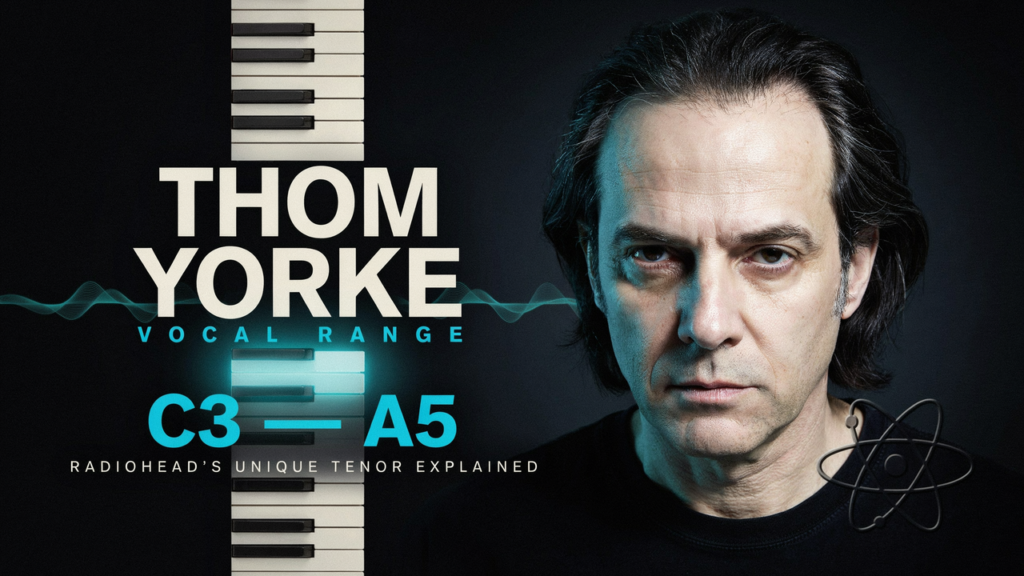
Thom Yorke Vocal Range at a Glance
| Detail | Information |
|---|---|
| Vocal Range | C3 – A5 |
| Octaves | ~2.5 octaves |
| Voice Type | Lyric Tenor |
| Tessitura | G3 – E5 |
| Highest Confirmed Note | A5 (falsetto) |
| Lowest Confirmed Note | C3 |
| Vocal Registers | Chest voice, mixed voice, falsetto, head voice |
What Voice Type Is Thom Yorke?
Thom Yorke is a lyric tenor. His speaking voice sits in the upper tenor range and his natural singing tessitura — the zone where his voice sounds most comfortable and resonant — centres between G3 and E5.
What complicates the classification is his extensive use of falsetto. In classical training, a lyric tenor’s falsetto would be kept largely separate from the main voice. Yorke blends both so naturally that his singing often defies clean register labelling — particularly in the D4–G5 range, where it is genuinely difficult to tell whether he is in a heavy mix, a light chest, or a fully supported falsetto.
Some analysts categorise him as a countertenor due to his falsetto dominance, but his chest voice and natural low-range capability confirm the tenor classification. He is a tenor who has trained his falsetto into his primary expressive register.
Thom Yorke’s Highest Notes
A5 — reached in falsetto in live performances of Creep, Fake Plastic Trees, and several Kid A and Amnesiac era songs. The A5 in Creep during the climactic “she runs, she runs” section is the most frequently cited example of his upper ceiling.
F#5 / G5 — his most frequently used upper notes in studio recordings. These appear in Exit Music (For a Film), How to Disappear Completely, and multiple songs from OK Computer and In Rainbows.
E5 — the top of his comfortable mixed voice range, used extensively across the Radiohead catalogue. This is where his voice has the most tonal control and emotional range.
His falsetto does not feel like a separate register being deployed — it arrives naturally as an extension of his chest and mixed voice, which is the technical quality that makes his upper range so distinctive.
Thom Yorke’s Lowest Notes
C3 — his lowest documented note, used in sparse, spoken-word or near-spoken vocal sections. Radiohead compositions occasionally call for low, almost spoken delivery, and Yorke reaches C3 in these passages.
E3–G3 — his practical lower range for sung passages. These notes appear in Climbing Up the Walls, Karma Police verses, and slower, more atmospheric passages where the arrangement drops low.
A3 — his most natural low sung pitch, where his chest voice has comfortable resonance without thinning. Much of Radiohead’s verse material sits in the A3–C4 zone for Yorke.
Thom Yorke’s Vocal Technique
Falsetto Integration The defining technical feature of Yorke’s voice is the absence of an audible break between registers. Most tenors have a clear passaggio around D4–E4 where the voice changes character as it moves from chest into mixed or head voice. Yorke has trained this break into near invisibility. The result is a voice that sounds like a continuous instrument from C3 to A5, without the gear-shift quality that marks less developed singers.
Emotional Placement Yorke is a singer who communicates primarily through placement and tone colour rather than volume or range extremes. He shifts between a slightly nasal, forward placement and a more open, rounded tone depending on the emotional context of the lyric. This is a subtle technique that most rock singers do not work at consciously.
Breath Control His breath management supports the sustained, often minimalist approach he takes to phrases. He holds notes for long durations at moderate volume — one of the more technically demanding things a singer can do, because it requires precise breath metering without the push of a loud dynamic to carry through the phrase.
Vibrato Yorke’s vibrato is narrow and restrained in most contexts. On emotionally loaded long notes it widens slightly, but he frequently uses straight tone — particularly in falsetto passages — which gives his voice a somewhat otherworldly, detached quality that became a defining sound for Radiohead’s electronic-influenced work on Kid A and Amnesiac.
Vulnerability as Technique Deliberately or not, Yorke uses moments of vocal fragility as expressive tools. The slight catch in his voice during the Creep chorus, the wavering quality on How to Disappear Completely — these are not technical failures but features. He has never tried to present a polished, controlled tone, and the result is a voice that communicates instability and emotion with unusual directness.
His Most Vocally Demanding Songs
Creep (1992) — His breakthrough performance and still one of his most demanding in terms of dynamic contrast. The verse sits quietly in his lower-middle range around A3–D4, then the chorus explodes into chest-mix territory around B4–D5, and the bridge reaches A5 in falsetto. The range of dynamics and register shifts across a single song is more demanding than it appears.
Exit Music (For a Film) (1997) — A slow build from a near-whispered opening around E3 to a fully voiced climax around F#5. The final section requires sustained upper-register delivery with full emotional intensity — technically one of his most demanding recorded performances.
How to Disappear Completely (2000) — The centrepiece of Kid A vocally. Extended falsetto sections around E5–G5, held quietly over a string arrangement, demonstrate his ability to sustain falsetto with precise control and minimal vibrato for extended periods.
Pyramid Song (2001) — Jazz-influenced piano ballad where Yorke’s voice sits primarily between C4 and F#5. The sustained notes in the final section show his mixed voice at its most refined.
All I Need (2007) — A gradually escalating performance that builds from restrained lower-register verses to an emotionally charged climax around E5–G5. The sustained intensity of the final section requires consistent breath support and register control across a long crescendo.
Karma Police (1997) — Deceptively simple. The restrained, almost monotone verse delivery between C4 and E4 followed by the chorus lift to B4–D5 showcases his ability to use minimal movement for maximum effect.
How Thom Yorke’s Voice Compares to Other Alternative Rock Singers
| Singer | Voice Type | Range | Octaves |
|---|---|---|---|
| Thom Yorke | Lyric Tenor | C3 – A5 | 2.5 |
| Chris Martin | Tenor | C3 – B5 | 2.5+ |
| Matt Bellamy | Tenor | D3 – B5 | 2.5+ |
| Liam Gallagher | Baritone | D3 – B4 | 2 |
| Eddie Vedder | Baritone | C#2 – B4 | 2.5 |
| Kurt Cobain | Baritone-Tenor | A2 – B4 | 2 |
Among alternative rock singers, Yorke sits comfortably in the upper tier for range. Chris Martin and Matt Bellamy have slightly wider documented ranges, but Yorke’s falsetto development and emotional control are consistently ranked above his contemporaries by vocal analysts.
His range is smaller than many classically trained singers, but in the context of rock music — where emotional delivery and distinctive tone carry more weight than total range — his 2.5 octaves are used more expressively than many singers achieve with 3 or more.
Thom Yorke’s Voice Over Time
1990s — The Pablo Honey, The Bends, and OK Computer period shows a rawer, more conventionally rock-oriented voice. The chest voice is used more prominently, and the falsetto appears as a contrast tool rather than a primary register.
2000s — With Kid A and Amnesiac, Yorke deliberately moved toward a more processed, falsetto-dominant approach. His natural voice was treated as one element among many rather than the centrepiece. This period produced his most experimental vocal performances.
2010s–present — His solo work with The Eraser, Tomorrow’s Modern Boxes, and ANIMA continued the electronic-influenced approach. His voice has deepened slightly in the lower register as natural maturation, but his upper falsetto extension remains intact. There are no credible reports of significant vocal deterioration.
FAQs
What is Thom Yorke’s vocal range? Thom Yorke’s vocal range spans C3 to A5, covering approximately 2.5 octaves. He is classified as a lyric tenor with exceptional falsetto development.
What voice type is Thom Yorke? Thom Yorke is a lyric tenor. His natural tessitura sits between G3 and E5, where his voice is most resonant and controlled. He is sometimes described as countertenor-influenced due to his extensive falsetto use.
What is Thom Yorke’s highest note? His highest confirmed note is A5, reached in falsetto during live performances of Creep and other Radiohead songs. His most frequently used upper note in studio recordings is around F#5–G5.
How many octaves can Thom Yorke sing? Thom Yorke can sing approximately 2.5 octaves, from C3 to A5.
Does Thom Yorke use falsetto? Yes — extensively. His falsetto is so well integrated with his chest and mixed voice that it functions as a primary register rather than a special effect. Much of Radiohead’s most iconic vocal work is delivered in falsetto or a falsetto-chest blend.
What makes Thom Yorke’s voice unique? The combination of seamless register blending, deliberate use of vocal fragility as expression, and an almost complete absence of conventional vibrato creates a sound that is immediately recognisable and difficult to imitate. He communicates emotional instability and depth with a voice that does not project traditional power.
Related article:
- Test your own vocal range free →
- Find your voice type →
- Tenor vocal range explained →
- Does falsetto count in vocal range? →
- Chest voice vs head voice →
- Chris Martin vocal range →
- Matt Bellamy vocal range →
- Compare your range to famous singers →
Erika Parker is a vocal analysis and singing education writer at Vocal Range Test. She focuses on vocal range testing, voice type analysis, pitch recognition, and singing tools for vocalists, musicians, choir singers, and beginners.