
Tina Turner’s vocal range spans from G2 to E6 — just over 3 octaves. She is classified as a mezzo-soprano, though in practice her voice functioned primarily as a rock-soul belter whose power and grit in the lower and middle registers defined her sound more than her upper ceiling.
Turner is one of the most distinctive voices in rock history — not because of range extremes but because of the sheer force, texture and emotional conviction of every note she sang. Her voice carried the weight of her life story, and audiences heard it.
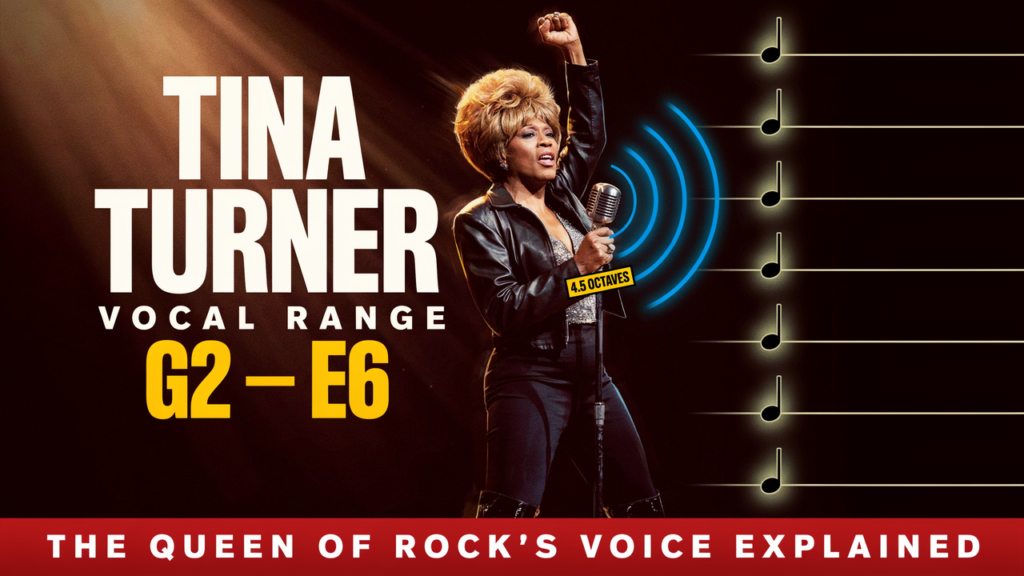
Tina Turner Vocal Range at a Glance
| Detail | Information |
|---|---|
| Vocal Range | G2 – E6 |
| Octaves | ~3 octaves |
| Voice Type | Mezzo-Soprano (rock-soul belter) |
| Tessitura | D4 – B4 |
| Highest Confirmed Note | E6 (head voice/whistle register passages) |
| Lowest Confirmed Note | G2 |
| Vocal Style | Raw belt, grit, chest-dominant power |
What Voice Type Is Tina Turner?
Tina Turner is classified as a mezzo-soprano, sitting between soprano and contralto in the female voice spectrum. Her natural speaking and singing voice has the warmth and depth associated with mezzo, and her tessitura — the zone of greatest comfort and resonance — centres around D4–B4.
In practice, she functioned as what vocal analysts call a dramatic mezzo belter — a voice built for power, presence and emotional rawness rather than classical precision. She rarely sang with the smooth, legato quality of a trained mezzo-soprano in the classical tradition. Instead she employed chest voice dominance, controlled grit, and an almost percussive attack on consonants that gave her delivery its characteristic urgency.
Tina Turner’s Highest Notes
E6 — her highest confirmed note, reached in studio recordings and occasional live performances. This sits in the upper soprano range, demonstrating that her voice was capable of significant upper extension beyond her normal performance range.
C5–D5 — her most frequently used upper notes in live performance. The belt passages in What’s Love Got to Do with It, Proud Mary and Simply the Best typically peak around C5–D5.
A5–B5 — accessible in head voice in studio contexts, used sparingly in live performance.
Her upper range was more developed than she regularly displayed in concert. Turner was a performer who prioritised connection and power over technical display, which meant she often sang comfortably below her ceiling rather than pushing it in every song.
Tina Turner’s Lowest Notes
G2 — her lowest confirmed note, reached in spoken-word and near-spoken vocal passages. This sits in contralto territory, below the standard mezzo floor of approximately A2, indicating genuine low register depth.
B2–D3 — her practical lower singing range. The verses of darker, more restrained songs in her catalogue occasionally dip into this area.
G3 — where her chest voice most naturally begins to carry full resonance in a singing context. Much of the verse material in her mid-career catalogue sits in the G3–E4 range.
Tina Turner’s Vocal Technique
The Belt Turner’s signature is her belt — the powerful chest voice extension into the upper-middle register that gives rock and soul singers their crowd-commanding presence. Her belt sits most naturally around A4–C5, where she achieves a full, thick, chest-dominant tone that cuts through band noise without electronic amplification.
Unlike many pop belters who push their chest voice from below and risk damage, Turner had a naturally robust chest voice that seemed to extend upward without the thinning that characterises forced belting.
Grit and Texture A deliberate feature of Turner’s sound is the grit — the slight roughness in tone, particularly at louder dynamics and on consonants. This is not damage; it is a stylistic feature she employed throughout her career and maintained control over. It gives her voice a lived-in, authentic quality that polished voices lack.
Phrasing and Attack Turner attacked phrases with percussive energy on consonants and initial vowel placements. She used the beginning of words — particularly words starting with hard consonants — as rhythmic events, not just lyric delivery. This gives her singing its unique urgency and makes phrases feel physically energetic.
Stamina Perhaps most remarkable is her stamina. Her performances were legendary for their physical intensity — dancing and moving continuously while delivering full-power vocals over multi-hour sets. Her ability to maintain vocal output under physical demand speaks to exceptional breath training and efficient technique.
Vibrato Her vibrato was natural, moderate and present primarily on sustained notes. It added warmth without drawing attention to itself — a vibrato that felt like an emotional expression rather than a vocal technique.
Her Most Iconic Vocal Performances
Proud Mary (1971 / 1988) — The Ike and Tina Turner version and her later solo live performances are both vocal benchmarks. The famous slow-to-fast arrangement gives her voice a full workout across dynamics, from a restrained, almost spoken opening to a full-power belt in the final section.
What’s Love Got to Do with It (1984) — The restraint of this performance is what makes it remarkable. Turner holds back throughout, never pushing into the upper belt territory she was capable of, and the control creates an emotional tension that defines the song.
Simply the Best (1989) — The centrepiece of her 1990s concert tours. The sustained belting in the final chorus around A4–C5 over multiple minutes demonstrates her stamina and power at their most sustained.
River Deep – Mountain High (1966) — Widely considered one of the greatest vocal performances ever recorded in rock and soul. Producer Phil Spector captured Turner’s voice in a wall-of-sound context that showcased her power and dynamic range simultaneously. The vocal intensity across 3.5 minutes of continuous building remains extraordinary.
We Don’t Need Another Hero (1985) — A more restrained ballad performance showing her mid-range at its warmest. The controlled dynamics and tone quality show a different side of her capability.
Tina Turner vs Other Female Rock and Soul Vocalists
| Singer | Voice Type | Range | Key Quality |
|---|---|---|---|
| Tina Turner | Mezzo-Soprano | G2 – E6 | Raw belt, grit, stamina |
| Aretha Franklin | Mezzo-Soprano | G2 – E6 | Phrasing, technique, soul |
| Pat Benatar | Mezzo-Soprano | A3 – B5 | Rock belt, power in upper mid-range |
| Janis Joplin | Mezzo-Soprano | D3 – C5 | Blues grit, emotional rawness |
| Linda Ronstadt | Soprano | C#3 – C6 | Clarity, range, versatility |
| Whitney Houston | Soprano | A2 – G#5 | Technical precision, upper power |
Turner and Aretha Franklin had almost identical documented ranges (both G2–E6) but entirely different styles. Franklin’s approach was rooted in gospel precision and technical control; Turner’s was rooted in rock energy and physical presence. Both are considered the defining female voices of their respective genres.
How Tina Turner’s Voice Changed Over Time
1960s (Ike and Tina Turner era) — Raw, incredibly powerful, and less technically refined. The Revue recordings show a voice with enormous natural capability being pushed hard without the control she developed later.
1970s — Transitional period. Her voice was consistent but her recording work was limited during this era.
1980s comeback — Her most critically successful vocal period. Private Dancer and its successors showed a more controlled, emotionally mature voice. She had learned when to hold back and when to release, which makes these recordings the best representatives of her complete instrument.
1990s–2000s — Her voice deepened slightly as natural maturation occurred. The belt remained powerful, though her live key choices sometimes reflected slightly lower transpositions of her classic material. Her stamina remained extraordinary into her 60s.
FAQs
What is Tina Turner’s vocal range? Tina Turner’s vocal range spans G2 to E6 — just over 3 octaves. She is classified as a mezzo-soprano with a powerful chest voice belt.
What voice type is Tina Turner? Tina Turner is a mezzo-soprano, specifically a dramatic mezzo belter. Her natural voice sits between soprano and contralto, with exceptional power in the chest-to-upper register belt zone.
What is Tina Turner’s highest note? Her highest confirmed note is E6, reached in studio recordings. Her most frequently used high note in live performance sits around C5–D5 in her belt range.
How many octaves does Tina Turner have? Tina Turner’s documented range covers just over 3 octaves, from G2 to E6.
Is Tina Turner a soprano or mezzo-soprano? She is a mezzo-soprano. Her voice sits below soprano range in terms of tessitura and natural placement. However, her upper extensions and belt capability occasionally overlap with soprano territory.
What made Tina Turner’s voice unique? The combination of extraordinary physical energy, chest voice power, controlled grit, and percussive phrasing created a voice that was immediately recognisable and impossible to imitate convincingly. No other singer combined her physical performance intensity with her vocal output across such a long career.
Related article:
- Test your own vocal range free →
- Find your voice type →
- Mezzo-soprano vocal range explained →
- Aretha Franklin vocal range →
- Pat Benatar vocal range →
- What are the female vocal ranges? →
- Compare your range to famous singers →
Erika Parker is a vocal analysis and singing education writer at Vocal Range Test. She focuses on vocal range testing, voice type analysis, pitch recognition, and singing tools for vocalists, musicians, choir singers, and beginners.