
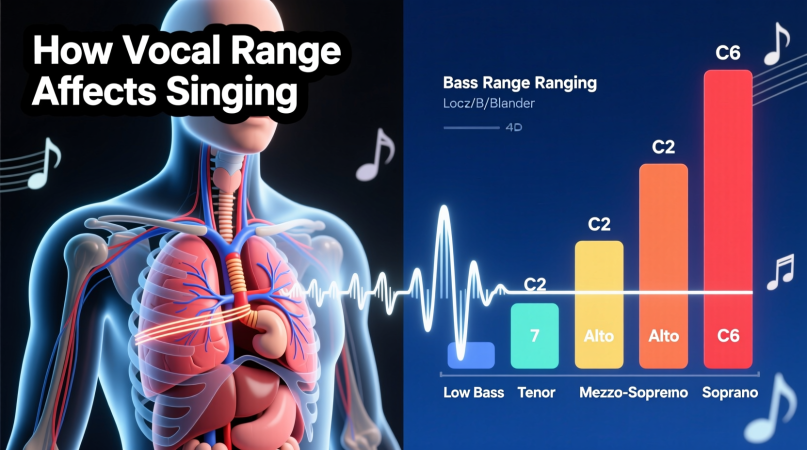
Your vocal range determines the set of notes you can sing comfortably. It influences what songs you can perform, how your tone develops, and how healthy your voice remains over time.
What Is Vocal Range?
Vocal range is the distance between the lowest and highest notes you can sing with control. Most people have around two octaves, while trained singers may reach three or four octaves.
Common Voice Types and Ranges
- Bass: E2 – E4
- Baritone: A2 – A4
- Tenor: B2 – A4
- Alto: F3 – F5
- Mezzo-Soprano: A3 – A5
- Soprano: C4 – C6 (and beyond for coloraturas)
Knowing where your voice falls helps you choose music that highlights your strengths.
instantly check your vocal range for free
How Vocal Range Shapes Your Singing
1. Song Selection
If a song sits too high or low for your range, it will feel strained and sound less controlled. Choosing music that fits your range lets you focus on expression rather than survival.
2. Tone and Expression
- Singing near the middle of your range usually produces the warmest, most stable sound.
- Higher notes may sound brighter and more dramatic.
- Lower notes can add depth and power.
3. Vocal Registers and Transitions
Your voice shifts between registers—chest, head, falsetto, and sometimes whistle. Learning to blend these registers smoothly keeps your tone even when moving across your range.
4. Performance Flexibility
A wider range offers more stylistic options. Rock, pop, jazz, and opera often demand different parts of the spectrum. The broader your usable range, the more music you can explore.
5. Vocal Health
Forcing notes outside your natural range can lead to fatigue or vocal damage. Healthy technique and breath support let you expand gradually while keeping your cords safe.
Real Examples of Range in Action
- Adele uses her lower mezzo-soprano range to create soulful, grounded tones.
- Freddie Mercury (around 4 octaves) shifted easily between registers, giving his performances power and drama.
- Mariah Carey expanded into the whistle register, adding a signature sound that set her apart.
These singers show how range can shape both style and identity.
Practical Tips for Working With Your Range
- Test your range with a piano, app, or online vocal range calculator.
- Warm up before singing to keep your voice flexible.
- Practice scales and sirens to build comfort in higher and lower notes.
- Prioritize technique—control and tone matter more than sheer range.
FAQs
Does vocal range affect how good a singer is?
Not necessarily. Many great singers succeed with modest ranges by using excellent tone and style.
Can vocal range be increased?
Yes, with consistent exercises and proper technique, most singers can safely expand their range by 1–2 octaves.
Why is tessitura important?
Tessitura is the section of your range where your voice sounds best and feels easiest. Most songs are written to sit in a singer’s tessitura rather than at the extremes.
What happens if you sing outside your range?
You risk strain, cracking, or long-term damage if done repeatedly without technique.
- Understanding John Legend’s vocal range shows how range impacts song choice and style.
- Studying Christina Aguilera’s vocal range illustrates the effect of range on vocal power and expression.
- Observing Brendon Urie’s vocal range demonstrates how wide ranges enable dynamic performances.
- Comparing with Adele’s techniques shows how vocal range shapes melodic possibilities.
- Examining Stevie Wonder’s vocal range highlights how range flexibility influences phrasing and style.
- Learning from Idina Menzel’s vocal range shows how strong upper notes affect song intensity.
- Insights from Luther Vandross’ vocal range demonstrate how mid-range mastery supports expressive singing.
Erika Parker is a vocal analysis and singing education writer at Vocal Range Test. She focuses on vocal range testing, voice type analysis, pitch recognition, and singing tools for vocalists, musicians, choir singers, and beginners.