
Lin-Manuel Miranda’s vocal range is best understood as a tenor-baritone musical-theatre range built around rap, rhythm, and storytelling, not as a showy high-note singer’s range. Public song databases often place the title song “Alexander Hamilton” around B2 to G4, but that should be read as a song/role estimate, not a complete measurement of Miranda’s personal vocal limits. His strength is not extreme range; it is speed, diction, breath management, character delivery, and writing material that fits the voice dramatically.
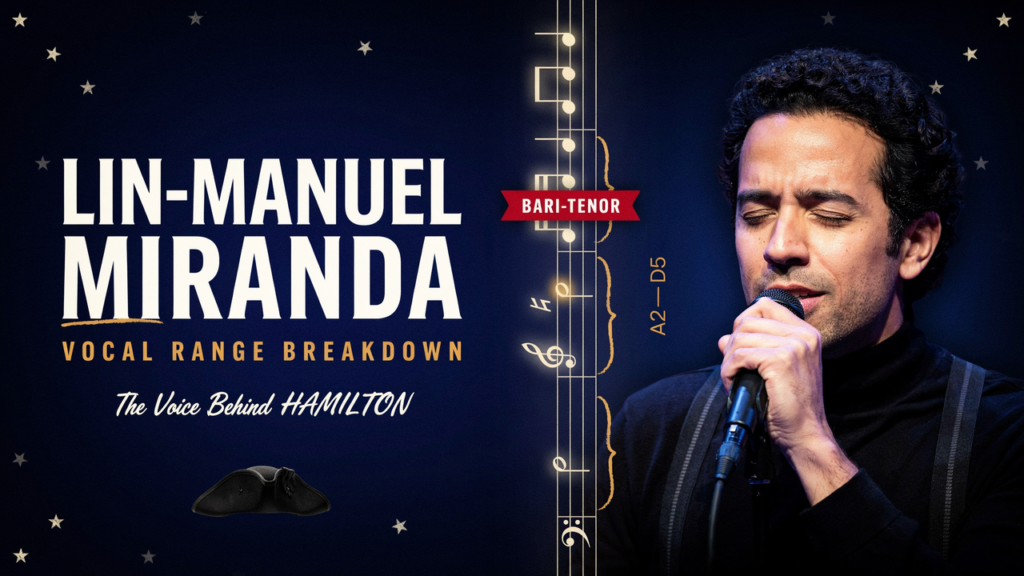
Lin-Manuel Miranda’s Vocal Range at a Glance
| Most useful voice-type description | Tenor-baritone / musical-theatre baritenor |
| Common Hamilton song estimate | About B2-G4 for “Alexander Hamilton” in public song databases |
| Vocal identity | Rap-forward, speech-rhythmic, bright, agile, and character-driven |
| Main strength | Diction, timing, breath pacing, and emotional storytelling |
| Best listening examples | “Alexander Hamilton,” “My Shot,” “Non-Stop,” “Hurricane,” “Dear Theodosia” |
If you are comparing your own voice to Miranda’s, do not start by chasing a single low or high note. First understand how range works in the vocal range guide, then test your own usable notes with the vocal range finder. His music rewards usable, repeatable range more than one-time extremes.
Is Lin-Manuel Miranda a Tenor or Baritone?
The most practical label is tenor-baritone, sometimes called a baritenor in musical-theatre discussion. He does not sound like a classical high tenor whose identity is built around ringing upper notes, but he also does not sit like a deep bass-baritone. His Hamilton material lives in a middle zone where speech, rap, and sung phrases overlap.
This is why a strict classical voice-type label can be misleading. In a classical setting, voice type depends on tessitura, passaggio, resonance, stamina, and training. In Miranda’s work, the more important question is whether the performer can sustain fast text, stay rhythmically sharp, and switch between speech-like rap and pitched singing without losing clarity.
For basic comparison, see the tenor vocal range and baritone vocal range pages. Miranda’s stage sound sits between those worlds, which is why “baritenor” is often more useful than forcing one fixed label.
Why His Range Is Hard to Measure Exactly
There is a difference between Lin-Manuel Miranda’s personal vocal range and the range of songs he wrote or performed. A song database may list the notes for “Alexander Hamilton,” but that does not prove every possible note Miranda can sing. It only describes the range of that song in a particular key or transcription.
Hamilton also complicates range analysis because much of the role is rhythmic speech on pitch or near pitch. Rap passages can sit between speaking and singing, while musical-theatre phrases require more sustained tone. That means the “hard part” is not always the highest note. Sometimes the harder task is delivering dense text cleanly while staying in time and saving enough breath for the next phrase.
If you want to see how your own voice type compares, use the voice types guide after testing your range. A voice that can technically hit Miranda’s notes may still struggle if the rhythm, consonants, and breath pacing are not solid.
What Makes His Hamilton Voice Work?
Miranda’s Hamilton voice works because it sounds restless. The character is always thinking, arguing, writing, and pushing forward. A smoother, more classically polished voice might make the role sound prettier, but it could also lose some of the urgency that defines Alexander Hamilton onstage.
In “My Shot,” the vocal challenge is not a single climactic high note. It is momentum. The performer has to keep the text alive, land consonants clearly, and keep breath support organized through long runs of words. In “Non-Stop,” the stamina demand becomes even clearer because the role keeps returning with new bursts of text and musical energy.
In slower moments like “Hurricane” and “Dear Theodosia,” the voice needs a different kind of control. The phrasing becomes more exposed, and the singer has less rhythmic density to hide behind. These songs show why Miranda’s voice should be judged by storytelling and suitability, not only by range size.
Range vs Performance Difficulty
A common mistake is assuming a song is easy because its listed range is not extremely wide. Hamilton proves the opposite. A song can sit in a moderate range and still be difficult because of tempo, breath demand, emotional pacing, and articulation.
For singers, that means the useful question is not “Can I hit the top note?” It is “Can I perform the whole song clearly, repeatedly, and in character?” If your pitch is unstable during fast passages, work first with the how to sing in tune guide before trying to copy Miranda’s delivery speed.
Belting is also not the center of Miranda’s vocal identity. Some Hamilton moments need intensity, but most of the role is about controlled projection and text. If you are working on louder musical-theatre phrases, the how to belt guide is more useful than forcing the sound from the throat.
Best Songs to Study His Voice
“Alexander Hamilton” is the best starting point because it introduces the role’s range, pacing, and speech-song style. It also shows how the character can be vocally present without needing a huge sustained belt.
“My Shot” is the clearest example of Miranda’s rap-forward vocal writing. The difficulty is diction, stamina, and rhythmic confidence.
“Non-Stop” is useful for understanding endurance. The role returns again and again, so the singer must manage energy instead of spending everything on one phrase.
“Hurricane” shows a more reflective side of the voice. It asks for clarity and emotional focus more than range display.
“Dear Theodosia” gives a gentler example of his sung tone and phrasing. It is a good reminder that Miranda’s musical effect often comes from directness rather than vocal decoration.
Can You Sing Like Lin-Manuel Miranda?
You can study his delivery, but you should not copy every detail of his tone. Start with your own comfortable speaking pitch, then find where the sung notes sit around it. If the song feels too low or too high, change the key rather than squeezing your voice into a role that does not fit.
The best practice method is to speak the lyrics in rhythm first, then add pitch. Once the words are clean, sing only short sections and check whether the tone stays relaxed. You can compare your range with famous performers using the singer comparison tool, but remember that Miranda’s main lesson is not “have the widest range.” It is “make the voice serve the story.”
FAQs About Lin-Manuel Miranda’s Vocal Range
What is Lin-Manuel Miranda’s vocal range?
There is no single verified public measurement of his full personal vocal range. For Hamilton material, public song databases often place “Alexander Hamilton” around B2 to G4, but that should be treated as a song estimate rather than a complete personal range.
What voice type is Lin-Manuel Miranda?
Tenor-baritone or baritenor is the most useful description for his Hamilton work. His voice sits in a middle male range and is shaped heavily by rap, speech rhythm, and musical-theatre phrasing.
Is Lin-Manuel Miranda a strong singer?
He is not usually discussed as a traditional powerhouse vocalist. His strength is performance intelligence: rhythm, diction, phrasing, writing for his own voice, and making the character sound urgent and human.
Is Hamilton hard to sing?
Yes, but not only because of range. Hamilton is hard because of fast text, breath pacing, stamina, rhythmic accuracy, and the need to stay in character while moving between rap and sung lines.
Can a baritone sing Lin-Manuel Miranda’s Hamilton songs?
Many baritones can sing parts of the role, especially if they have a flexible upper middle range and strong diction. The key may need adjustment depending on the singer’s comfort, stamina, and performance setting.
Erika Parker is a vocal analysis and singing education writer at Vocal Range Test. She focuses on vocal range testing, voice type analysis, pitch recognition, and singing tools for vocalists, musicians, choir singers, and beginners.