
Adam Levine’s vocal range spans approximately E2 to B5, with his signature sound built around an extensive falsetto and light head voice. He is best classified as a light lyric tenor, known for his bright timbre, agile upper register, and distinctive falsetto-driven style that shaped the identity of Maroon 5’s music.
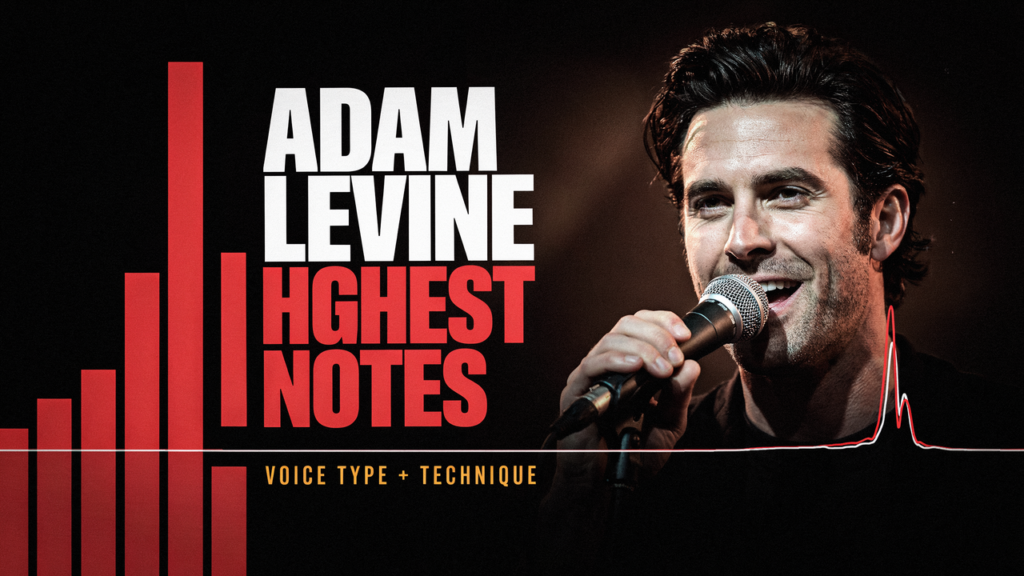
Adam Levine’s True Vocal Range
Adam Levine’s confirmed total vocal range is E2 – B5, though his practical singing range is more concentrated in the G3 – E5 region.
The key to understanding Levine’s voice is not the size of his range, but where he chooses to sing. His music lives in the upper mid-range, creating a recognizable, high-floating sound.
Range Summary Table
| Attribute | Details |
|---|---|
| Total Range | E2 – B5 |
| Practical Range in Songs | G3 – E5 |
| Vocal Weight | Light |
| Primary Register Usage | Falsetto and light head voice |
| Tessitura | High for a male pop singer |
| Style Signature | Airy, bright, smooth upper register lines |
Unlike many male pop vocalists who rely on chest-dominant belting, Levine built his career on falsetto-led melodies, which is a defining element of Maroon 5’s sound.
Adam Levine’s Voice Type (Light Lyric Tenor Classification)
Adam Levine is a light lyric tenor, which means:
- His tone is bright, light, and youthful
- His voice lacks the weight of dramatic or spinto tenors
- He naturally gravitates toward higher tessituras
- His lower register is softer and less resonant
- His upper register is agile but not belt-driven
Why He Is Not a Countertenor
This is a common misconception.
A countertenor sings primarily in the falsetto/head register with a light, flute-like tone.
Adam Levine:
- Speaks in a standard tenor range
- Uses falsetto as a stylistic choice, not a base register
- Has more brightness and ring in the upper mids than countertenors
- Does not exhibit countertenor resonance characteristics
Thus, “male singer with prominent falsetto” does not mean countertenor.
To support long-term progress, start with the structured approach outlined in our vocal range improvement plan. Pair this with healthy habits from vocal health tips for singers to prevent strain during training. When practicing songs, the song key finder helps ensure you’re singing in the right key for your range. For additional refinement, challenge your ear with the ear training game to sharpen pitch accuracy.
Adam Levine’s Highest Notes (Studio & Live Documentation)
Adam Levine’s upper capabilities rely heavily on falsetto.
Highest Verified Notes
| Register | Note | Characteristics |
|---|---|---|
| Falsetto | B5 | Thin, bright, and stylistically consistent |
| Falsetto | A5 | Clean and sustained in various live moments |
| Head Voice | F5 | Used for emotional peaks in early music |
| Mixed Voice | D5–E5 | Light mix, not heavily belted |
Songs That Showcase His Upper Register
- “She Will Be Loved” – smooth head-falsetto blend
- “Maps” – repeated falsetto above E5
- “Sugar” – hook-driven falsetto lines
- “Animals” – edgy, high-range vocal placement
Levine rarely belts above C5; instead, he shifts into falsetto earlier than most tenors, giving his voice its trademark airy quality.
Adam Levine’s Lowest Notes (Accurate Vocal Documentation)
Levine’s lower register is present but not a defining strength.
Lowest Verified Notes
- E2 in studio-controlled recording contexts
- F2–G2 occasionally in live intros
- Lower mid-range (A2–C3) used sparingly in ballads
Characteristics of His Low Register
- Quiet
- Thin compared to his upper register
- Not heavily utilized
- Serves as emotional contrast rather than a functional range
His voice is built to ascend, not descend.
Register-by-Register Breakdown (Advanced Vocal Science)
Chest Voice (E2 – B3)
- Light and soft
- Lacks heavy resonance
- Not used for powerful belting
- Functions primarily for verse passages
Mix Voice (C4 – E5)
Adam Levine’s mixed voice is lighter than most pop tenors.
Characteristics:
- Minimal chest dominance
- Smooth transitions into falsetto
- Not designed for rock-style, power belting
- Works well in pop, funk, and R&B textures
He rarely pushes mixed voice beyond E5 due to vocal weight limitations.
Head Voice (E4 – G5)
- Rounded and slightly airy
- Used for early Maroon 5 emotional climaxes
- More control than his chest voice
- Bridges seamlessly into falsetto
Falsetto (G4 – B5)
This is the most defining characteristic of Adam Levine’s vocals.
Falsetto attributes:
- Breathiness by design
- Clear pitch even at high frequencies
- High agility
- Used as main melodic content, not just ornamentation
Few male singers rely on falsetto as heavily and consistently as Levine.
Why Adam Levine Uses Falsetto as His Primary Register
Adam Levine’s falsetto usage is both biologically favorable and musically intentional.
Physiological Factors
- Thin, flexible vocal folds
- Light vocal mass ideal for falsetto creation
- Natural breath flow conducive to soft phonation
Stylistic Factors
- Maroon 5’s early songs were written around his falsetto tone
- Pop-funk genres benefit from smooth high-register hooks
- Falsetto created a unique and instantly recognizable brand
This combination explains why his falsetto feels effortless and central to his artistry.
Adam Levine’s Vocal Tone & Technique
Tonal Qualities
- Bright, light, and slightly nasal
- Air-forward resonance
- Smooth transitions with minimal grit
- Fast, clean vibrato when used
Technical Strengths
- Exceptional falsetto control
- Stable pitch during soft phonation
- High-register agility
- Seamless head-falsetto transitions
Technical Limitations
- Limited dynamic power
- Weak lower register resonance
- Inconsistent live control when fatigued
- Minimal use of strong mix belts
His voice is optimized for tone and smoothness, not power.
Adam Levine’s Vocal Range in Maroon 5 Songs
Falsetto-Heavy Songs
- “Maps”
- “Sugar”
- “Payphone”
- “She Will Be Loved”
Mid-Range Dominant Songs
- “Girls Like You”
- “Memories”
- “Payphone” (verse sections)
Lower-Range Showcases
- “Lost Stars” (live versions)
- “Sad”
His catalog is overwhelmingly written to emphasize the upper mid-range and falsetto register.
Comparison: Adam Levine vs Other Pop Tenors
| Singer | Range | Voice Type | Traits | Comparison |
|---|---|---|---|---|
| Adam Levine | E2 – B5 | Light Lyric Tenor | Airy falsetto | Most falsetto-centric |
| Bruno Mars | D3 – D6 | Lyric Tenor | Strong mix, solid belts | More power than Levine |
| The Weeknd | C3 – E6 | High Tenor | Darker tone, strong head voice | More range and resonance |
| Charlie Puth | C3 – C6 | Tenor | Strong mix + falsetto blend | More vocal versatility |
Adam Levine’s distinctive identity lies in the tone, not the range.
Adam Levine Vocal Range Chart
E2 ——————— A2 ——————— C4 ——————— E4 ——————— A4 ——————— E5 ——————— B5
  Low Notes     Chest Voice     Middle     Mix Range     Head Voice     Falsetto
This visualization shows how Levine’s upper register dominates his vocal style.
Frequently Asked Questions
What is Adam Levine’s vocal range?
Approximately E2 – B5, with heavy falsetto usage.
What voice type is Adam Levine?
Light lyric tenor.
Why does Adam Levine sound so high?
Because he relies on falsetto and light head voice instead of chest voice.
What is his highest note?
Around B5 in falsetto.
Is Adam Levine a countertenor?
No. He is a tenor who uses falsetto stylistically.
Can Adam Levine belt high notes?
He can, but rarely chooses to. His style prioritizes smooth falsetto.
How good is Adam Levine live?
Usually consistent, though falsetto-heavy singing can be sensitive to fatigue.
- To see how Adam Levine’s tenor compares to other pop stars, review the average vocal range for a female as a contrasting reference point.
- His longevity is easier to understand when you explore does vocal range change with age.
- Singers aiming to extend their upper notes can benefit from these breathing techniques to improve vocal range.
- Building the stamina needed for Maroon 5–style sets requires daily exercises to increase vocal stamina.
- Mapping where Levine sits vocally starts with learning what the average vocal range is.
- To compare his register placement, you can check how vocal range affects singing.
- If you want to model his progression, this guide on how to train vocal range outlines a proven development path.
Erika Parker is a vocal analysis and singing education writer at Vocal Range Test. She focuses on vocal range testing, voice type analysis, pitch recognition, and singing tools for vocalists, musicians, choir singers, and beginners.