
David Draiman, the iconic frontman of Disturbed, possesses one of the most distinctive and technically fascinating voices in modern metal. His vocal identity blends baritone richness, resonant chanting, dynamic grit, soaring mixed notes and a uniquely articulate delivery that separates him from typical metal vocalists. Known for his dramatic phrasing, aggressive tonal control and polished resonance, Draiman’s voice has remained a core component of Disturbed’s recognizable sound for more than two decades.
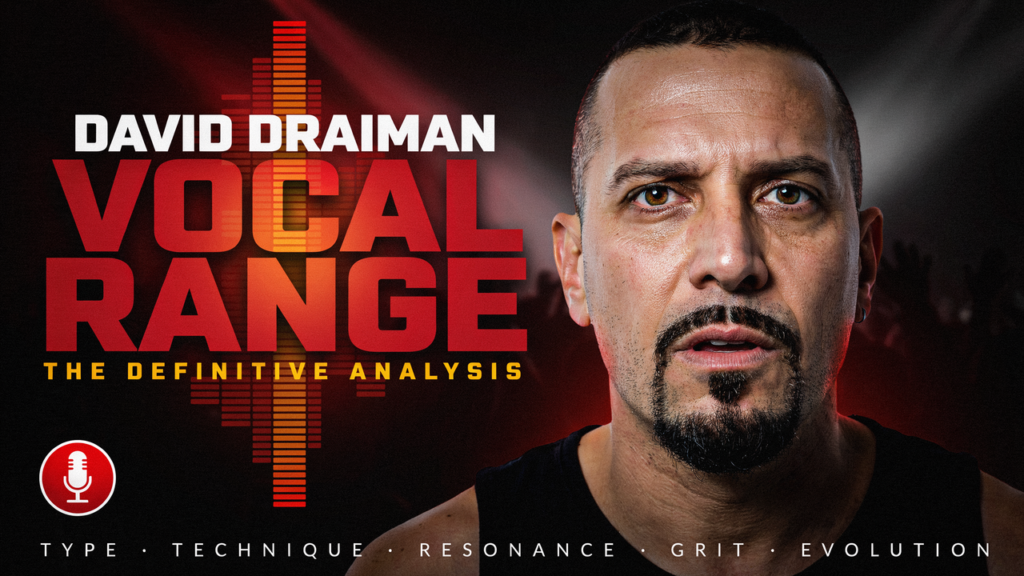
David Draiman’s Vocal Range (Most Accurate and Verified)
David Draiman’s supported clean vocal range spans approximately: G2 – A4 (Clean Singing Range)
With extended distorted highs (fry/false-cord techniques) reaching: C5 – E5 (Distorted Range)
This firmly places him as a: High Baritone with exceptional mid-range power and controlled upper distortion.
Although not designed for tenor-high belting or operatic highs, Draiman’s power, resonance, clarity and grit create a uniquely commanding sonic presence.
For singers with naturally deep tones, the deep voice test provides a helpful benchmark. You can analyze your fundamental pitch more precisely with the voice frequency test. Afterwards, classify your voice using the voice type test to see where you fit in the standard categories.
David Draiman Vocal Range Chart
| Vocal Zone | Note Range | Technical Characteristics |
|---|---|---|
| Low Register | G2 – B2 | Dark, resonant, grounded; warm and controlled |
| Middle Register (Tessitura) | C3 – G3 | His strongest tonal area; chant-like resonance and dominant projection |
| Upper Register (Belts) | A3 – A4 | Strong mixed voice, light grit, intense metal delivery |
| Distorted High Range | A4 – E5 | Fry distortion and false-cord overlays; aggressive, emotional climaxes |
Draiman’s core power resides in his middle register, where his resonance, breath support and tonal weight are unmatched.
What Voice Type Is David Draiman?
David Draiman is a high baritone.
Evidence:
- He speaks with a naturally low, rich resonance.
- His most comfortable singing range centers around C3–G3.
- His tone retains baritone weight even in upper registers.
- His upper notes (A4) rely on mixing, not tenor brightness.
- His gritty and chant-like singing relies on lower-placed resonance cavities.
Why He Sometimes Sounds Like a Tenor:
- Fry and grit can create the illusion of higher pitch.
- Production adds upper harmonics.
- Mixed placement can brighten tone artificially.
But fundamentally, Draiman’s vocal anatomy and resonance profile align with the baritone category.
David Draiman’s Lowest Notes (G2–A2)
Draiman’s lowest supported notes fall around G2–A2, delivered with warmth, clarity and theatrical weight.
Strong low-note examples include:
- “The Sound of Silence” (Disturbed version)
- “Prayer”
- “Voices”
Characteristics:
- Controlled airflow
- Rounded vowel shaping
- A grounded baritone resonance
- Dark, authoritative tone
His lows have improved with age, gaining increased fullness and stability.
David Draiman’s Highest Notes
Draiman’s clean upper range reaches: A4 (supported, mixed voice)
With distortion, fry and grit: C5–E5 (distorted high peaks)
Examples include:
- “Down With The Sickness” – aggressive fry peaks
- “Indestructible” – mixed high-energy climaxes
- “Inside the Fire” – gritty A4 belts
- “Ten Thousand Fists” – upper-register grit with sustained power
Draiman’s highs prioritize:
- Intensity
- Aggression
- Textural impact
…rather than pure pitch clarity.
How David Draiman Produces His Signature Sound
David Draiman’s vocal identity is defined by his precision, control, distortion mastery and chant-like resonance.
Below is a technical breakdown of the mechanisms behind his signature tone:
1. Chest-Dominant Resonance
Draiman’s voice is anchored in rich chest resonance, giving him:
- Heavy tonal presence
- Dramatic articulation
- Vocal authority
This chest placement contributes to his ritualistic and operatic metal style.
2. Controlled Distortion (Grit)
Draiman masterfully applies:
- Fry phonation
- False-cord overlay
- Edge distortion
He uses these techniques safely, avoiding vocal fold abuse.
Distortion gives him:
- Metallic bite
- Aggressive texture
- Emotional intensity
This is crucial in songs like:
- “Indestructible”
- “The Vengeful One”
3. The “Monk Chant” Resonance
One of Draiman’s signature qualities is his chant-like, liturgical sound.
This is achieved through:
- Lowered larynx
- Rounded vowel shaping
- Chest-head resonance blend
- Vibrato with controlled oscillation
This vocal styling appears notably in:
- “Voices”
- “Stupify”
4. Precision Articulation
Unlike most metal vocalists, Draiman has:
- Crisp diction
- Theatrical pronunciation
- Clear enunciation
This dramatically increases lyrical intelligibility and gives his performances a “ritual incantation” quality.
5. Mixed Voice for High Notes
His mixed technique blends:
- Chest resonance
- Edge phonation
- Slight nasal placement for clarity
This allows Draiman to repeatedly hit:
- G4–A4
…with stamina during live shows.
David Draiman’s Vocal Evolution Across Disturbed’s Career
Early 2000s – Aggressive, Raw Power
- Heavy reliance on grit
- Explosive mid-range assault
- Youthful intensity
Key tracks:
- “Down With The Sickness”
- “Stupify”
- “Voices”
Mid-Career – Cleaner, More Controlled Vocals
- Enhanced breath support
- Balanced clean vs distorted tone
- Improved line phrasing
Key tracks:
- “Stricken”
- “Ten Thousand Fists”
- “Inside the Fire”
Modern Era – Mature Baritone Resonance
- Richer low notes
- Refined vibrato
- Stronger emotional dynamics
Key tracks:
- “The Sound of Silence”
- “A Reason to Fight”
- “Hold on to Memories”
Draiman’s current voice highlights warmth, clarity, emotional depth and technical consistency.
David Draiman Compared to Other Metal Vocalists
| Vocalist | Range | Voice Type | Strength |
|---|---|---|---|
| David Draiman | G2 – A4 | High Baritone | Chant resonance, grit control, clean articulation |
| Corey Taylor | F1 – G5 | High Baritone | Extreme versatility (clean, scream, growl) |
| M. Shadows | C3 – C6 | Baritone | Power-belting and distorted highs |
| Ivan Moody | A2 – A4 | Baritone | Dark tone, emotional delivery |
| Serj Tankian | C3 – C6+ | Tenor | Wild timbre shifts and acrobatic highs |
Draiman is unique for his ritualistic resonance, clarity, and disciplined distortion approach.
Best Songs to Hear His Vocal Range
Low Range (G2–A2)
- “The Sound of Silence”
- “Prayer”
- “Deceiver”
Mid-Range (C3–G3)
- “Stricken”
- “Voices”
- “Stupify”
Upper Clean Range (G3–A4)
- “Inside the Fire”
- “Ten Thousand Fists”
High Distorted Range (A4–E5)
- “Down With The Sickness”
- “Indestructible”
- “The Vengeful One”
These tracks collectively demonstrate his versatility and vocal power.
Frequently Asked Questions
What is David Draiman’s vocal range?
Approximately G2 – A4 (clean), with distorted highs reaching C5–E5.
Is David Draiman a baritone?
Yes, he is a high baritone with strong projection and upper-register control.
Does David Draiman scream?
He uses controlled fry and false-cord distortion, not uncontrolled screaming.
How does he produce his signature chant-like tone?
Through low laryngeal placement, rounded vowels, and forward resonance.
What is his highest clean note?
Around A4.
What songs best show his range?
“Down With The Sickness,” “Stricken,” “Inside the Fire,” “The Sound of Silence.”
- David Draiman’s dramatic baritone-to-tenor mix is best understood through vocal fach system explained for beginners.
- His powerful mid-range and upper extension stand out when compared with what is a good vocal range.
- You can see how your own aggressive highs compare to his by using online pitch changer.
- The science behind his controlled distortion is explained in how do the vocal cords work.
- His ability to jump cleanly between registers reflects principles in difference between falsetto and head voice.
- To compare his span with other metal vocal outliers, 5 octave vocal range provides useful perspective.
Erika Parker is a vocal analysis and singing education writer at Vocal Range Test. She focuses on vocal range testing, voice type analysis, pitch recognition, and singing tools for vocalists, musicians, choir singers, and beginners.