
Jim Morrison’s voice is one of the most unmistakable in rock history—dark, warm, magnetic, and drenched in poetic mystique. As the iconic frontman of The Doors, Morrison didn’t rely on high notes or technical acrobatics. Instead, he leveraged a deeply resonant baritone voice that commanded attention through tone, charisma, and emotional storytelling. His voice embodied both danger and seduction, blending spoken poetry with bluesy phrasing and psychedelic drama.
But what exactly was Jim Morrison’s vocal range? How low could he sing? What made his voice so hypnotic? And how did his technique shape The Doors’ signature sound?
This comprehensive 2025 expert analysis reveals Morrison’s full range, voice type, lowest and highest notes, tonal mechanics, and vocal evolution across his career.
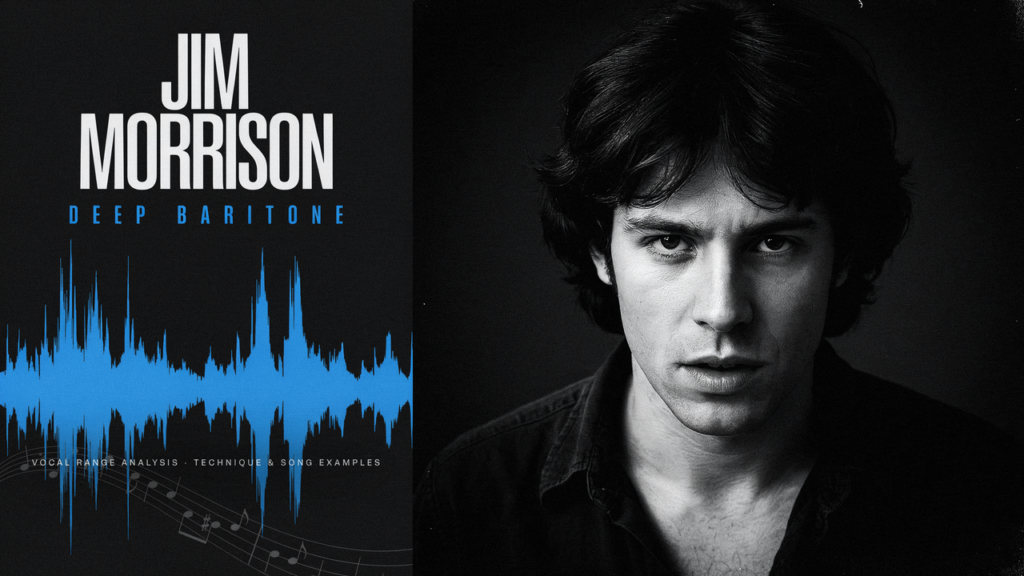
What Is Jim Morrison’s Vocal Range?
Based on studio recordings, isolated tracks, and verified live performances, Jim Morrison’s vocal range falls approximately between: E2 – F#4
(With his most comfortable tessitura in the A2 – E4 zone.)
This means Morrison possessed a low baritone range, emphasizing low-mid resonance rather than upper-register power.
Morrison’s Range Breakdown
| Register | Notes | Vocal Traits |
|---|---|---|
| Low Range | E2–A2 | Deep, rumbling, resonant; signature Morrison color |
| Mid Range | A2–E4 | His primary expressive zone; warm, smoky, commanding |
| Upper Range | E4–F#4 | Used sparingly; brighter tone with added grit |
Morrison rarely pushed into high territory because his artistic identity lived in the low-centered, hypnotic baritone resonance.
Was Jim Morrison a Baritone? Yes — Specifically a Low Baritone
Morrison’s voice fits squarely into the low baritone classification. This voice type is known for its richness, depth, and powerful lower harmonics—traits Morrison embraced naturally.
Why Morrison Is a Low Baritone
- Deep speaking voice with relaxed larynx
- Strong chest-dominant resonance
- Reduced brightness typical of tenors
- Fuller, darker tone around A2–C3
- Limited use of upper mix or falsetto
His tone profile resembles the lineage of deeper-voiced artists like:
- Johnny Cash
- Leonard Cohen
- Nick Cave
- Ian Curtis
However, Morrison’s delivery was unique due to his dramatic, poetic performance style, not just his vocal anatomy.
Jim Morrison’s Lowest Notes (With Song Examples)
Jim Morrison’s low notes form the foundation of his iconic sound. They are natural, unforced, and delivered with a dark warmth that defines The Doors’ atmospheric aesthetic.
Verified Low Notes
| Song | Approx. Note | Description |
|---|---|---|
| “Riders on the Storm” | E2 | A haunting, velvety low that anchors the entire track |
| “The End” | F#2 | Spoken-sung depth with cinematic presence |
| “People Are Strange” | F2 | Rounded, theatrical, controlled |
| “LA Woman” | G2 | Gritty blues phrasing with low-grounded resonance |
These lows were not studio tricks—Morrison naturally possessed one of the deepest and most authentic baritone tones in classic rock.
Did Jim Morrison Sing High Notes?
Morrison rarely pushed his upper range, but he did occasionally sing in the mid-high 4th octave for expressive intensity.
Upper-Range Examples
| Song | High Note | Vocal Approach |
|---|---|---|
| “Break On Through” | E4–F4 | Energetic, gritty upper chest voice |
| “Touch Me” | F4 | Brightened tone with slight laryngeal lift |
| “Light My Fire” (live) | F#4 | Rock-influenced shout-singing |
These notes are not extremely high for male singers, but Morrison approached them with drama, not technical polish. His upper range served mood rather than virtuosity.
The Technical Secrets Behind Morrison’s Vocal Tone
Jim Morrison’s voice wasn’t powerful because of range—it was powerful because of technique, intonation choices, and vocal posture.
1. Relaxed Larynx = Deep Resonance
Morrison’s larynx sat low naturally, creating:
- A darker tonal color
- Strong low-frequency presence
- Depth even in conversational singing
This is the key to his signature “booming” baritone.
2. Chest-Dominant Singing
He sang almost exclusively in chest voice, which gave:
- Weight
- Warmth
- Gravity
- Theatrical authority
No mix voice. No falsetto. All chest.
3. Proximity Effect Mastery
Morrison used the microphone like a theatrical tool:
- Close for whispers
- Further for shouts
- Seamless transitions for dramatic tension
His technique influenced future artists in rock, goth, and post-punk.
4. Breathy, Shadowed Resonance
Morrison often added breathiness for intimacy, especially in:
- “Riders on the Storm”
- “The Crystal Ship”
This enhanced the sensual, mystical aura around his vocals.
5. Poetic Phrasing & Rhythmic Delivery
Morrison often blended:
- Singing
- Chanting
- Speaking
- Whispering
This hybrid approach elevated his vocals beyond melody—into psychedelic storytelling.
6. Analog Recording Warmth
The Doors’ vintage gear—tube mics, tape saturation, plate reverb—enhanced his tone, emphasizing lower harmonics.
How Jim Morrison’s Voice Evolved Over His Career
Morrison’s vocal journey had three distinct phases:
Early Years (1967–1968)
- Smooth, clear baritone
- Strong breath control
- Clean articulation
- Fuller tone with minimal rasp
Middle Career (1969–1970)
- More textured, blues-driven phrasing
- Increased rasp from lifestyle and touring
- Heavier chest resonance
- Stronger contrast between soft and loud dynamics
Later Years (1970–1971)
- Darker timbre
- More spoken-word passages
- Reduced upper-range brightness
- Enhanced emotional weight
Although slightly weathered, his voice gained expressive depth that complemented The Doors’ evolving sound.
Studio vs. Live: Two Different Morrisons
Studio Morrison
- Controlled tone
- Smooth resonance
- More nuanced phrasing
- Carefully shaped warmth
- Legendary low-range intimacy
Live Morrison
- Raw, primal, unpredictable
- More shouting and vocal fry
- Increased rasp and blues influence
- Greater dynamic extremes
- Unfiltered emotional intensity
Fans loved both—one the mystical studio poet, the other the wild, visceral shaman of rock.
How Your Vocal Range Compares to Jim Morrison
Morrison’s tessitura—the range he lived in most—is ideal for many natural baritones: A2 – E4
If you sing comfortably in this zone, your voice may align closely with Morrison’s vocal type.
A free vocal range test tool can help you confirm your own range.
Frequently Asked Questions
What is Jim Morrison’s vocal range?
Approximately E2 – F#4.
Was Jim Morrison a baritone?
Yes, he was a low baritone with a naturally deep, resonant voice.
Why does Jim Morrison’s voice sound so deep?
A combination of anatomy (low larynx), relaxed technique, and vintage microphone proximity.
Could Jim Morrison sing high notes?
Yes, occasionally up to F#4, though his artistry centered in lower registers.
Did Morrison’s lifestyle affect his voice?
Yes—later recordings show increased rasp, but also added emotional dimension.
- Explore the baritone vs bass page to understand where Jim Morrison’s deep voice fits.
- Learn tips to extend your lower vocal range to strengthen baritone tones like Morrison’s.
- Check out breathing techniques for singing to support powerful low notes.
- Try our warm-up exercises for baritone-bass to prepare your voice for deep passages.
- Understand how to do vibrato in singing to add expression to baritone lines.
- Learn how to expand vocal range for both upper and lower extremes.
- Compare Morrison’s voice with other singers using the singer comparison tool to see his baritone in context.
Erika Parker is a vocal analysis and singing education writer at Vocal Range Test. She focuses on vocal range testing, voice type analysis, pitch recognition, and singing tools for vocalists, musicians, choir singers, and beginners.