
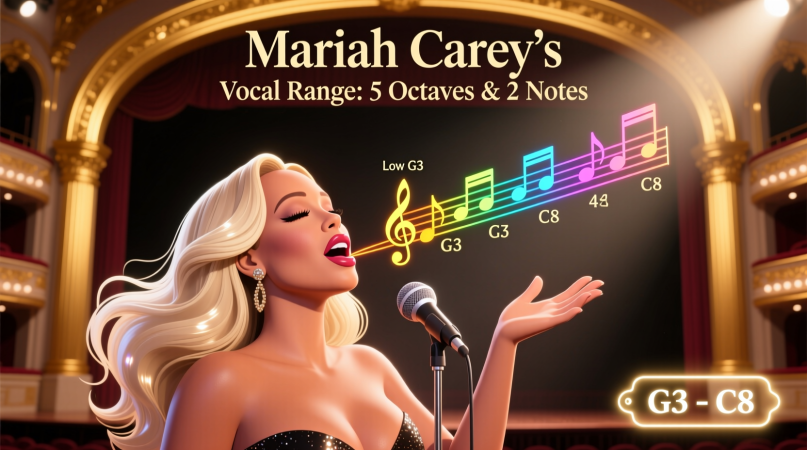
Mariah Carey is widely associated with a five-octave vocal range, with many fan and vocal analyses placing her usable recorded range somewhere around the low second octave up to the whistle register near G7. Those exact endpoints should be treated as estimates rather than an official measurement, because studio layers, live keys, whistle tones, vocal fry, and isolated one-off notes can all change how a range is counted.
The more useful answer is this: Mariah’s voice is famous because she combines a rare upper extension, agile runs, a breathy pop tone, and musical control. Her whistle register is the headline, but her phrasing, melisma, and ability to move between registers are what made the sound influential.
Quick Answer: Mariah Carey’s Vocal Range
| Common claim | About five octaves |
| Commonly cited low area | F2/G2/B2 depending on the analysis and what counts as usable singing |
| Commonly cited high area | Whistle register notes around G7 |
| Practical voice type | Soprano-leaning pop/R&B voice with coloratura-like agility |
| Signature feature | Whistle register, melisma, airy tone, and flexible register shifts |
If you are comparing your own voice with Mariah’s, first separate total range from comfortable singing range. A basic vocal range map or vocal range finder can show your current low and high notes, but it cannot tell you whether those notes are healthy, repeatable, or performance-ready.
Why People Say Mariah Has a Five-Octave Range
The five-octave claim comes from the distance between her commonly cited lower notes and her whistle-register highs. In simple terms, an octave is the distance from one note name to the next higher or lower version of the same note, such as C4 to C5. Five octaves is a very large span for a pop singer, especially when the upper end includes whistle-register pitches.
The debate begins when people decide what should count. A low note in vocal fry does not carry the same musical weight as a sustained chest note. A studio whistle tone may not tell us the same thing as a live phrase in the middle of a demanding set. That is why a cautious article should say “commonly cited” or “reported” instead of presenting one exact range as clinically verified.
Lowest Notes: Why the Bottom Range Is Debated
Mariah’s lower range is often listed differently across vocal-range communities. Some cite notes around F2 or G2, while others prefer B2 as a clearer, more usable lower boundary. The difference usually comes down to whether the analysis includes very quiet lows, vocal fry, harmonized studio layers, or only notes that sound stable and intentional in a musical phrase.
For most listeners, the bottom note is less important than how she uses her lower and middle voice. Her verses often use a soft, breathy, intimate tone, which creates contrast before the chorus, belts, runs, or whistle notes arrive.
Highest Notes and the Whistle Register
Mariah Carey’s highest famous notes live in the whistle register, the extremely high coordination above typical head voice for many singers. Songs such as “Emotions” and “All in Your Mind” are often discussed because they make whistle notes part of the musical identity rather than treating them as a short gimmick.
Whistle register is not the same thing as ordinary falsetto. If you want the broader register context, compare it with head voice vs falsetto, then remember that whistle notes sit in an even higher and more specialized coordination for many voices.
The important technical point is that a whistle note does not automatically mean a singer can use that pitch in every setting. A note can be real and still be occasional. Range is strongest when the singer can repeat the note musically, in tune, and without obvious strain.
Mariah Carey’s Voice Type
Mariah Carey is often called a soprano, and many fans describe her as a coloratura soprano because of her high extension and agility. In pop and R&B, though, voice type labels are less strict than they are in classical singing. Microphone technique, studio production, repertoire, and style all shape how the voice is heard.
A careful practical label would be soprano-leaning pop/R&B singer with coloratura-like agility. That wording respects the high notes and fast ornamentation without pretending that a pop career works exactly like classical Fach classification.
For context, a standard soprano vocal range explains where soprano voices typically sit, but Mariah’s artistry extends beyond a simple category because her sound depends heavily on breathy tone, runs, mix, and whistle coordination.
What Makes Her Technique So Recognizable?
Mariah’s signature is not just range. It is the way she connects different vocal colors inside one phrase. A line may begin with an airy onset, move through a clean middle note, slide into a melismatic run, and finish with a whistle accent. That is a very specific pop-vocal language.
- Whistle notes: the rare high extension that made her instantly recognizable.
- Melisma: fast, decorative runs that still follow the emotional shape of the phrase.
- Breathy tone: a soft texture that makes verses feel close and intimate.
- Register shifts: quick movement between chest, mix, head-dominant tones, and whistle.
- Dynamic contrast: quiet phrases and huge climaxes inside the same song.
Singers studying this style should build coordination before volume. Understanding mixed voice is more useful than trying to jump straight into her highest notes.
Best Songs to Hear Mariah Carey’s Range
No single song proves a full range, but several tracks show important parts of Mariah’s instrument.
| Song | What to Listen For |
|---|---|
| “Emotions” | Whistle-register phrases and bright upper agility |
| “Vision of Love” | Melisma, sustained phrasing, and gospel-influenced pop singing |
| “All in Your Mind” | Whistle accents and early-career upper extension |
| “My All” | Breathy low-middle tone and emotional control |
| “Without You” | Big pop-ballad shaping, dynamic lift, and powerful climaxes |
Her official Grammy artist profile is useful for broader career context, but it does not settle the exact low-note/high-note debate; for that, careful listening and transparent methodology matter more than one headline number. See the Grammy Mariah Carey artist profile for awards and discography context.
Mariah Carey vs Ariana Grande
Mariah Carey and Ariana Grande are compared often because both are associated with agile pop vocals and whistle-register effects. The comparison is useful, but it should not be reduced to who has the bigger number.
Mariah’s sound is usually warmer, breathier, and more R&B-gospel influenced, with whistle notes woven into her songwriting identity. Ariana’s voice is lighter, more contemporary-pop centered, and often built around smooth agility, stacked harmonies, and bright upper placement. You can compare the two more directly in the Ariana Grande vocal range guide or use the singer comparison tool for a side-by-side range view.
Common Myths About Mariah’s Range
- “Mariah has seven octaves.” This is often repeated online, but it is not the safest claim. Five octaves is the more common mainstream description, and exact endpoints still depend on counting method.
- “Whistle notes mean she never strains.” Even elite singers have changing vocal condition, aging, fatigue, illness, and live-performance limitations.
- “Range alone makes her great.” Her influence also comes from songwriting, phrasing, tone, and the way she made technical singing sound emotionally personal.
- “A high note is automatically usable range.” A one-off note is different from a note that can be repeated musically and safely.
Can You Train to Sing Like Mariah Carey?
You can train some of the skills that appear in Mariah’s singing, but copying her exact sound is not the goal. Whistle register is not available in the same way for every singer, and forcing it can lead to tension. A healthier path is to build your own voice in stages.
- Find your current range first, without chasing extreme notes.
- Warm up gently before testing high notes or whistle-like sounds.
- Work on pitch accuracy and breath management in your middle range.
- Develop mix before trying louder upper notes.
- Use rest, hydration, and recovery as part of the practice plan.
For tracking progress, an octave range test can help you measure span over time, but treat the result as feedback rather than a permanent identity.
FAQ
What is Mariah Carey’s vocal range?
Mariah Carey is commonly described as having about a five-octave vocal range. Exact note endpoints vary by source, so it is safer to treat ranges such as F2/G2/B2 to G7 as estimates rather than official measurements.
What is Mariah Carey’s highest note?
Her highest commonly cited notes are in the whistle register, often discussed around G7 in fan and vocal analyses. The exact highest note depends on which recording or performance is being counted.
What is Mariah Carey’s lowest note?
Her lowest note is debated because some analyses include very low fry-like or quiet notes, while others count only clearer sustained singing. That is why you may see F2, G2, or B2 listed in different places.
Is Mariah Carey a soprano?
She is usually described as a soprano-leaning pop/R&B singer with coloratura-like agility. In non-classical music, that label is practical rather than a strict opera Fach classification.
Does Mariah Carey use whistle register or falsetto?
Mariah is famous for whistle-register notes. Falsetto and head voice are different upper-register coordinations, while whistle register sits higher and has its own distinct sound and feel.
How many octaves can Mariah Carey sing?
The common answer is about five octaves. The exact number can shift depending on whether the count includes isolated lows, studio notes, live notes, and whistle-register pitches.
Final Thoughts
Mariah Carey’s vocal range is extraordinary, but the best way to understand it is not to argue over one perfect endpoint. Her greatness is the combination of range, whistle register, runs, tone, musical instinct, and emotional phrasing. The five-octave reputation matters, but the artistry is what made the voice unforgettable.
Erika Parker is a vocal analysis and singing education writer at Vocal Range Test. She focuses on vocal range testing, voice type analysis, pitch recognition, and singing tools for vocalists, musicians, choir singers, and beginners.