
Sebastian Bach is usually discussed as a high-tenor rock singer with a loud, cutting upper register and a gritty metal edge. His exact vocal range has not been officially published, so claims like “C2 to D5” should be treated as fan estimates rather than verified facts. A safer summary is this: Bach’s most famous singing sits in powerful high-tenor territory, especially on Skid Row songs where he carries bright upper notes with more weight and distortion than many glam-metal singers.
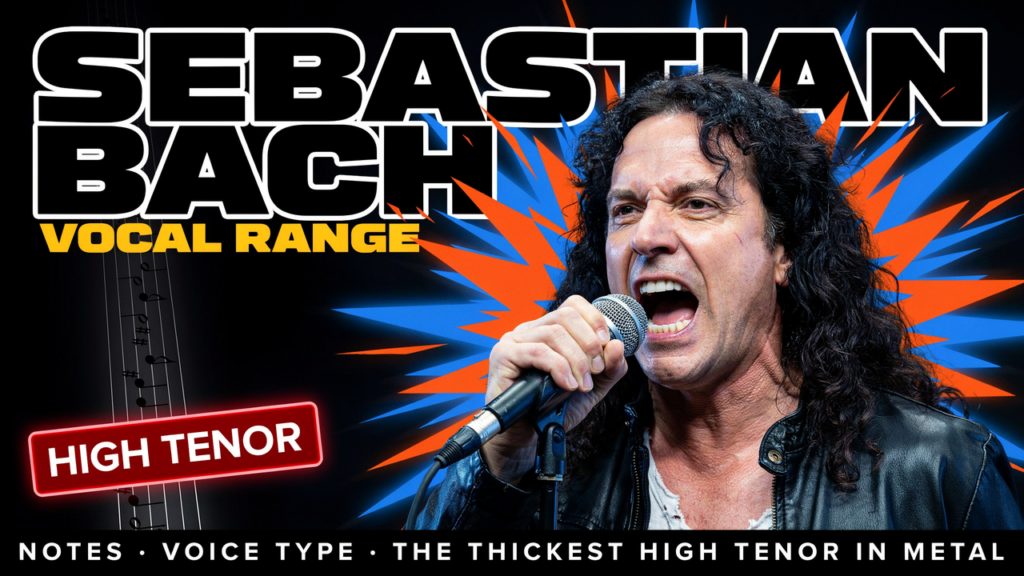
Sebastian Bach Vocal Range at a Glance
| Estimated voice type | High tenor / rock tenor |
| Range certainty | Estimated from performances, not officially verified |
| Signature sound | Bright high notes, rasp, metal grit, strong projection |
| Most famous era | Skid Row’s late-1980s and early-1990s recordings |
| Best-known vocal showcases | “18 and Life,” “I Remember You,” “Youth Gone Wild” |
If you are comparing your range with Bach’s, use a general vocal range guide first, then check your notes with a vocal range finder. His voice is not only about the highest note. The bigger lesson is how he combined tenor brightness, rock intensity, and characterful rasp into a sound that cut through heavy guitars.
What Voice Type Is Sebastian Bach?
Bach is best described as a high tenor in a rock and metal context. That does not mean he sings like a classical tenor. Rock voice types are usually less formal because the style depends on amplification, distortion, vowel shaping, microphone technique, and sustained energy. Still, compared with most male voices, his best-known material clearly leans high.
The tenor vocal range page explains the basic male high-voice category, but Bach’s sound is heavier and rougher than a clean lyric-tenor model. He often uses a speechy, urgent placement with grit on top. That gives his upper notes a raw metal sound instead of a polished theatre or classical tone.
Why Exact Note Claims Are Tricky
Online range lists often reduce singers to a lowest note and highest note, but that can mislead readers. A single low note in a live clip may not be a usable lower range. A screamed or distorted high note may not be the same as a clean sung note. Studio layering, age, key changes, and live-tour fatigue can also change what the audience hears.
For Sebastian Bach, the strongest claim is not an exact octave count. It is that his Skid Row-era performances show a very high, forceful rock-tenor approach. Fans often cite high C/D territory in his classic material, but without an official published range, it is better to call those listener-based estimates rather than confirmed measurements.
The Skid Row Sound: Power, Rasp, and High Notes
Bach’s defining vocal period came with Skid Row. Songs like “18 and Life” and “I Remember You” show the contrast that made him stand out: controlled verses, a bright upper register, and a chorus sound that feels both melodic and aggressive. The voice is not just screaming. It has pitch center, vowel shape, and dramatic lift.
That is why his best high notes feel larger than the note name itself. He brings chest-like intensity into the upper range, then adds rock rasp for emotional pressure. Singers studying that style should understand chest voice vs head voice and mixed voice, because heavy rock singing often relies on blending weight and release rather than simply pushing louder.
How His Rasp Works Musically
Bach’s rasp is part of his identity, but it should not be copied carelessly. In strong rock singing, grit has to sit on top of a supported tone. When singers chase the rough sound first, they often squeeze the throat and lose pitch, endurance, or vocal comfort. Bach’s best recordings work because the rasp is attached to a clear musical line.
If you want to build rock high notes, start with clean coordination before adding distortion. The guide on how to sing high notes without straining is a better first step than trying to imitate the roughest part of his sound. For long-term singing, the vocal health for singers guide is also relevant.
Stamina and Live Performance
One reason Bach remains interesting vocally is stamina. In a 2025 MusicRadar interview, he described doing 91 cities in 2024 and said he knows how to warm up his voice before shows, while criticizing singers who go all out at soundcheck before the audience is even there. That detail matters because a singer with a demanding high-tenor style cannot rely on raw force forever. Warm-ups, pacing, and restraint are part of the job.
The same principle applies to non-famous singers. A voice like Bach’s sounds wild, but sustainable rock singing still needs preparation. Before range work or belting, use a practical voice warm-up, keep the first few songs controlled, and save the biggest high notes for the moments that need them.
Broadway and Theatrical Singing
Bach’s career also includes theatre work, including Jekyll & Hyde and other stage appearances. That side of his career shows another part of his instrument: projection, diction, and character. A Broadway-style role is not the same as fronting a hard rock band. It asks for repeatable phrasing and clearer storytelling across a full show.
That theatrical side helps explain why his singing can sound dramatic rather than random. Even in a metal setting, his best performances have a sense of arc: the verse sets the scene, the pre-chorus builds pressure, and the chorus releases it.
Can You Sing Like Sebastian Bach?
You can learn from his approach, but copying the full sound is risky if your voice is built differently. Start by finding your own range, then build clean high notes, then add style slowly. If your voice hurts, goes hoarse quickly, or loses pitch when you add rasp, back off. Bach’s sound is exciting because it balances intensity with control, not because it ignores technique.
For most singers, the useful takeaway is not “sing as high as Bach.” It is “make the high notes purposeful.” His best moments sound huge because the notes arrive at the emotional peak of the song.
FAQs About Sebastian Bach’s Vocal Range
What is Sebastian Bach’s vocal range?
His exact range is not officially verified. Fan estimates often place him in a wide high-tenor range, with especially notable upper-register singing in classic Skid Row songs.
Is Sebastian Bach a tenor?
Yes, he is generally best described as a high tenor or rock tenor. His voice sits high for a male rock singer and is known for bright upper notes with gritty intensity.
Can Sebastian Bach sing high C?
Listeners often cite high C and nearby upper notes in his classic performances, but exact note claims should be treated as estimates unless they come from a verified isolated analysis or official source.
What makes Sebastian Bach’s voice special?
His voice combines high-tenor brightness, strong projection, rock rasp, and a dramatic delivery that works well over heavy guitars.
Is Sebastian Bach’s rasp safe to copy?
Not without caution. Rasp should be built on clean support and comfortable technique. If it causes pain, tightness, or lasting hoarseness, stop and work with a qualified voice teacher.
Final Thoughts
Sebastian Bach’s vocal range is best understood as an estimated high-tenor rock range rather than a fixed official note chart. His legacy comes from the way he used that range: piercing upper notes, gritty emotion, strong melodic pitch, and enough stamina to carry demanding songs live. That mix is why his Skid Row-era vocals still stand out in hard rock and metal discussions.
Erika Parker is a vocal analysis and singing education writer at Vocal Range Test. She focuses on vocal range testing, voice type analysis, pitch recognition, and singing tools for vocalists, musicians, choir singers, and beginners.